Akkadian Empire
I: Sargon’s Route to Empire.


Akkadian Empire
I: Sargon’s Route to Empire.
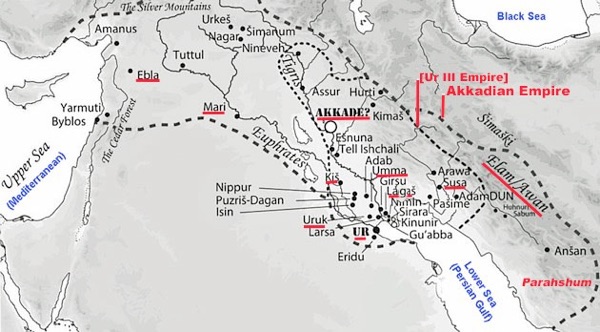
Image adapted from Piotr Steinkeller (referenced below, 2021, Map 2.1, at p. 69)
My additions in red and blue
Introduction
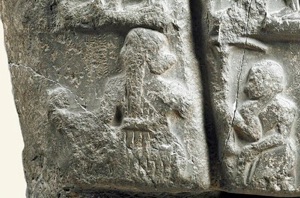
Image of Sargon (left), identified by inscription ((RIME 2:1:1:10; CDLI, P461936)
Detail of a victory stele of Sargon from Susa (now in the Musée du Louvre (Sb 1): image from the museum website
As Piotr Steinkeller (referenced below, 2021, at p. 44) observed, the creation of the so-called Akkadian or Sargonic Empire by Sargon of Akkad:
“... was a completely novel experiment in the use of political power.”
Not least among the novel features of this ‘empire’ were the facts that:
✴the political power in question was passed down by dynastic succession from Sargon to his great grandson, Shar-kali-sharri over a period of about a century; and
✴at the height of their power, these dynastic kings of Akkad controlled the vast territory marked out in the map above.
Nevertheless (as the sharp-eyed will have noticed) Sargon’s capital is marked on the map as ‘Akkad ?’, since no archeological remains of this much-documented city have been found. (It is generally agreed that it was probably on the Tigris, near its confluence with the Diyala river, as in the map above).
We also have only scant ‘original’ evidence for the way in which Sargon established his empire. For example, the short inscription on the stele illustrated above is the only survivor from Sargon’s reign that refers to him by name: the inscription in question (RIME 2:1:1:10; CDLI, P461936):
✴is on a fragment of four-sided victory stele from the Elamite city of Susa that is now in the Musée du Louvre (Sb 1); and
✴identifies the royal person depicted among the reliefs on ‘side A’ (illustrated above) as:
“Sargon, the king ....”.
The reliefs on the surviving stele fragment leave us in no doubt that it commemorated an important battle in which Sargon led his army to victory, but it is impossible to identify the defeated enemy with any certainty: while the stele itself was excavated at Susa, we cannot assume that this was its original location (and hence that it commemorated Sargon’s conquest of Elam). Having said that, these reliefs (and those on another stele that was found nearby and is probably attributable to Sargon) do repay further analysis. However, this discussion is best deferred until we have analysed the surviving epigraphic evidence.
Year Names of Sargon
Walther Sallaberger and Ingo Schrakamp (referenced below, at p. 42) reproduced three year names of Sargon on surviving administrative documents from Nippur (although we do not know their chronological order:
✴the year in which Sargon destroyed Elam;
✴the year in which Sargon went to Simurrum (in northeastern Mesopotamia); and
✴the year in which Sargon destroyed Uru’a (= Arawa, the ‘bolt of Elam’).
They also argued (at p. 100) that another year name from Nippur can be attributed to Sargon:
✴the year in which Mari was destroyed.
As we shall see, all of these conquests almost certainly belong to the later period of Sargon’s career, after his ‘world changing’ conquest of Sumer.
Original Royal Inscriptions of Sargon
Douglas Frayne (referenced below, 1993, at p. 3) observed that:
“The Sargonic period marks the first time that the Akkadian language was extensively used for royal inscriptions, [at least in Sumer]. The majority of Sargon’s inscriptions are recorded in that language, [although] a minority are known in bilingual (Sumerian and Akkadian) versions and a handful are in Sumerian alone.”
As Andrea Seri (referenced below, Table 3.2, at p. 90) pointed out, the ‘Old Akkadian’ dialect spoken in the reign of Sargon represents the earliest attestation of what we know as the Akkadian language. This is a Semitic language and, as Seri also pointed out (at p. 87), we know that the ‘East Semitic’ language that was used in texts from Ebla (in modern Syria) prior to Sargon’s reign was written using the same cuneiform script as Sumerian. Unsurprisingly then, Sumerian cuneiform was also used in Sargon’s Akkadian inscriptions.
Inscribed Mace Head from Ur
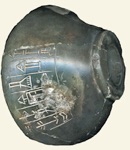
Fragmentary mace head from Ur carrying an inscription (RIME 2:1:1:4; CDLI, P217324)
Now in the Penn Museum (CBS 14396): image from CDLI
It is important to bear in mind that almost all of the known inscriptions of Sargon have come down to us in the form of Old Babylonian copies: as mentioned above, the only known ‘original’ inscription taht can be securely attributed to him is that on on the stele Sb 1. However, it seems likely that in inscription on the mace head illustrated above is attributable to him:
✴the mace head was discovered at Ur and is now in the Penn Museum (CBS 14396); and
✴the part of the inscription on it that is still legible (RIME 2:1:1:4; CDLI, P217324) describes a now-unnamed king as the:
“... conqueror of Uruk and U[r]”.
As it happens, a fragmentary tablet from Nippur that is also in the Penn Museum (N 6266) carries a now-fragmentary Old Babylonian copy of an inscription that names:
“Sargon, king of Akkad, conquerer of Uruk ...”, (RIME 2:1:1:5; CDLI, P227511 ; lines 3’-6’).
Douglas Frayne (referenced below, 1993, at pp. 17-8) suggested that these two fragmentary inscriptions can be used to complete each other, in which case, they each named:
“Sargon, king of Akkad, conqueror of Uruk and Ur”.
The find spot of the mace head is of some significance: it was found in the Enunmah, a large building at Ur that seems to have served as a storehouse related the temple of the moon god Nanna/Sin (the patron deity of the city). As it happens, an engraved disc from Ur that is now in the Penn Museum (B16665) carries an inscription (RIME 2:1:1:6, P217330) on the reverse (which has been completed using an Old Babylonian copy as the composite as RIME 2:1:1:6, P461942) records the name of
“Enheduana, the zirru-priestess, wife of Nanna and daughter of Sargon, king of Kish ...”, (lines 4-7).
This demonstrates Sargon’s appreciation of the political importance the cult of Nanna at Ur, making it entirely possible that:
✴Sargon had dedicated the mace head to Nanna in his temple at Ur soon after he conquered the city; and
✴it had subsequently been moved to the Enunmah for safe-keeping.
Old Babylonian Copies of Sargon’s Inscriptions
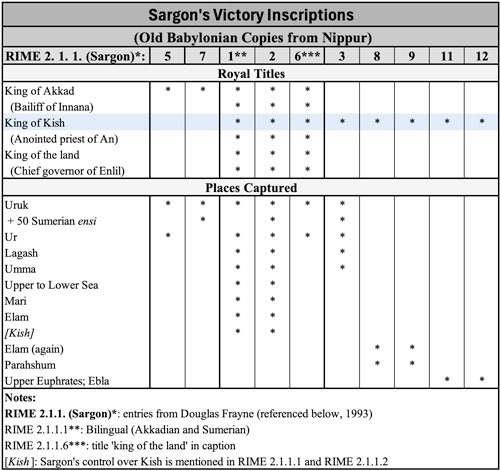
Table 1: Surviving Old Babylonian copies of Sargon’s victory inscriptions
Given this death of ‘original’ evidence for Sargon’s ‘route to power’, it is fortuitous that the survival of a number of Old Babylonian copies of his royal inscriptions from Nippur allow us to develop a model of the phases in his spectacular career. In the table above, I have tabulated the most important of these in a way that suggests a correlation between:
✴his secular titles; and
✴the extent of his empire.
It seems to me that these inscriptions can be split into three groups, referred to in what follows as:
✴Group 1, in which he is king of Akkad (tout court), presumably at the start of his reign ;
✴Group 2, in which he is king of Akkad, king of Kish, king of the land (= king of Sumer); and
✴Group 3, in which he is king of Kish (tout court), a title that was also used by his immediate successors and seems to have meant ‘king of everywhere’.
In other words, it seems to me that this tabulation suggests that the inscriptions in my three groups belong to three consecutive phases in Sargon’s brilliant career.
The Old Babylonian Sources
As we have seen, RIME 2:1:1:5 (CDLI, P227511) survives on a fragmentary tablet from Nippur that is also in the Penn Museum (N 6266), completed by the ‘original’ inscription RIME 2:1:1:4 (CDLI, P217324) on a mace head from Ur:
✴all of the other inscriptions summarised in the table are found on a Sammeltafel (tablet that carries copies of a number of inscriptions) from Nippur that is now in the Penn Museum (CBS 13972); and
✴all but two of them are also found on a similar tablet from Nippur that is now in Istanbul (Ni 3200)).
As Naohiko Kawakami (referenced below, at p. 8) observed:
“If these two tablets had not been recovered, we would have virtually no primary evidence for Sargon's military activities.”
Douglas Frayne (referenced below, 1993, at p. 9) suggested that:
“The originals of these copies may have been inscribed on triumphal steles that once stood in the courtyard of Enlil's Ekur temple at Nippur.”
Sargon, King of Akkad (Group 1)
Group 1 in the table above contains 2 Old Babylonian copies in which Sargon is named as King of Akkad (tout court):
✴The first of them (RIME 2.1.1.5) is discussed above.
✴The second (RIME 2.1.1.7, CDLI P461932). The relevant lines (1-15) reads:
“Sargon, [king of Akkad co[nquered the city] of Ur[uk and was victorious in battle]. [Further], he [personally captured [50 ensi and the [king (of Uruk).
Note that Douglas Frayne (referenced below, 1993, at p. 21) completed the underlined italic text above from RIME 2.1.1.3 (see below) and, in the table above, I have also completed it on that basis.
Although this body of evidence is less secure than one would wish, it does seem likely that, at the time of Sargon’s conquest of Uruk and Ur, his official title was simply ‘king of Akkad’.
One of the few things that we know for certain about Sargon’s early career is that he was closely associated with Akkad. Indeed, according to the biographical note in the (Old Babylonian) Sumerian King List (SKL 269-270), he is credited with having built Akkad. However, Akkad almost certainly existed before Sargon assumed its kingship because, as Walther Sallaberger and Ingo Schrakamp (referenced below, at p. 41) pointed out, an administrative document at Nippur was dated to:
“The year in which Enshakushana defeated Akkad.”
This must refer to King Enshakushana of Uruk, who is known from his own royal inscriptions:
✴Walther Sallaberger and Ingo Schrakamp (referenced below, at p. 93) argued that:
“Before Sargon, Akkad was not known as a city, so this [year name] can be taken as the first indirect proof for the existence of Sargon as a contemporary of Enshakushana. Although this document does not bear a direct reference to king Sargon, prosopography demonstrates that Sargon must have ruled at Nippur not too many years later. This fact supports the impression that the reference to Akkad in the Enshakushana year date, in fact, points to a mighty ruler there, namely Sargon.”
✴However, as Piotr Steinkeller (referenced below, 2017, note 487, at p. 190) pointed out:
“Correctly, all that this [year name] proves is the existence of Akkad at the time of Enshakushana. While it does not exclude the possibility that Sargon ruled over Akkad [when Enashakushana defeated it], it in no way demonstrates it.”
Unfortunately, nothing in the surviving inscriptions of Enshakushana allows us to either date his reign or locate his capital. However, there is no reason to doubt the relative chronology of the SKL, which lists Enshakushana of Uruk (SKL 186-7) before Lugalzagesi of Uruk (SKL 259-60), after whose reign the kingship was transferred to Sargon (SKL 266-71). In other words, we should probably assume that Enshakushana did indeed defeat Akkad and that Sargon subsequently rebuilt it as his capital (or perhaps as one of his capitals).
Sargon, King of Akkad, King of Kish, King of the Land (Group 2)
Group 2 in the table above contains 3 Old Babylonian copies:
✴RIME 2.1.1.1; CDLI, P461926 (which is bilingual;
✴RIME 2.1.1.2; CDLI, P461927; and
✴RIME 2.1.1.6; CDLI, P461931.
In all of these, his full title is:
“Sargon, king of Akkad, bailiff of the goddess Ishtar, king of Kish, anointed priest of the god An, lugal kalamaki (King of the Land = King of Sumer], ensi (governor) of the god Enlil” (see, for example, RIME 2.1.1.2; CDLI, P461927, lines 2-11).
Note, however that, in RIME 2.1.1.6, the title lugal kalamaki does not appear at the start of the inscription but is given in Caption 1 (which presumably accompanied an inmage of the victorious Sargon).
The first two of these inscriptions present very similar accounts of Sargon’s campaign in southern Mesopotamia (which culminated in his annexation of the lands over which King Lugalzagesi of Uruk had previously exercised hegemony), including the fact that he:
“... captured Lugalzagesi, king of Uruk, in battle (and) led him off to the gate of the god Enlil in a neck stock”, (see, for example, RIME 2.1.1.2, lines 25-34).
They also note that:
“Mari and Elam stood (in obedience) before Sargon, lugal kalamaki”, (see, for example, RIME 2.1.1.2, lines 92-99).
This suggests that the original inscribed monuments had been erected at Nippur in order to commemorate Sargon’s (presumably very recent) conquest of Sumer. The inscriptions do not claim that he had also conquered either Mari or Elam at this point, and it is possible that the rulers of these cities had simply recognised Sargon as overlord.
Unfortunately, the passage in RIME 2.1.1.6 that described Sargon’s conquests in now lacunose;
“Wh[en] the god Enlil rendered a verdict for him and (Sargon) conquer[ed] Uruk ... “ (lines 10-15).
It then recorded that he dedicated the object carrying the original inscription) to Enlil and
“... purified Nippur for (him)”, (lines 22--29).
The copyist also reproduced a caption on the base of the object that presumably accompanied an image of the captive king:
“Lugalzagesi, lord of Uruk and king of Ur”, (caption 2).
Thus, we might reasonably assume that this inscription (RIME 2.1.1.6) is broadly contemporary with RIME 2.1.1.1 and RIME 2.1.1.2.
Significance of the Title ‘lugal kalama’
As Jasmina Osterman (referenced below, at p. 54) observed, the use of the title lugal kalama in royal inscriptions seems to have originated with King Enshakushana of Uruk, as evidenced by:
✴an inscription (RIME 1:14:17:1; CDLI, P431228), which was carried by a number of stone bowls at Nippur that were dedicated at Nippur to ‘Enlil, king of all the lands (lugal kurkurra)’ by:
“... Enshakushana, lord of Sumer (en kiengi) and king of the land (lugal kalama), ...
✴an inscription (RIME 1:14:17: 3; CDLI, P431230) on a foundation tablet from Uruk that commemorates the building of a now-unknown temple by:
“... Enshakushana, lord of Sumer (en kiengi) and king of the land (lugal kalama), son of Elili ...”, (lines 2-4).
The title was also used in an inscription (RIME 1.14.20.1; CDLI, P431232, lines 3-12) of King Lugalzagesi (who probably followed Enshakushana as king of Uruk), which was similarly carried by a number of stone bowls at Nippur:
✴“For the god Enlil, lugal kurkirra: Lugalzagesi, king of Uruk, lugal kalama, ishib priest of An, lumah-priest of Nisaba, son of U-u, ensi of Umma, lumah-priest of Nisaba”, (lines 1-12); and
✴“When the god Enlil, lugal kurkirra, gave to Lugalzagesi nam-lugal-kalama (the kingship of kalama) ...”, (lines 36-41).
Tohru Maeda (referenced below, 1981) suggested that:
✴the title lugal kalama (king of the land) was given to the overlord of Sumer (see p. 7); and
✴the kingship of kalama lay within the gift of Enlil.
We can now return to the significance of this title in the context of Sargon’s Group 2 inscriptions, in which Sargon used the title:
“... king of Akkad, mashkim priest of lnanna, king of Kish, guda priest of An, lugal kalama (king of the land) [and] ensi/ensi-gal (governor/mighty governor) of Enlil”, (see, for example, RIME 2.1.1.2; CDLI, P461927, lines 2-11).
As Tohru Maeda (referenced below, 2015, at p. 14) observed, in these inscriptions, Sargon’s religious and secular titles:
“... were arranged alternately, one after the other. There are no other royal inscriptions in the 3rd millennium BC using this arrangement except for the ‘Lugalzagesi inscription’ [RIME 1.14.20.1; CDLI, P431232, discussed above]”.
He argued (at p. 15) that:
“The inscriptions of Sargon and Lugalzagesi are the only ones which use this peculiar style consisting of secular and religious titles. Based on this observation, we can be certain that Sargon modelled this inscription on Lugalzagesi's.”
In other words, we might reasonably assume that, at the time of his Group 2 inscriptions at Nippur, Sargon:
✴modelled his titulary on that of Lugalzagesi;
✴specifically included his kingship of kalama because this implied that Enlil had facilitated his victory over Lugalzagesi; and
✴made these changes when he celebrated his definitive victory over Lugalzagesi at Nippur and:
“... led him off to the gate of the god Enlil in a neck stock”, (see, for example, RIME 2.1.1.1, lines 25-34).
Significance of Sargon’s Title ‘lugal Kish’ in the Group 2 Inscriptions
Piotr Steinkeller (referenced below, 2013, note 51, at p. 146) argued that the title ‘lugal kish’:
“... meant shar kishshatim [= king of all] already in Sargonic times, [as] is shown by the fact that, in the same inscriptions:
✴[the ‘Kish’ in this title] invariably lacks the indicator KI; whereas
✴ the [actual city of Kish is always written with it [as Kishki].
Here it is also significant that Sargon ... never claimed to be the kings of the city of Kish, [his] own particular kingship being localised in the city of Akkad.”
Thus, for example, in transliterations of RIME 2.1.1.2; CDLI, P461927, we read:
✴lugal akadeki (king of Akkad - lines 2-3);
✴lugal kish (king of Kish, not given the determinative ki and usually translated as ‘king of the world’ - line 6); and
✴kishki (the city of Kish - line 103).
However, it seems to me that, even though ‘Kish’ in the title lacks the determinative ‘ki’, it cannot mean ‘king of the world’, since, had it done so, then the other two titles (Kink of Akkad, king of Sumer) would have been otiose. In other words, in my view, when written as part of Sargon’s Group 2 titulary, it almost certainly reflected Sargon’s actual kingship of Kish (or, perhaps, of the erstwhile territory of Kish). As it happens, we know that Sargon actually did control Kish in the Group 2 period, since we read (in a line cited by Steinkeller):
“Sargon, lord of the land of Sumer, altered the two sites of Kish: he made the two (parts of Kish) occupy (one) city”, (RIME 2.1.1.2; CDLI, P461927, lines 100-8).
This passage presumably refers to his amalgamation of the previously twin cities of Kish itself and nearby Hursagkalama, both of which were clearly under Sargon’s control at this time.
Sargon, King of Kish (Group 3)
Group 3 in the table above contains 5 Old Babylonian copies from Nippur in which Sargon is designated as king of Kish (tout court). The first of them (RIME 2.1.1.3; CDLI, P461928), after noting that Ilaba was Sargon’s personal god, records that:
✴“Sargon, lugal kish, with nine contingents from Akkad, conquered the city of Uruk, was victorious in battle, captured 50 ensi and personally captured the king”, (lines 3-20):
✴on a subsequent occasion, Sargon and Lugalzagesi:
“... fought each other at Ur and Sargon was again victorious (lines 27-31); and
✴Sargon was also victorious at Umma; and Lagash (lines 32-46).
This is the only known case in which Sargon used the title ‘lugal kish’ (tout court) in an inscription that (apparently) deals with his victories in Sumer.
The other four inscriptions in this group belong to the period in which Sargon extended his area of control beyond Sumer:
✴The next two inscriptions (RIME 2.1.1.8; CDLI, P461933 and RIME 2.1.1.9; CDLI, P461935) both characterise Sargon as ‘lugal kish, conqueror of Elam and Parashum’ and identify various enemy leaders (the most important of whom was King Hishibrasini of Elam), who were presumably depicted as captives on the original victory monuments at Nippur.
✴The last two inscriptions (RIME 2.1.1.11; CDLI, P461937, which is bilingual and RIME 2.1.1.12; CDLI, P461938) deal with Sargon’s campaign in the area of the Upper Euphrates and against Ebla (in modern Syria). Although they seem to be duplicates, Douglas Frayne (referenced below, 1993, at p. 30) argued that they probably came from two separate originals, since one would not expect to find an original inscription copied twice on one Sammeltafel. In the form in which they have come down to us, they both:
•begin with the information that:
“Sargon, lugal kish, was victorious (in) 34 battles”; and
•record that Sargon:
“... bowed down to the god Dagan at Tuttul, ... [who] gave to him the Upper Land: Mari, Iarmuti and Ebla as far as the Cedar Forest and the Silver Mountains.”
Frayne (as above) commented that:
“It is unclear why captions naming the defeated enemy leaders of Sargon's ... campaign [in Sumer] are listed at the end of [RIME 2.1.1.12].”
Taken together, these inscriptions indicate that, some time after Sargon’s defeat of Lugalzagesi, as he expanded his empire beyond the confines of Mesopotamia, he dropped the titles ‘king of Akkad’ and ‘king of the land’, styling himself simply as ‘king of Kish’.
ED III Kings of Kish in Southern Mesopotamia
At least four ED III rulers whose capitals were in southern Mesopotamia (for whatever reason) claimed the title ‘king of Kish as an additional title:
✴Meskalamdu (RIME 1.13.5.1; CDLI, P431203) and his son, Mesanepada (RIME 1.13.5.2; CDLI, P431204), both of whom were kings of Ur;
✴Eanatum, ensi of Lagagash (RIME 1.9.3.5; CDLI, P431079, lines 98-106); and
✴Lugalkiginedudu, king of Ur and Lord of Uruk (RIME 1.14.14.2; CDLI, P431217).
However as far as we know:
✴Enshakushana remained ‘lord of Sumer (en kiengi) and king of the land (lugal kalama)’, despite the fact that he claimed to have:
•defeated and captured the Kishite king Enbi-Ishtar; and
•dedicated the property of Kish, which he had destroyed, the Enlil; and
✴Lugalzagesi similarly never used the title king of Kish.
Akkadian Kings of Kish
This brings us to the question of why Sargon adopted the title ‘lugal kish’ (tout court) in the later part of Sargon’s reign and why is sons and successors, Rimush and Manishtushu, retained this practice throughout their respective reigns. As we have seen, Piotr Steinkeller (referenced below, 2013, at p. 146) argued that, at least by the time of Sargon, this title:
“... served as a generic designation of a universal ruler, corresponding to the later title ‘shar kishshatim’ (king of all’).”
However, Nikita Artemov (referenced below, at p. 72) argued that:
“The popular view that the Old Akkadian title ‘lugal kish’ either:
✴is to be read shar kishshatim; or
✴while being formally identical with the ED title shar kish, means shar kishshatim on the connotative plane [= by way of a pun];
is, in fact, neither provable nor plausible. The earliest attestations for kishshatum (totality) are Old Babylonian; the word occurs neither in Old Akkadian nor (what is more) in Old Assyrian sources. The main argument brought forward by Piotr Steinkeller [see above] in favour of the reading shar kishshatim for the Old Akkadian lugal Kish is .... [that], at the end of the ED period, the name of the city of Kish was always written kishki in Sumerian. However, the absence of the determinative was convincingly explained as a graphic archaism by William Hallo ([referenced below)] who pointed out that lugal kish in the Old Akkadian royal inscriptions reproduced not only the ED II/IIIa writing of the title lugal kish (without determinative) but also its sign forms; thus, [for example], the sign lugal used in the original inscriptions of Rimush;
✴resembles strikingly the sign form used in the royal inscriptions of Mesilim, [a well known king of Kish from the ED I-II period]; and
✴differs from its more modern version(s) occurring ... in late ED royal inscriptions since the time of [Eanatum, ensi of Lagash, who received nam-lugal kishki (the kingship of the city of Kish) from Inanna]”, (RIME 1.9.3.5, col. vi, line 4).
In other words, Artemov argued that Sargon used the title lugal kish (without determinative) in order to present himself as a Kishite king of the stature of the ED I-II kings of Kish.
However, this still leaves open the following questions:
✴why did Sargon ‘drop’ the titles ‘king of Akkad’ and ‘king of the land of Sumer’ in his Group 3 period while retaining the title ‘king of Kish’ (tout court): and
✴why both Rimush and Manishtushu continue this practice throughout their respective reigns.
At least part of the answer might lie in an observation of Tohru Maeda (referenced below, 1981, at p. 8):
“... in all cases, [the title] ‘king of Kish’, when held by Sumerian rulers [including Mesanepada, Eanatum and Lugalkiginedudu], had a close relationship to the goddess Inanna, but not to the god Enlil, the chief god of Sumer. This relationship between the title ‘king of Kish’ and Inanna stands in contrast to the kingship of the Land, [which was] given by the god Enlil to Lugalzagesi.”
In the case of Sargon, it is clear from the inscriptions from Nippur discussed above that he claimed the patronage of Enlil after his defeat of Lugalzagesi and he routinely commemorated his victories at Nippur. Nevertheless, the patron deities of the Akkadian dynasty were the god Ilaba and the goddess Ishtar, who was syncretised with Inanna soon after his conquest of Sumer.
Sargon’s Victory Steles
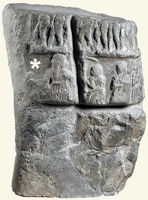
Left: Side A of a victory stele of Sargon from Susa, now in the Musée du Louvre (Sb 1)
asterisk marks the figure of Sargon, identified by inscription
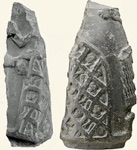
Right: two views of the surviving fragment of a victory stele from Susa, now in the Musée du Louvre (Sb 2)
Images from the museum website
As discussed above, the only surviving inscription that can be attributed with certainty to Sargon is on the four-sided fragment of a stele from Susa (illustrated on the left above). In this section, I will analyse the iconographical evidence of the reliefs:
✴on this stele, which is now in the Musée du Louvre (Sb 1): and
✴another fragmentary stele from Susa (illustrated on the right from two different angles) which is also in the Musée du Louvre (Sb 2).
Douglas Frayne (referenced below, 1993, at p. 310) noted that these two steles were found about 50 meters apart. They are made from the same material (which is often given as diorite, although has apparently been identified as olivine gabbro), and they both carry a now-fragmentary Old Akkadian inscriptions:
✴The inscription (RIME 2:1:1:10; CDLI, P461936) on Sb 1 is in two parts::
•the caption on side A (at the location marked with an asterisk in the illustration above) identifies the adjacent figure as:
“Sargon, the king”; and
•a fragmentary inscription on the opposite side C, which is part of a curse formula, reads:
“[When Sargon conquered a now unknown the place in] battle ... [If anyone should violate this stele], may they [= two gods] ... tear out his foundations and pluck out his seed”.
✴The inscription (RIME 2.0.0.1002) of Sb 2, which is also part of a curse formula, reads:
“... [may the gods [DN] and Ilaba [tear out] his foundations”.
Douglas Frayne (as above) noted that, although the king's name is not preserved in this surviving fragment:
“... stylistic considerations ... suggest that it [= Sb 2] may have belonged to Sargon.”
The analysis below of the iconography of the reliefs on these stele is largely based on the important paper published by Lorenzo Nigro (referenced below).
Stele SB 1
According to Douglas Frayne (referenced below, 1993, at p. 26) observed that Sb 1:
“... which was deliberately defaced in antiquity:
✴may have been set up in Susa to commemorate Sargon's victory over Elam; or
✴alternatively, may have been a piece of booty brought by the Elamites from Babylonia”
This is an important point, since the museum notes (for example) confidently assert that:
✴Sargon originally erected it in the Enlil temple at Nippur; and
✴it was brought to Susa by the Elamite king Shutruk Nahunte in the early 12th century BC.
In fact, while it is true, as (for example) Imane Achouche (referenced below, at pp. 10-11 and note 30) pointed out, that:
✴Shutruk Nahunte brought a large number of statues and other objects to Susa as booty from his successful raids in Babylonia (and that he added an inscription on some of them in which he noted their original locations and dedicated them to the god Inshushinak); and
✴this stele may have been among these objects (albeit that any inscription to this effect no longer survives);
there is no surviving evidence that proves that this was the case. It is, for example, equally possible that:
✴it was brought to Susa by another ruler (perhaps, for example, Puzur-Inshuhinak, who (as we shall see) ruled at Susa just prior to the Ur III period, at which time he conquered a swathe of territory that included Akkad); or
✴it was erected by Sargon himself at Susa (and perhaps dedicated to Inshushinak) to commemorate his conquest of Elam and Parashum (as Frayne suggested).
This stele (as it now survives) is of rectangular section:
✴sides A-C carry reliefs in two registers, although only the lower part of the reliefs in the upper registers survives;
✴the curse formula mentioned above is below the surviving lower relief on side C; and
✴the original surface of side D has been lost.
Surviving Reliefs on Sides A and B
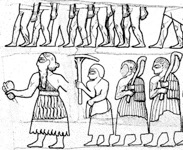
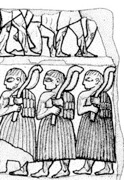
Side A Side B
Sketches of the reliefs on sides A and B of stele Sb 1 . from Lorenzo Nigro (referenced below, Figure 8, at p. 92
As mentioned above, the first figure depicted in the lower register of my side A represents Sargon (identified by inscription). According to Lorenzo Nigro (referenced below, at p. 94), he:
“... wears a flounced robe [that is] fixed at the waist by a wide belt and wields a mace in his right hand. [He has a long beard and] his hair is restricted by the pointed chignon, a typical royal Akkadian hair style.”
Although most scholars agree that Sargon holds a mace in his right hand, the surface of the stele here is damaged and alternative interpretations of the residual evidence are possible: for example, Benjamin Foster (referenced below, at p. 195 and note 37, at p. 221) argued that:
✴Sargon would not have held a mace just below its head; and
✴the mace head in the relief is more probably the fastener of a prisoner net (the shape and diagonal pattern of which are apparently ‘still visible on the stone and in good photographs’).
The figure following Sargon is usually described as a servant holding a parasol. However, I suggest that
✴the putative parasol in his right hand is actually a battle standard that he has just received from Sargon; and
✴he holds in his left hand a downward facing weapon that is similar to those held by the men behind hm.
Lorenzo Nigro (as above) characterised the following 5 men (two on side A and 3 of side B) as ‘dignitaries’ and argued (at p. 96) that they were:
“... members of the military class that benefited from the royal conquests. These commanders (whose rank is indicated by the crescent-like axe, the flounced shawl and the bold skirt with long fringes) were the political élite whom Sargon attracted through his promise of great rewards ... from his military success.”
According to Lorenzo Nigro (referenced below, Table 1, at p. 94):
✴the relief in the upper register of side A (his side B) depicts 7 bound prisoners under the control of an Akkadian soldier;
✴that in the upper register of side B (his side A) depicts 2 pairs of figures, each pair involving an Akkadian and an enemy soldier:
•the first Akkadian subdues a kneeling enemy; and
•the second takes another into captivity.
I suggest that both of these enemies (who seem to be still alive) will soon join their compatriots in the procession in the upper register of side A.
Surviving Reliefs on Side C
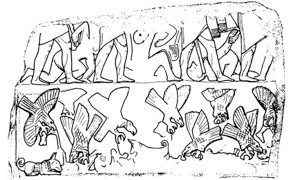
Sketch of the reliefs on sides C of stele Sb 1, from Lorenzo Nigro (referenced below, Figure 12, at p. 97)
According to Lorenzo Nigro (referenced below, at p. 98), the relief in the upper register of Side C depicts a series of four military engagements, each involving an Akkadian and an enemy soldier:
✴the Akkadians all face right and are depicted in a regular manner; but
✴there is nothing orderly about the way in which the three enemy soldiers whose images survive are depicted:
•the first has been struck in the side by a spear that he is trying to pull out;
•the second (who may well be dead) seems to be being held up by his arms; and
•the third kneels with his head pinned to the ground.
Nigro observed (at p. 99) that, in the lower register, the reliefs depict the result of earlier brutal engagements of this kind, when:
“... enemy corpses are abandoned to vultures and dogs. ... Cruel details, such as the dog on the left devouring human limbs or the vulture on the right carrying off a [human] leg, increase the tragic climax of the imagery.”
As he also pointed out, this lower scene was adapted from the famous scene on the victory monument from Girsu that modern scholars know as the ‘Stele of the Vultures’, which had been commissioned about a century earlier by Eanautum, ensi of Lagash (as discussed further below).
Significance of the ‘Vultures’ Motif
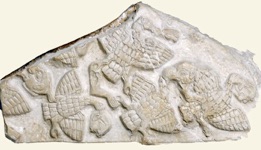
Fragment A (‘historical’ side) from the Lagashite Stele of the Vultures
Now in the Musée du Louvre (AO 50): image from the museum website
Lorenzo Nigro (referenced below, at p. 99) highlighted an important difference between the use of the ‘vultures’ motif in Eanatum’s ‘Stele of the Vultures (illustrated above) and Sargon’s Sb 1:
✴In the former, the motif is in the top register, where it would have represented the culmination of Eanatum’s victory in a border dispute with the neighbouring state of Umma.
✴In the latter, it was in the bottom register, where it:
“... eloquently represent the destiny reserved for those who will not accept Sargon’s authority.”
However, the enemy corpses depicted here were now less valuable than able-bodied captives depicted in the upper register: as he pointed out (at p, 97) he was aiming to extend (rather than simply to defend) his existing territory, and this required a great deal of manpower. As he observed (at pp. 99=100):
“If we suppose that a representation of divine support was carved at the [now-lost] top of the stele (for instance the king in front of patron deities), this would explain why its visual counterpart [= the terrible plight of those who would not submit] was put, by opposition, at the bottom of the monument..of the monument.”
Significance of the Portrayal of Sargon and the Other Akkadians
Lorenzo Nigro (referenced below, at p. 96) observed that:
“Sargon is portrayed [on side A] in a resolute advance, indicating the Akkadian policy of military expansion. The king is shown as the real author of the victory: the regularly arrayed officials following him represent members of the military class that benefited from the royal conquests.”
He also observed (at p. 98) that:
“Rhythmic dynamism [also] represents a visual medium largely exploited by Sargonic artists for conveying the ideology of an expanding power, as it was conceived during the third phase of Sargon's reign, when an imperialistic policy was definitely embraced.”
He made this comment in relation to the depiction of the Akkadian soldiers in the upper register of side C, whose inexorable march to the right takes place against a chaotic background of dead and dying naked enemy soldiers. However, I would argue that this visual medium is applied to all of the Akkadian figures in the relief (including Sargon himself). Nigro summarised his point in his conclusions (at p. 100), arguing that this iconography testifies to:
“... the imperialistic policy of the mature phase of Sargon's reign, when he extended his military enterprises far beyond Mesopotamia proper.”
While it is hard to disagree with most of this powerful analysis (and I doubt that I have done full justice to it), I am not sure that Sb 1 can be confidently placed in ‘the third phase of Sargon's reign’: after all, his victories over:
✴a now-unknown king of Akkad, thereby attaining kingship;
✴ now-unknown king of Kish (traditionally King U-Zababa), thereby attaining control of northern Mesopotamia; and
✴King Lugalzagsi of Uruk, thereby attaining control of all of ‘Mesopotamia proper’;
must have felt similarly ‘game-changing’ at the time.
Stele SB 2
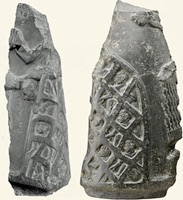
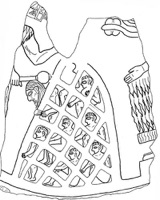
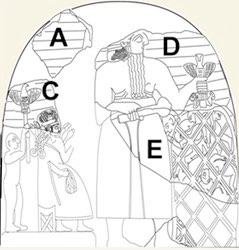
Left: two views of the surviving fragment of a victory stele from Susa, now in the Musée du Louvre (Sb 2)
Images from the museum website
Middle: sketch of the ‘flattened’ relief from Lorenzo Nigro (referenced below. Fig.1, at p. 86)
Right: sketch of the reconstructed scene in the upper register of ‘mythological’ side)
of Eanatum’s Stele of the Vultures, with the surviving fragments (A, C, D and E) indicated
Image from Licia Romano (referenced below, 2007, Figure 1, at p. 21)
As noted above, Douglas Frayne (referenced below, 1993, at p. 310) noted that this stele was discovered at Susa, about 50 meters from Sb 1. The museum note asserts, without any had evidence, that it originated in Sumer and that king Shutruk Nahunte brought it to Susa in the early 12th century BC. As Lorenzo Nogro (referenced below, at p. 85) observed:
“The unique shape of [this] fragment of SB 2 (illustrated on the left above) suggests that it was the upper register of an ogival stele, with only scant traces of a lower register present.”
This upper register would originally have been elliptical in section (see Nigro’s Figure 2, at p. 87), tapering towards the top. The surviving fragment preserves one of the thin ends of the ellipse, and the curvature here is such that it is impossible to show the entire relief on the surviving fragment in a single photograph: the sketch above presents a ‘flattened out’ view of it. It depicts two now-fragmentary figures flanking a prisoner net in which seven naked men are trapped, with the head of one of them protruding from the upper left. While little survives of the two flanking figures, it seems that they originally represented:
✴a standing male figure on the left who:
•held the top of the net in his left hand; and
•touches the protruding head with the mace that he still holds in his right hand; and
✴a seated deity on the right.
It is clear from the illustrations above that the motif of the prisoner net at the centre of this relief is taken from the scene in the upper register on the ‘mythical’ side of Eanatum’s ‘Stele of the Vultures’ (see above): in both scenes, a standing male figure holds:
✴the fastener of a prisoner net in his left hand; and
✴a mace in his right hand, with the mace head touching (and possibly striking) the protruding head of one of the prisoners.
However, as Lorenzo Nigro (referenced below, at p. 85) observed, there are a number of important differences between these two portrayals, perhaps the most important of which concerns the identity of the standing male figure wielding the mace:
✴in the case of Eanatum’s relief, Sébastien Rey (referenced below, 2024, at pp. 247-8) identified this figure as Ningirsu, the city god of Lagash and Girsu; while
✴as we shall see, Lorenzo Nigro (as above) identified the corresponding figure in Sargon’s relief as Sargon himself.
Captives in the Prisoner Net
One of the surviving fragments of Eanatum’s stele (fragment E’ in the sketch on the right above) carries the upper part of the original prisoner net, which contains five heads (including the one that protrudes at the upper left): in his reconstruction of the original, Sébastien Rey (referenced below, 2024, Figure 92, at p. 244) suggested that the lower part would have contained another four. As he observed (at p. 248) the surviving heads in the net (including the one that protrudes) are all bald and unbearded, and the naked bodies around them were:
“... twisted and contorted in unnatural positions that emphasise the extreme degradation to which they had been subjected.”
It is possible that the prisoners’ heads had been shaved as part of this humiliation. Lorenzo Nigro (referenced below, at p. 89 and note 13) assumed that the other men in the net were dead, but I suggest below that the owner of the protruding head survived the battle.
As Lorenzo Nigro (referenced below, at p. 89) observed, the net in the relief on Sargon’s stele Sb 2 (which survives in its entirety) contains seven prisoners, six of whom are depicted:
“... as [regularly-arranged], seated figures, stretching their right hands towards Sargon in a gesture of submission. ... [Furthermore, they are carefully and realistically depicted] with curly hair and well-formed muscles”.
Interestingly, this portrayal reflects the same policy as that noted above in Sb 1 (above), in which Sargon apparently valued living prisoners more than enemy corpses.
Ethnicity of the Captive Prisoners
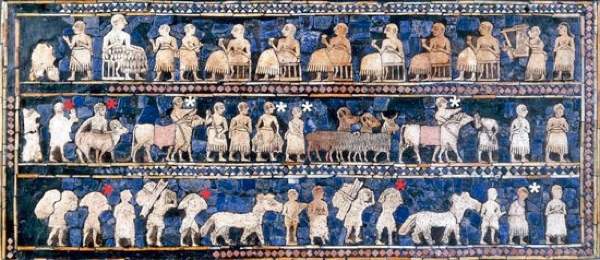
Peace side of the ‘Standard of Ur‘ , from the ‘Royal Cemetery of Ur
Now in the British Museum (BM 121201): image adapted from the museum website
Red asterisks: men who certainly have curly hair
White asterisks: men in the lower two registers who are certainly Sumeriam
As noted above, we have no direct evidence indication where and against whom Sargon secured the victory commemorated in Sb 2. However, Lorenzo Nigro (referenced below, note 14, at p. 89) argued that the curly hair of the 6 prisoners inside the net:
“... is comparable with that of Sumerian soldiers carrying pieces of booty on the lower register of [the ‘peace side’ of the ‘Standard of Ur’ [illustrated above], thus confirming the South Mesopotamian provenance of the prisoners in the net.”
Since this assertion is important for the analysis that follows, we need to look at the basis for it in some detail. This important object was discovered in one of the graves of the so-called ‘Royal Cemetery of Ur’ and is broadly contemporary with Eanatum’s ‘Stele of the Vultures’. As Sarah Collins (referenced below, at pp. 27-30) observed:
✴the top register on this side of the standard depicts a traditional royal banquet that would have been held at Ur to celebrate the victory depicted on the other side of the standard; and
✴the men depicted in the two lower registers:
“... are evidently part of one long procession bringing animals and goods towards [this] banquet.”
Thus, there is actually no reason to think either:
✴that any of the men depicted in these two lower registers were soldiers; or
✴that any of the objects that they carry had been acquired as booty.
Collins (as above) also published (as her Figure 21, at p. 33) a photograph of the two lower registers of this side of the standard that had been taken in 1973, when the (often damaged) figures were easier to see, and the conclusions that she reached from this image included the following:
✴the four men in the middle register bringing the bulls goats and fish to the banquet (indicated above by white asterisks) are all almost bald and clean shaven and wear the ‘typically Sumerian’ fringed skirt (see pp. 31-2);
✴only one man in the bottom register (second from the right, also indicated above by a white asterisk) has the same appearance (see p. 33);
✴at least two of the three men on the left in the middle register (indicated above by red asterisks) seem to be wearing a non-Sumerian style of skirt (= wrapped in a way that results in an angled hem) and have curly hair (see p. 32); and
✴almost all of the men in the bottom register wear these non-Sumerian skirts and at least three of them (each of whom has a sack on his shoulders and is also indicated above by a red asterisk) probably has curly hair (see pp. 32-3).
In other words, in the standard, curly hair is associated with non-Sumerians. Interestingly, Jerold Starr, in this page on his website Sumerian Shakespeare (who drew attention to Nigro’s note 14 and who argued, like Collins, that the curly-haired men depicted in the standard were non-Sumerian) further suggested that they were Akkadians (meaning here from northern Mesopotamia rather than specifically from the city of Akkad). However, it seems to me that there is no reason why they could not have come from further afield.
Identity of the Owner of the Protruding Head
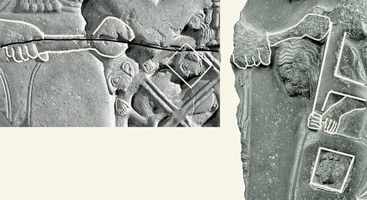
Left: detail from ‘fragment E’ of Eanatum’s ‘Stele of the Vultures‘ (my additions in white)
Right: detail from Sargon’s stele Sb 2 (my additions in white)
Sébastien Rey (referenced above, 2024, at p. 248) suggested that, since the protruding head in ‘fragment E’ of Eanatum’s ‘Stele of the Vultures’ is larger than those inside the net, it probably belongs to the enemy commander. Furthermore, we might reasonably assume that he was the ensi of Umma, since he was important enough to (metaphorically) deserve the attention of Ningirsu. The inscription on the stele tells us that, after his defeat, he was forced to swear on oath that he would forthwith respect Ningirsu’s rights over the disputed territory, which suggests that he survived his defeat (since his oath would have been of little value had he been destined for execution). If so, then the motif of Ningirsu holding a mace to his head would have symbolised his abject act of submission (an impression reinforced by the fact that his hands seem to be grasping the net and he had apparently presented his head for Ningirsu’s attention of his own volition).
Lorenzo Nigro (referenced below, at pp. 90-1) reasonably argued that, since the head protruding from the prisoner net in Sargon’s stele (illustrated above on the right) is markedly larger than those of the other six captives, it too belonged to the defeated ‘enemy commander’. Pierre Amiet (referenced below, at p. 12) argued more specifically that this head:
“... must be that of the enemy king, who is distinguished (like Sargon [for example, in Sb 1]) by his beard and long hair, which may have come undone at the moment of his capture”, (my translation).
Nigro (who, as we have seen, assumed that the other captives in the net were Sumerians) assumed that this protruding head must have belonged to a pre-Sargonic Sumerian king. He supported his argument by comparing this portrayal with that of the ‘smitten rebel ruler’ in a victory stele from Telloh (= Girsu), the surviving fragments of which are now in the Musée du Louvre (AO 2678). In the most relevant of the surviving reliefs on this later stele (see the second image on the museum website and the sketch in Sébastien Rey, referenced below, 2024, on the left side in Figure 107, at p. 312), the standing Akkadian commander (almost certainly a Sargonic king, usually but not securely identified as Rimush, Sargon’s son):
✴has planted his right leg on the leg of Nigro’s ‘smitten rebel’, who sports a beard and long hair; and
✴strikes the rebel’s head with the mace that he holds in his right hand.
It seems to me that it is indeed likely that:
✴the Akkadian king’s victim here is indeed a king; and
✴Girsu lay within the territory that he had claimed to rule.
However, this does not prove that he was either ethnically or culturally a Sumerian (and he was obviously not pre-Sargonic): in my opinion, he was more probably an Akkadian governor who had rebelled against the Akkadian king and claimed the kingship of the territory that he governed for himself.
This brings us back to the identity of the king whose head protrudes from the prisoner net in Sargon’s stele SB 2. Lorenzo Nigro (referenced below, at p 93) argued that, since he:
“... bears the clearly distinguishable emblems of Mesopotamian kingship, [he] is Lugalzagesi of Uruk.”
However, as I argued above, there is no reason the think that the beard and long hair of the protruding head represented ‘emblems of kingship’ in pre-Sargonic Sumer. As it happens, the surviving evidence (which is admittedly much earlier than Lugalzagesi) suggests the opposite. For example, on the ‘peace side’ of the ‘Standard of Ur’, the king of Ur (the third figure from the left in the upper register in the image above) was beardless. The equivalent figure on the ‘war side’ is badly damaged, but Sarah Collins (referenced below at p. 26 and Figure 17) noted that he was also he appears beardless in a surviving watercolour painting of this figure at the time of its excavation (1929). Another example is found in Eanatum’s ‘Stele of the Vultures’: Sébastien Rey (referenced below, 2024, at p. 250) recoded that images of him survive in each of the two upper registers on the ‘war side’, where he appears:
“... beardless, while strands of his thick, long, wavy hair can be seen protruding from under the bottom of his pointed helmet and falling down onto his shoulders. Above that, the bulk of his hair is formed into a chignon that is held in a bipartite band ...”
He then commented that this arrangement recalls the helmet of ‘Meskalamdu, king of Ur’. This is a reference to the gold helmet (illustrated in this page of the website ‘Sumerian Shakespeare‘ of Jerald Jack Starr, that the young warrior who was buried in grave PG 755 in the ‘Royal Cemetery of Ur’ was wearing at the time of his burial. However, as Douglas Frayne (referenced below, 2008, at p. 401) pointed out, while this young man was probably called Meskalamdu, he was unlikely to have been the documented king of this name, although he might have been a son of King Mesanepada. On the basis of this evidence, it seems that:
✴Sargon’s chignon in Sb 1 might have derived from Sumerian precedents, although this ‘emblem’ was not confined to kings in pre-Sargonic Sumer; and
✴(as far as I know) his long beard in Sb 1 is not found as an emblem of kingship in the (scant) surviving evidence from pre-Sargonic Sumer.
Thus, the beard on the protruding head in SB 2 possibly precludes the identification of its owner as a Sumerian, and his long hair (whether or not it has fallen from a chignon) tells us nothing about his ethnicity.
Lorenzo Nigro put forward a third argument in favour of Lugalzagesi as the owner of the protruding head: he argued (at p. 93) the curse formula inscribed on SB 2 is one of only three inscriptions of Sargon that mention Ilaba and, since the other two (RIME 2.1.1.2; CDLI, P461927 and RIME 2.1.1.3; CDLI, P461928):
“... belong to the initial phase of Sargon's reign, when [he] subdued the city-states of southern Mesopotamia and defeated their leader, Lugalzagesi, ... the dedication on Stele Sb 2 may probably be ascribed to the same early phase.”
Actually, I would argue that:
✴Sargon’s titulary in RIME 2.1.1.3 points to a later date than the rest of that text suggest (as mentioned above); and
✴the curse on Sb 1 (which Nigro dates to a later phase in Sargon’s career) might well have invoked the same two gods as SB 2 (i.e., Ilaba and probably Ishtar);
although I acknowledge that neither of these objections can be proved. However, a more important point is that Sargon explicitly stated in RIME 2.1.1.3 that Ilaba was his personal god, and he remained the dynastic god of the Akkadian kings for four generations: as Stefan Nowicki (referenced below, at p. 68) observed, the cult of Ilaba, at least in Mesopotamia:
“... was established by Sargon [and it remained] ... typical of the Akkadian dynasty ... [It] emerged no earlier than the time of Sargon and it vanished immediately after the Akkadian dynasty had faded away.”
In other words, even if Nigro is correct in asserting that Ilaba is only present in Sargon’s surviving royal inscriptions from the early phase of his career, this would have to have been the result of an accident of survival: Ilaba was Sargon’s personal god and he continued to feature prominently in the inscriptions of his successors, including his great grandson, Sharkalisharri, one of whose year names was:
“... the year in which Sharkalisharri laid the foundations of the Annunitum temple [= the temple of Ishtar Annunitum] and the Ilaba temple in Babylon and captured Sarlag, king of Gutium”, (see Walther Sallaberger and Ingo Schrakamp (referenced below, at p. 46).
It seems to me that:
✴there are at least three potential candidates for the ownership of the protruding head in Sb 2:
•the now-unknown king of Kish (traditionally King U-Zababa) whom Sargon defeated and replaced;
•King Lugalzagsi of Uruk, whom he captured and brought before Enlil at Nippur before deposing him; and
•King Hishibrasini of Elam, who, as we have seen, was apparently depicted on a victory monument at Nippur that carried the inscription RIME 2.1.1.9; CDLI, P461935 (see lines 42-4); and
✴Lugalzagesi is arguably the least likely of these three candidates.
Standing Male Figure on the Left
Lorenzo Nigro (referenced below, at p. 85) identified this now-fragmentary figure (whose left shoulder and arm survive) as Sargon, who:
✴wears a ‘royal cloak’ over his shoulder;
✴originally held the top of the net in his left hand; and
✴holds a mace in his right hand, with the mace head against the protruding head of the enemy commander.
This identification is generally accepted: see, for example:
✴Nicolò Marchetti (referenced below, at p. 301 and note 50); and
✴Renate van Dijk-Coombes (referenced below, at p. 157, citing Nigro).
Nigro observed (at p. 87) that the corresponding figure in Eanatum’s ‘Stele of the Vultures’ had been Ningirsu (the city god of Lagash) and commented that:
“From the iconological point of view, [this substitution of a mortal king for a city god] represents a meaningful variation, since the ideological significance of the imagery changes completely, ascribing to the king [rather than to a god] the primary merit of victory.”
However, it seems to me that this change might have been less dramatic than it seems at first sight, since:
✴as we have seen, two gods (one of which was Ilaba) feature in the now-fragmentary curse formula above Sargon’s outstretched arm;
✴as is shown in Nigro’s Figure 2 (at p. 87), there would have been room to the left of the figure of Sargon for the figure of a god on the now-lost part of the relief (and this putative god might well have been Ilaba, whom Sargon identified as his ‘personal god’ in the inscription RIME 2.1.1.3; CDLI, P461928); and/or
✴it is possible that the mace in Sargon’s left hand was ‘read’ as the ‘mace of Ilaba’, the weapon with which he had captured 50 ensi during his conquest of Sumer (as recorded in the inscription RIME 2.1.1.2; CDLI, P461927, at lines 16-18).
In other words, it is possible that the full relief on this side of the original stele (which was possibly accompanied by one or more inscriptions) had portrayed Sargon as a victorious ruler who had secured the victory in question as the agent of his personal god, Ilaba.
Seated Figure on the Right
As Lorenzo Nigro (referenced below, at p. 85) observed, all that survives of this seated figure is an outstretched hand, part of a foot, and part of a flounced skirt. However, he noted that:
“Three undulating rays [probably] rising from the shoulder of this figure are preserved on the top of the stele, one of [which] ends in a mace head. This detail has been convincingly interpreted as the attribute of a warrior deity, namely Ishtar, the Akkadian dynastic goddess.”
He also observed (at p. 87) that this full-sized enthroned figure would have dominated this side of the stele.
Renate van Dijk-Coombes (referenced below, at p. 157, citing Gudrun Colbow, referenced below, at p. 107) agreed with this identification, observing that:
“... the relief [on Sb 2] is the earliest Akkadian depiction of Ishtar as ... a goddess of war. This scene recalls motifs found in the textual repertoire: it appears that [Sargon] has ... been victorious in battle with the support of the goddess.”
She also observed (at p. 147) that:
“Inanna/Ishtar was the goddess of war, particularly from the Akkadian period, when she was the imperial goddess of the Akkadian Empire. During this period, Ishtar in her warlike aspect was known as Ishtar-Annunītum ...”
Precedents for the Depiction of Ishtar
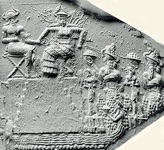
Left: Impression from a seal depicting Ishtar and the deified Naram-Sin
Now in private ownership; image from the website of the Morgan Library and Museum
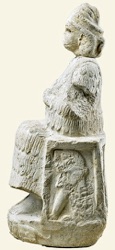
Right: Statue of Peltikalim (Ishtar) from Susa, commissioned by Puzur-Inshushinak, ensi of Susa
Now in the Musée du Louvre ( Sb 54 + Sb 6617): image from the museum website
Donald Hansen (referenced below, entry 133, at pp. 206-7) discussed a particularly good example of the iconography used for this warlike Ishtar, which is illustrated on the left above: as he pointed out, she is seated on a lion throne with weapons emerging from her shoulders, her right hand grasping the arm of the deified Naram Sin (Sargon’s grandson) and her left hand holding ropes that are attached to the noses of four of his captives (two of whom seem to be ‘foreign’ gods). This comparison arguably allows us to assume that, in Sb 2, Ishtar was similarly depicted on a lion throne.
More than a century after Naram-Sin, Puzur-Inshushinak, the ensi of Susa, commissioned a statue (illustrated above on the right) of an enthroned goddess on a lion throne (although her only other surviving attribute, as far as we know, is a headdress with horns over the hair). However, the throne bears a dual inscription:
✴one written in Akkadian (the language of the earlier Akkadian overlords of Susa); and
✴the other written in Linear Elamite (LE) script, which (as observed in the Hatamti-Linear Elamite Database):
“... has so far been used exclusively to record texts in the now-extinct and isolated Elamite (= Hatamtite) language.”
As Javier Álvarez-Mon (referenced below 2018, at p. 181) observed, the Akkadian inscription is now fragmentary, although it does still record the name of ‘Puzur-Inshushinak, ensi of Susa’. François Desset et al. (referenced below, 2026, at p. 58) has recently translated the LE inscription as:
“(Statue of) Peltikalim. The hatpak [= ensi] of Susa, Puzur-Sushinak (speaks as follows): My lady ...”
They noted (again at p. 58) that:
“Peltikalim almost certainly derives from Akkadian Bel(a)t-ekallim (Lady of the Palace), a well-known byname of Inanna/Ishtar“; and
added (at p. 59) that:
“... some iconographic details of the statue (i.e., the eight-petaled rosette on the pedestal and the six lions depicted on the throne and at the feet of the goddess) [also] point to Inanna/Istar ... as being the deity that is portrayed.”
Javier Álvarez-Mon (referenced below 2020, at p. 150), when considering the relief of the eight-petaled rosette below the feet of this goddess, similarly observed that:
“One can hardly overlook the association of rosettes and lions with the [Sumerian/ Akkadian] Inanna/ Ishtar.”
Interestingly, we know from an inscription (RIME 3/2:1:1:29, CDLI, P432139, lines 15’-28’) of King Ur-Namma (the founder of the later Ur III dynasty) that he had ‘liberated’ Akkad from the control of Puzur-Inshushinak, which would explain why this Elamite ruler would have claimed the patronage of Peltikalim/Ishtar.
It is, in fact, unsurprising to find Ishtar is a prominent position on this relief: as Julia Asher-Greve and Joan Goodnick Westenholz (referenced below, at p. 62) pointed out:
“In the Old Akkadian period, Ishtar was the titulary goddess of Akkad, the capital of the Akkadian empire, and her fortunes and characteristics were intimately linked with the political aspirations of the Sargonic rulers. Sargon and his successors actively encouraged the syncretism between Ishar of Akkad and Inanna of Uruk in order to make the national Akkadian goddess acceptable to the Sumerians.”
She pointed out that, while:
✴Ishtar of Akkad was primarily a goddess of battle (Ishtar-Annunītum = Ishtar the skirmisher); and
✴the primary aspect of Inanna of Uruk was her personification of Venus [= the morning and the evening star];
the latter goddess had an Akkadian counterpart, whose name was written as ‛dInanna -kà-kà-bù’ (Istar the star). In short:
“... the qualities and functions of these two goddesses are essentially fused in the Old Akkadian period.”
Relationship between the Steles Sb 1 and Sb 2
As we have seen, the steles Sb 1 and Sb 2 were both found at Susa, where their respective find spots were apparently only about 50 meters apart. Furthermore, they are made from the same material (olivine gabbro) and they both carry a now-fragmentary Old Akkadian. inscriptions. Their respective shapes indicate that they did not come from the same stele, although it is possible that the two original steles employed essentially the same iconography.
To explore this further, we might look again at the suggestion by Lorenzo Nigro (referenced below, at pp. 99-100) that, in Sb 1, the surviving image in the bottom register of side C (which depicts vultures and dogs devouring the corpses of the enemy soldiers who had been killed during Sargon’s victory) would have represented the ‘visual counterpart’ of the culminating scene that would have occupied the now-lost upper register. His also suggested that the relief in this now-lost register might well have contained:
“... a representation of Sargon’s divine support ... (for instance, the king in front of patron deities) ...”
I suggest that the surviving relief in Sb 2 arguably constitutes a ‘representation’ of this kind: Sargon secures the submission of the enemy commander using the mace of his personal god, Ilaba (and possibly with an image of Ilaba behind him), while Ishtar (the other patron deity of the Akkadian kings) looks on. I would argue that, by the same logic, the now-lost reliefs of the lower registers of SB 2 might well depicted scenes from the battle that culminated in this submission. Note also that these two steles carried very similar curse formulae:
✴the inscription (RIME 2.0.0.1002) of Sb 2 reads:
“... [may the gods [DN] and Ilaba [tear out] his foundations”; and
✴the similar inscription (RIME 2:1:1:10; CDLI, P461936) on Sb 1 is in two parts::
“... may they [= two gods] ... tear out his foundations and pluck out his seed.”
I would argue that the two gods named in both inscriptions were Ilaba and Ishtar. In short, I think that the reliefs on each of these steles were designed in two parts:
✴scenes from a major battle from which Sargon emerged as the victorious conqueror; and
✴one or more scenes in which Ilaba and Ishtar provided ‘divine support’ for the consequent transfer of power.
However, in my view, the most important (not to say unexpected) similarity between that is that they both clearly reference Eanatum’s ‘Stele of the Vultures’ (a point to which I return below).
This raises the question of whether these stele commemorated the same battle. Lorenzo Nogro (referenced below) argued strongly again this proposition: for example:
he remarked (at p. 98) on the contrast between:
✴the ‘rather static composition’ of the relief on Sb 2: and
✴the ‘rhythmic dynamism’ of the surviving reliefs on Sb 1; and
argued (for example, in his concluding remarks at p. 100) that this reflected two different phases of Sargon’s career and thus two different phases of Sargon's propaganda:
✴Sb 2 stressed the ‘divine sanction’ that he received for his victory over Lugalzagesi, which gave him hegemony over Sumer and was ‘’the founding event of Sargon’s power’); while.
✴Sb 1 testified to:
“... the imperialistic policy of the mature phase of Sargon's reign, when he extended his military enterprises far beyond Mesopotamia proper.”
However, I have argued above that Sb 2 cannot be securely associated with Sargon’s victory over Lugalzagesi. Furthermore, I would argue here that the contrast between:
✴the ‘rather static’ composition of the surviving relief on Sb 2; and
✴the ‘rhythmic dynamism’ of the surviving reliefs on Sb 1;
is associated with their respective subjects, and can also be found (for example) in the contrast between:
✴the ‘static composition’ of the ‘mythological side’ of Eanatum’s ‘Stele of the Vultures’; and
✴the ‘rhythmic dynamism’ of the ‘historical side’ of Eanatum’s stele (which is also a characteristic of the ‘war side’ of the Standard of Ur).
In other words, I would argue that the stylistic differences between the reliefs on the two steles are of no value in determining:
✴whether of not they commemorated different different conquests; and
✴if they did, then which on came first.
Sargon and the ‘Stele of the Vultures’
I commented above on the fact that Sargon’s steles Sb 1 and Sb 2 both ‘channel’ Eanatum’s much earlier ‘Stele of the Vultures’, which had been erected in the Ningirsu Temple at Girsu in commemoration of his victory in a border dispute with the neighbouring city of Umma. In this section, I address the circumstances in which he would have become aware of this stele , which means that we first look at what is known about its history.
History of the ‘Stele of the Vultures‘
All of the surviving fragments of the ‘Stele of the Vultures’ were found on the site of the original Ningirsu temple, which was excavated on ‘Tell K’ at Girsu. Sébastien Rey (referenced below, 2024, at p. 285) argued that it was:
✴originally placed in the Ningirsu temple built by Ur-Nanshe (Eanatum’s grandfather):
“... almost certainly placed in the trophy room”;
✴preserved during the rebuilding of this temple by Enmetena (Enmetena’s nephew) and then:
“... returned to its place of honour in the victory room ...”;
✴remained there after the renovation of the temple by Urukagina (the last known ruler of Lagash before Sargon’s conquest of Sumer): and
“... was finally destroyed by Lugalzagesi after his devastating conquest of Lagash.”
Actually, there is no hard evidence that Lugalzagesi extended his depredations to Girsu: all we know is that Urukagina, who had been the lugal of Lagash when Lugalzagesi was still ensi of Umma (and probably subordinate to King Enshakushana of Uruk), complained bitterly that:
“The ensi of Umma, having sacked Lagash, has committed a sin against the god Ningirsu. The hand that he has raised against [Ningirsu] will be cut off! It is not a sin of Urukagina, lugal of Girsu. May Nisaba, the god of Lugalzagesi, the ensi of Umma, make them [= the people of Umma] bear this sin on their necks!”, (RIME 1.19.9.5; CDLI, P431158, lines 95-9).
As Sébastien Rey ( referenced below, 2016, at pp. 65-6) pointed out, this account, which contains the last-known record of the events in the border dispute between Lagash and Umma, indicates that, while Lugalzagesi plundered Lagash (desecrating the Bagara temple of Ningirsu, the temple of Gatamdu and the Ibgal temple of Innana) and its surrounding territory, he by-passed Girsu, where Urukagina took refuge (taking the title of lugal of Girsu).
As we have seen, Sargon recorded in his Group 2 inscriptions that, during his victory over Lugalzagesi (now king of Uruk) and his conquest of Sumer, he had destroyed the walls of Uruk, Ur and Umma while treating Lagash somewhat differently:
“[Sargon] conquered Eninmar, destroyed its walls, and conquered its district and Lagash, as far as the sea. He washed his weapons in the sea”, (RIME 2.1.1.2: CDLI, P461927. lines 47-61).
This suggests that, by the time of Sargon’s invasion of Sumer, Lagash had lost its walls and was merely part of the territory of Eninmar [on the Lower Sea ??’]. We find an ensi of Lagash called Meszi on one of Sargon’s Group 3 inscription (RIME 2.01.01.12; P461938), among a group of three presumably captured Sumerian governors, the other two being from Ur and Umma (see lines 46’-54’). However, we find no mention of Girsu on his surviving inscriptions, and it is entirely possible that Urukagina (or another ruler who succeeded him at Girsu) supported Sargon’s invasion. In other words, it is entirely possible that Sargon saw the ‘Stele of the Vultures’ in all its glory in Urukagina’s Ningirsu temple on Tell K before both the temple and the stele were destroyed.
Sargon and Eanatum
Text
References
Desset F. et al., “Linear Elamite Inscriptions and Related Cuneiform Texts: { Linear Elamite Texts from Susa”, (2026) Bologna
Achouche I., “How Many Lives for a Mesopotamian Statue?”, Arts 13 (2024) online
Rey S., “Temple of Ningirsu: the Culture of the Sacred in Mesopotamia”, (2024) University Park, PA
Artemov N., “LUGAL KIŠ and Related Matters: How Ideological are Royal Titles?”, in:
Portuese L. and Pallavidini M, (editors), “Ancient Near Eastern Weltanschauungen in Contact and in Contrast: Rethinking Ideology and Propaganda in the Ancient Near East”, (2022) Münster, at pp. 67-86
Osterman J., “From ki-en-gi to Šumerum: How Sumer was Created ?”, Radovi HSP, 54:3 (2022) at pp. 39-72
Steinkeller P., ‘The Sargonic and Ur III Empires’, in:
Bang P. F. et al. (editors), “The Oxford World History of Empire (Volume 2): The History of Empires”, (2021) New York, at pp. 43-72
Álvarez-Mon J., “The Art of Elam (ca. 4200–525 BC)”, (202o) Oxford and New York
van Dijk-Coombes R. M., “Lady of Battle, his Beloved Spouse”, Die Welt des Orients, 50:1 (2020) 146-76
Álvarez-Mon J., “Puzur-Inšušinak, the last king of Akkad? Text and Image Reconsidered”, Elamica 8 (2018) 169-217
Rey S., “For the Gods of Girsu: City-State Formation in Ancient Sumer”, (2016) Oxford
Steinkeller P., “History, Texts and Art in Early Babylonia: Three Essays”, (2017) Boston and Berlin
Foster B., “The Age of Agade: Inventing Empire in Ancient Mesopotamia”, (2016) London abd New York
Crawford H., “Ur: City of the Moon God”, (2015) London and New York
Nowicki S., “Sargon of Akkad and his God: Comments on the Worship of the God of the Father among the Ancient Semites”, Acta Orientalia Academiae Scientiarum Hungaricae, 69:1 (2016) 63-82
Collins S., “The Standard of Ur”, (2015) London
Sallaberger W. and Schrakamp I., “Part I: Philological Data for a Historical Chronology of Mesopotamia in the 3rd Millennium”, in:
Sallaberger W. and Schrakamp I. (editors), “Associated Regional Chronologies for the Ancient Near East and the Eastern Mediterranean. History and Philology: Volume 3”, (2015) Turnhout, at pp. 1-130
Asher-Greve J. M. and Goodnick Westenholz J., “Goddesses in Context: On Divine Powers, Roles, Relationships and Gender in Mesopotamian Textual and Visual Sources”, (2013) Fribourg and Göttingen
Steinkeller P., “An Archaic “Prisoner Plaque” from Kiš”, Revue d'Assyriologie et d'Archéologie Orientale, 107 (2013) 131-57
Seri A., “Adaptation of Cuneiform to Write Akkadian”, in:
Woods C. (editor), “Visible Language: Inventions of Writing in the Ancient Middle East and Beyond”, (2010) Chicago IL, at pp. 85-98
Frayne D. R., “The Royal Inscriptions of Mesopotamia, Vol. 1: Presargonic Period (2700-2350 BC)”, (2008) Toronto
Marchetti N., “Mesopotamian Early Dynastic Statuary in Context”, in:
Kaniuth K. et al. (editors), “Tempel im Alten Orient 7: Internationales Colloquium der Deutschen Orient-Gesellschaft: 11.-13. Oktober 2009 München”, (2013) Wiesbaden, at pp. 283-310 Frayne D. R., “The Royal Inscriptions of Mesopotamia, Vol. 1: Presargonic Period (2700-2350 BC)”, (2008) Toronto
Romano L., “La Stele degli Avvoltoi: una Rilettura Critica”, Vicino Oriente, 13 (2007) 3-24
Maeda T., “Royal Inscriptions of Lugalzagesi and Sargon” , Orient, 40 (2005) 3-30
Kawakami N., “The Northwestern Territorial Extent of Sargon's Empire of Akkad”, (2004) thesis of the University of Liverpool
Hansen D. P., "Art of the Akkadian Dynasty", in:
Aruz J. and Wallenfels R. (editors), “Art of the First Cities: The Third Millennium BC, from the Mediterranean to the Indus”, (2003) New York, at pp. 189-238
Nigro L., “The Two Steles of Sargon: Iconology and Visual Propaganda at the Beginning of Royal Akkadian Relief", Iraq, (1998) 85-102
Goodnick Westenholz J., “Legends of the Kings of Akkad”, (1997) Winona Lake, IN
Frayne D. R., “Sargonic and Gutian Periods (2334–2113 BC): The Royal Inscriptions of Mesopotamia. Early Periods (Volume 2)”, (1993) Toronto, Buffalo and London
Colbow G., “Die kriegerische Ištar: Zu den Erscheinungsformen bewaffneter Gottheiten zwischen
der Mitte des 3. und der Mitte des 2. Jahrtausends”, (1991) Munich
Maeda T., “King of Kish in Pre-Sargonic Sumer”, Orient, 17 (1981) 1-17
Amiet P., “L'Art d'Agadé au Musée du Louvre”, (1976) Paris
Hallo W. W., “Early Mesopotamian Royal Titles.: A Philologic and Historical Analysis”, American Oriental Series 43, (1957), New Haven CT