Empires of Mesopotamia:
First Dynasty of Lagash: Eanatum and Enmetena


Empires of Mesopotamia:
First Dynasty of Lagash: Eanatum and Enmetena
Eanatum
‘Stele of the Vultures’
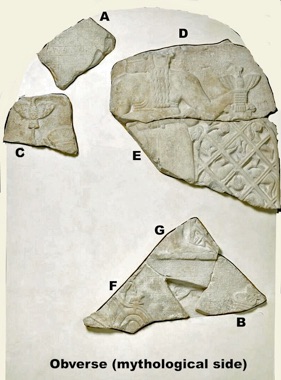
Surviving fragments from the obverse of the two-sided ‘Stele of the Vultures’ from the Temple of Ningirsu at Girsu,
now in the Musée du Louvre (AO 50): images from the museum website (my additions in black)
The important ‘Stele of the Vultures’ (illustrated above) is known from seven fragments (A-G, exhibited in the Musée du Louvre as AO 50) of what was originally a huge limestone stele:
✴fragments A-F were excavated at the site of the Temple of Ningirsu at Girsu; and
✴fragment G, which clearly belonged to this stele, subsequently emerged in London and was re-united with the other fragments in Paris.
All of these fragments carry reliefs and inscriptions on both sides. As Renate van Dijk-Coombes (referenced below, at pp. 198-9) observed, when these fragments were laid out in what would have been their respective positions, it became obvious that the stele had what might be dubbed:
✴a historical side that is divided into four registers, in which the reliefs illustrate a battle and its aftermath; and
✴a mythological side (see the illustration above), in which the reliefs depict the imagined actions of two deities thereafter.
The inscription (RIME 1.9.3.1; CDLI, P431075) on each of the vertical edges identifies:
“Eanatum, kur gu2 gar-gar (the subjugator of the lands of Ningirsu)”, (lines 630’-632’ and 633’-635’).
The stele owes its modern name to the relief on the reverse of Fragment A, which depicts a flock of vultures carrying off the remains of fallen enemy soldiers (which would have represented the final scene in the ‘historical’ sequence).
Reliefs on the Mythical Side of the Stele
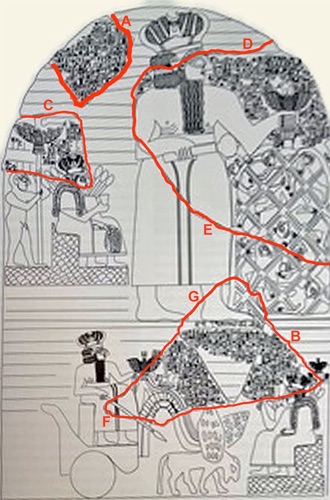
✴in the upper register;
•the large male figure standing at the centre (who holds a mace in his right hand and, in his left hand, holds a battle-net full of naked prisoners of war that is topped by Ningirsu’s emblem, the Anzu bird, is almost certainly Ningirsu himself; and
•the small head of the figure behind him (who in his reconstruction, is enthroned in front of a battle standard) belonged to the goddess Ninhursag; and
✴in the lower register:
•the chariot was probably driven by Ningirsu (albeit that only part of his skirt now survives); and
•the small head to the right probably belonged to the same goddess as the one in the upper register.
I discuss the evidence for the identity of this goddess below.
Identity of the Goddess of Fragments B and C
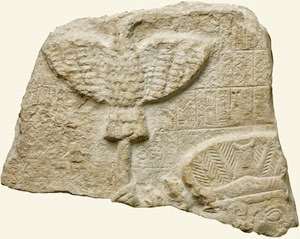
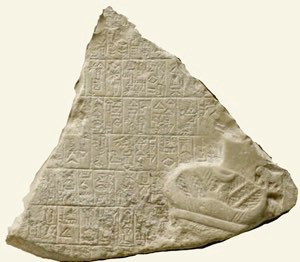
Details of obverse fragments C (left) and B of the ‘Stele of the Vultures’, both depicting the head of a goddess
Now in the Musée du Louvre (AO 50): images from the museum website
Sebastien Rey (referenced below, at p. 247) argued that, although the goddess in these fragments is usually depicted as standing (see, for example, the drawing by Elizabeth Simpson, reproduced in Irene Winter, referenced below, Figure 3, at p. 13):
“... it should probably be assumed that [she] was shown seated, possibly on a throne decorated [with symbols of her usual attributes].”
He also described the surviving iconographic clues to the identity of this goddess:
✴her distinctive crown, which he described as:
“... a Thunderbird crown, decked with a lion-headed eagle [often referred to as ‘the Anzu bird’]; and
✴the mace heads that were originally behind her shoulders (see the surviving mace behind her head in both fragment B (in which she is looking left) and fragment C.
He also noted that, in fragment B, the:
“... small passant left-facing lion ... might suggest part of a temple façade or (perhaps less likely), a canopy ...”.
As noted above, Rey argued (at pp. 246-7) that this goddess was probably Ninhursag (the mother of Ningirsu). He therefore suggested that, since she was probably seated, she was:
“... possibly [depicted on a] throne decorated with pebble-like rock forms to represent the mountain with which she is associated”, (see p. 247).
He explained (at p. 246) his reason for this identification as follows:
“Ninhursag, [whose name means] ‘the Lady of the Mountain’, is closely associated with her son in all myths relating to the warrior god, and, [in both fragments B and C, she wears a Thunderbird crown, [the Thunderbird = Anzu, an emblem of Ningirsu], while, in fragment C, the association is further strengthened by the addition of a standard topped with another Thunderbird or possibly an eagle.”
However, it seems to me that the evidence from surviving myths is not particularly myths that do survive.useful for the events of a reign as early as that of Eanatum and, in any case, Ninhursag is more commonly associated with Enki in the myths that do survive. Furthermore, the evidence from the standard in fragment C is very weak: as Piotr Steinkeller (referenced below, 2019, note 63, at p. 1001) observed:
“... as clearly shown by [published photographs of obverse fragment C, including the one reproduced above], the head [of the bird on this standard behind the goddess] is distinctly different [from the Anzu bird closing the net in obverse fragment E].
The Inscription on the Stele
The inscription (RIME 1.9.3.1, P431075) that surrounds the figures on both sides of the stele deals principally with a border dispute between Lagash and Umma. It begins on the obverse of fragments A, D and C. Only a single isolated phrase survives from the opening passage:
“... he reduced its subsistence rations, he reduced its grain rent”, (lines 1’-4’).
As we shall see from what follows, we might reasonably assume that ‘he’ was the ‘Man of Umma’, and that he was deemed to have broken the terms of a commercial undertaking between Umma and Lagash. This is followed by a broken but reasonably coherent passage:
“The king of Lagash ... the Man of Umma committed an aggressive act ... and [approached ?] the frontier of Lagash. Akurgal, king of Lagash, the son of Ur-Nanshe, king of Lagash ...’’, (lines 5’-20’).
Thus, it seems that, after a period of increasing tension, Akurgal led the army of Lagash against the invading army of Umma (apparently while his father was still alive). The following text is again broken, but it seems that Akurgal succeeded in bringing the situation under control.
The next episode begins (at line 21’) when the Man of Umma re-opens hostilities, causing Ningirsu to exclaim into the wind that this sacrilegious mortal is threatening:
“... my own possessions in the field of the Gu'edena”, (lines 32’-37’).
Faced with this defiance:
“... Ningirsu ... implanted the semen for Eanatum in the womb ... [and] rejoiced over him.
✴Inanna stood beside him and named him ‘[the one who is] fitting for the Eanna of Inanna of the Ibgal’.
✴Inanna set him on the right knee of Ninhursag, [who] suckled him.
✴Ningirsu rejoiced over Eanatum.
✴Ningirsu, the one who had implanted his semen in the womb, laid his ... [gigantic hand] upon him.
Ningirsu, with great joy, [granted him] nam-lugal (the kingship) of Lagash”, (RIME 1.9.3.1, P431075, lines 40’-82’).
In short, in order to deal with the latest outrage from Umma, Ningirsu miraculously:
✴ensured the birth of a hero who is:
•named (as Eanatum) by Inanna; and
•suckled by Ninhursag; and
✴grants him the kingship of Lagash.
After much repetition of Eanatum’s divine credentials and his cursing of the sacrilegious ensi of Umma, Ningirsu appears to him in a dream:
“As Eanatum lay sleeping, his beloved king, Ningirsu, came to stand by his head ... [and told him that]:
‘Umma, like Kish, shall ... wander about and, by means of ones seized by anger(?), shall surely be removed. ... I shall smite [the enemy soldiers] and make their myriad corpses stretch to the horizon. ... [The people of Umma] shall raise a hand against [their leader] and, in the heart of Umma, they shall kill him. Ush/Ushurdu] by name ...”, (lines 121’-152’).
This suggests that Kish was allied with Umma and that Ningirsu promised Eanatum that this allied army was doomed to defeat, and that the ensi of Umma would be killed by his own subjects (which is presumably what happened, although the actual account of the battle at lines 153’-168’ is too lacunose for us to be sure). We then read that, after the promised victory:
“Eanatum, a man of just words, marked off the border territory, which [or some of which ??] he left under the control of Umma, [and he] erected a stele in that place”, (lines 169’-176’: see also the translation by Jerrold Cooper, referenced below, at p. 45.]
We then read that::
“[Eanatum then] defeated the Man of Umma ... and heaped up 20 burial mounds there [on the boundary mound named Namnunda-kigara ??]”, (lines 177’-181’);
Jerrold Cooper (referenced below, at p. 26) argued that this probably indicates that fighting with Umma resumed later in Eanatum’s reign, and that he claimed a second victory. Finally. in this part of the text, we read that:
“Eanatum obliterated many foreign lands for Ningirsu. He returned to Ningirsu the Gu’edena, his beloved field”, (lines 187’-194’).
In the rest of the text on the obverse and at the start of the text on the reverse, Eanatum forces the Man Umma to swear on the battle nets of a series of deities that he would respect the terms of an agreement as to the location of the border and the use of the border territories, after which he sent messenger doves to relate the agreed term to:
✴Enlil, king of heaven and earth, at the Ekur in Nippur (lines 263’-267’);
✴‘my mother’, Ninhursag at Kesh, (lines 315’-318’);
✴Enki, king of the Abzu, (lines 368’-372’);
✴Sin, ‘my king’, the impetuous calf of Enlil, (lines 428’-438’); and
✴Utu, king of vegetation, at the Ebabbar at Larsa, (lines 488’-490’).
This is followed by another ‘divine pedigree’, followed by a list of other military successes:
“Eanatum, king of Lagash:
✴given strength/power by Enlil;
✴fed wholesome milk by Ninhursag;
✴given a good name by Inana;
✴given wisdom by Enki;
✴chosen by the heart of Nanshe, the powerful mistress;
✴kur gu2 gar-gar (the subjugator of the lands of Ningirsu);
✴the beloved of Dumuzi-Abzu;
✴nominated by Hendursag;
✴beloved friend of Lugaluru;
✴beloved husband of Inanna;
defeated:
✴Elam and Subartu, the lands of timber and goods;
✴now-unknown locality;
✴Susa;
✴Arawa/Urua, [even though ?] its ruler had set up its standard at the head [of its army ?];
✴ [several lines missing];
✴Arua, which he obliterated; [and ?]
✴the [leader of ??] k-ien-gi (= Sumer ?), Ur ...”, (lines 564’-605’).
(It is unclear why Eanatum uses the title lugal in this inscription, rather than the usual title ensi.)
Interestingly, Kish is also referred to on one of the surviving fragments of this stele: we read that, as Eanatum lay sleeping, ‘his beloved king, Ningirsu’ appeared to him in a dream to reassure him that:
“Umma, like Kish, shall therefore wander about, and by means of ones seized by anger(?), shall surely be removed”, (obverse, lines 124’-136’).
This seems to suggest that Kish was allied with Umma at this time, which might explain why (according to the Eanatum Boulder):
✴Kish subsequently ‘trembled before’ Eanatum; and
✴Inanna, who loved him, ‘gave him the kingship of Kish’.
In this context, we should also consider another inscription of Eanatum (RIME 1.9.3.10, P431085), which is on a fragmentary vase from Lagash that is now apparently in the Iraq Museum) records Eanatum’s construction of a structure for Ningirsu that he dubbed the E-za (Stone House):
“For the god Ningirsu, warrior of the god Enlil: Eanatum, ensi of Lagash:
✴á-sum-ma (granted power by) Ningirsu;
✴[the one] who restored to Ningirsu his beloved Gu’edena;
✴[the one] who subjugates the lands for Ningirsu;
... built the E-za (Stone House) for the god Ningirsu out of silver and lapis lazuli. He [also] built for him a storehouse, a building of alabaster stone, and amassed piles of grain for him (there). Eanatum:
✴[the one to whom] Ningirsu granted the gidru (sceptre).
His personal god is Sul-MUSHxPA.”
Eanatum and Inanna

Image of goddess with similar iconography to the goddess on the ‘Stele of the Vultures’
Now in the Staatliche Museen, Berlin (VA 7248): image from website of the Morgan Library
As we have seen, Renate van Dijk-Coombes (referenced below, at p. 201) argued that the goddess depicted in both of the registers on the obverse of the ‘Stele of the Vultures’ (fragments B and C, illustrated above) is probably Ninhursag or possibly Inanna (and she pointed out, at note 8, that she is sometimes identified as Nisaba).
The relevant iconographic evidence for this identification is provided by the two other reliefs that are illustrated above:
✴that on one side of an inscribed limestone stele from Lagash that is now in the Iraq Museum (IM 61404), which dates to the reign of Ur-Nanshe, Eanatum’s grandfather; and
✴that on a fragment of an inscribed stone vessel that is now in the Staatliche Museen, Berlin (VA 7248), which almost certainly came from Lagash or Girsu and dates to the reign of Enmetena, Eanatum’s nephew.
Ur-Nanshe is depicted on the other side of the first stele. identified by inscription (RIME 1.9.1. 6a, P431039) as:
“Ur-Nanshe, son of Gu-NI.DU), ensi of Lagash, [the one who] built the Ibgal (= great oval temple of Inanna at Girsu).”
He is accompanied on this face of the by a cup=bearer and, below them, his wife and daughter, all identified by inscription. Most of the other inscriptions on both sides of the stele are now lacunose and largely illegible, although the first line duplicates the inscription identifying Ur-Nanshe as the builder of the Ibgal, which suggests that the enthroned goddess depicted on the opposite side in Inanna. Giovanni Lovisetto (referenced below, at p. 55) observed that she:
“... holds a branch of dates [in her right hand] and possibly a cup, while her extraordinarily long and voluminous hair falls from a (possibly horned) headdress over her shoulders.”
The inscription (RIME 1.9.5. 25, P431142) on the Enmetena vase reads:
“... he [= Enmetena] built E-engur of Zulum for [the goddess Nanshe: he built Abzu-pasira for the god Enki, king of Eridu; [he built the giguna [for] goddess Ninhur[sag]; ... when ... had been granted [presumably by a goddess], he, [Enmetana] set up (this) bur-sag vessel for her.”
Inanna is mentioned in some of the surviving fragments of the inscribed text:
✴as Pirjo Lapinkivi (referenced below, at p. 20) pointed out, Eanatum is referred to as the dam kiag2 (beloved spouse) of Inanna (at reverse, lines 586’-587’); and
✴she is also referred to (at obverse, lines 56’-60’) as:
“Inanna, [who] ... named -Eanatum] as:
‘[the one who is] fitting for the E-anna of Inanna of the Ib-gal (‘great oval’ [temple])”.
This is a reference to a temple excavated at at Lagash that had an outer oval-shaped walled court, which is known from inscribed foundation figurines as the Ibgal of Inanna (see, for example, Paul Collins, referenced below, at p. 105).
Eanatum’s Other Victories
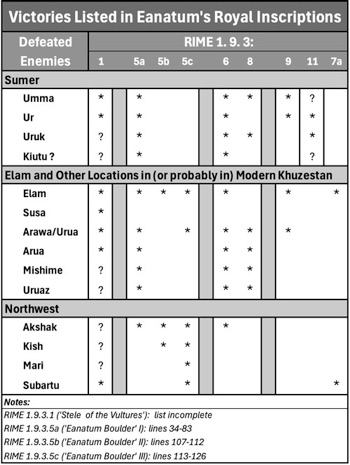
See Stefano Seminara (referenced below) and Piotr Steinkeller (referenced below, 2018, at p. 180)
for the relevant geographical locations
The table above summarises the victories that Eanatum claimed in his surviving royal inscriptions, allocated into geographical regions largely on the basis of the analyses of Stefano Seminara (referenced below) and of Piotr Steinkeller (referenced below, 2018, at p. 180). Note that:
✴the list from the inscription on the reverse of the ‘Stele of the Vultures’ (RIME 1.9.3.1, discussed above) is inevitably incomplete; and
✴the list from the inscription on the so-called ‘Eanatum Boulder’ (RIME 1.9.3.5.discussed below) is split into three consecutive parts, since, some defeated enemies appear in this inscription more than once.
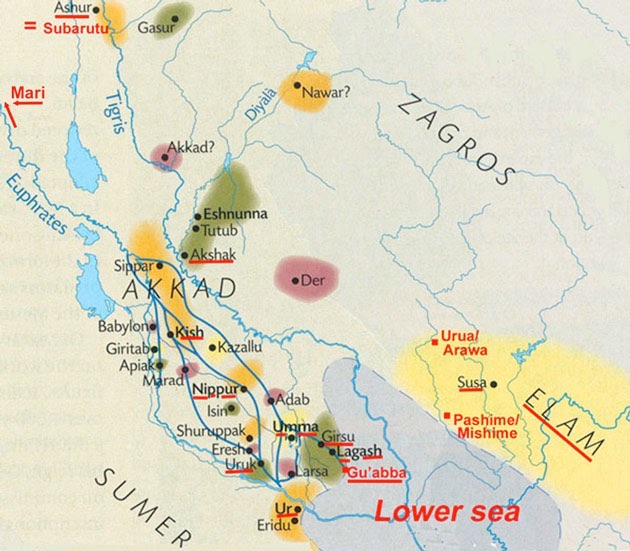
Mesopotamia and its neighbours in the 3rd millennium BC
Adapted from Sébastien Rey (referenced below, 2019, at p. 31): my additions in red
The map above illustrates the geographical extent of Eanatum’s claimed victories, which encompasses:
✴the Mesopotamian valley, from Subartu and Mari to Uruk and Ur; and
✴the lowland plain east of the Tigris, between what was then the ‘Lower Sea’ and the Zagros mountains.
‘Eanatum Boulder’
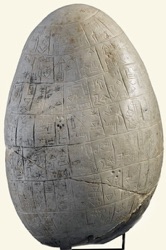
‘Eanatum Boulder’, from Girsu (now in the Musée du Louvre: AO 2677)
Image from the museum website
The inscription on the so-called ‘Eanatum Boulder’ (RIME 1.9.3.5; CDLI, P431079) which is known from two examples (one on the boulder from Girsu illustrated above and another from Lagash, which is now in the Iraq Museum) contains the most comprehensive list of Eanatuum’s known victories (see the table above). More specifically:
lines 34-83 (see column RIME 1.9.3.5a) contains an essentially complete list of Eanatum’s victories in:
Sumer; and
Elam; and
lines 107-126 (see columns RIME 1.9.3.5, b and c) contains the fullest of the surviving accounts of his victories in the Northwest.
Victories in Sumer
The list of victories in the ‘boulder inscriptions’ begins with Eanatum’s defeats of Elam and Arawa/ Urua (discussed below). The inscription the records that:
“Eanatim defeated Umma and made 20 burial mounds.
He returned to Ningirsu his beloved field, the Gu'edena.
He defeated Uruk.
He defeated Ur.
He defeated Kiutu” (lines 45-58).
Although the location of Kiutu is uncertain. it is usually assumed to have been in Sumer (see, for example, Stefano Seminara (referenced below, at p. 160). As we have seen, Eanatum’s defeat of Ur is recorded in a now-lacunose passage of the ‘Stele of the Vultures’:
“... defeated [GN], and destroyed Arua.
... Kiengi (the land of Sumer).
He defeated U[r].
[Lacuna of about 19 lines]”, (lines 599’-605’).
None of our surviving sources provides the context for Eanatum’s victories over any of Uruk, Ur and Kiutu, but it is reasonable to assume that they were all allies of Umma during its territorial dispute with Lagash. In other words, it is likely that all of these ‘victories’ in Sumer were purely defensive.
Victories over Elam
As set out in the table above, Eanatum recorded a victory over ‘Elam’ on 7 occasions in his surviving royal inscriptions:
✴in the inscription (RIME 1.9.3.5; CDLI, P431079) on the ‘Eanatum Boulder’:
•he defeated “Elam, the lofty mountain, and heaped up tumuli”, (lines 34-8);
•“Elam trembled before [him] (and) he drove the Elamite back to his own land”, (lines 107-9); and
•he defeated “Elam, Subartu and Arawa/ Urua at the Asuhur”, (lines 118-21); and
✴in other inscriptions, he defeated/subjugated:
•“Elam and Subartu, mountainous lands of timber and treasure”, (RIME 1.9.3.1; CDLI, P431075, lines 588’-590’);
•“Elam, the lofty mountain and heaped up tumuli”, (RIME 1.9.3.6; CDLI, P431080, lines 37-41; and RIME 1.9.3.8, P431083, at lines 24-8);
•“[Elam] and Subartu”, (RIME 1.9.3.7a, CDLI; P431081), lines 7-8; and
•the mountain land of Elam (RIME 1.9.3.9, CDLI; P431084, lines 15-6).
In these inscriptions, the locality translated as ‘Elam’ is indicated by the sign ‘NIM’: according to François Dessset (referenced below, at p. 1):
“The sign NIM, used with a topographic value [rather than applied to a person or an object] is first attested without any doubt, [in] Eanatum inscriptions.”
He expanded on this (at p. 4) as follows:
“A new function appeared [for the sign NIM] in the archives of Lagash, first of all in the inscriptions of Eanatum, [and, explicitly, in RIME 1.9.3.9, in which] the sign NIM [was combined] with a territory, KUR (country / mountain) [in the phrase] KUR NIMki (the mountain land of Elam). ... NIM seemed to be linked to a topographical reality, [created by the] Mesopotamians, ... by qualifying [a previously unnamed KUR (country/ mountain)] with a sign traditionally associated with persons. The territory thus defined probably corresponded to a general concept: the eastern highlands.”
Piotr Steinkeller (referenced below, 2018) similarly observed that:
“As employed in 3rd millennium sources, the designation [NIM = Elam] generally excludes Khuzestan ... where the [lowland] cities of Susa, Arawa (Uru’a), Uru’az, AdamDUN, Awan and Mishime (Pashime) were located. However, already in the Early Dynastic IIIb sources from Lagash, Elam is occasionally used as a broad description of the entire eastern lank of southern [Mesopotamia]. Since [this] period, if not earlier, Elam also served as a general and convenient label for the dwellers of the Iranian highlands, meaning ‘highlander’ or the like.”
Piotr Steinlkeller (referenced below, 2018, at p. 180) interpreted the surviving evidence for Eanatum’s victories in this region as follows:
“... [E-anatum conducted] military operations against Susa and a number of other cities located in Khuzestan, among them: Arawa/ Uru’a; Uru’az; and Pashime/ Mishime. Since [he] claims to have sacked and destroyed the latter cities, it appears certain that he actually campaigned in the Susiana. In the same inscriptions, [he] also repeatedly boasts of having defeated ‘the land of Elam’ and to have subjugated it ... to the god Ningirsu”.
Apparently, this engagement was part of a larger war, which was
waged against the city- state of Lagash by a coalition consisting of Akshak, Kish, Mari,
Elam, Shubur and Arawa (Frayne 2008: 145–152, E-anatum 5 and 6). This coalition
invaded Lagash’s territory, with one of the battles, specifically involving Elam, Shubur
and Arawa, having been fought at a Lagash location called Asuhur. The defensive
nature of this engagement is revealed by E-anatum’s own testimony, according to
which “he sent the Elamite back to his land” (Frayne 2008: 145–149, E-anatum 5 vi
8).11 It is possible that this conlict with Elam was causally connected with the aforementioned
campaign in Khuzestan, with the latter event having been a consequence
of E-anatum’s successful repulsion of the foreign armies from the city- state of Lagash.
Eanatum’s defeats of Elam and Arawa/ Urua
Urua, and he killed its ruler;
Mishime, [which] he destroyed; and
Arua, [which] he obliterated.
All the lands trembled before Eanatum, the one nominated by Ningirsu,. In the year that the king of Akshak rose up, Eanatum, the one named by Ningirsu, drove Zuzu, the king of Akshak, from the Antasura [temple] of Ningirsu to Akshak, which he destroyed”, (RIME 1.9.3.5; CDLI, P431079, lines 35-83).
The second list began with the information (known from no other source) that:
“Because Inanna so loved Eanatum, ... [she] gave him the nam-lugal (kingship) of Kish in addition to the nam-ensi2 (rulership) of Lagash”, (lines 98-107).
It is then recorded that:
“Elam trembled before Eanatum; he drove the Elamite back to his own land.
Kish trembled before Eanatum.
He drove the king of Akshak back to his own land”, (lines 107-112).
The third list immediately followed:
“For Ningirsu: Eanatum, ensi of Lagash, who subjugates kur-kur (the foreign lands) for Ningirsu, defeated:
Elam, Subartu and Urua at the Asuhur [canal]; and
Kish, Akshak and Mari at the Antasura [temple] of Ningirsu”, (lines 113-126).
Eanatum’s Victories
Interestingly, Kish is also referred to on one of the surviving fragments of this stele: we read that, as Eanatum lay sleeping, ‘his beloved king, Ningirsu’ appeared to him in a dream to reassure him that:
“Umma, like Kish, shall therefore wander about, and by means of ones seized by anger(?), shall surely be removed”, (obverse, lines 124’-136’).
This seems to suggest that Kish was allied with Umma at this time, which might explain why (according to the Eanatum Boulder):
✴Kish subsequently ‘trembled before’ Eanatum; and
✴Inanna, who loved him, ‘gave him the kingship of Kish’.
In this context, we should also consider another inscription of Eanatum (RIME 1.9.3.10; CDLI, P431085), which is on a fragmentary vase from Lagash that is now apparently in the Iraq Museum) records Eanatum’s construction of a structure for Ningirsu that he dubbed the E-za (Stone House):
“For the god Ningirsu, warrior of the god Enlil: Eanatum, ensi of Lagash:
✴á-sum-ma (granted power by) Ningirsu;
✴[the one] who restored to Ningirsu his beloved Gu’edena;
✴[the one] who subjugates the lands for Ningirsu;
... built the E-za (Stone House) for the god Ningirsu out of silver and lapis lazuli. He [also] built for him a storehouse, a building of alabaster stone, and amassed piles of grain for him (there). Eanatum:
✴[the one to whom] Ningirsu granted the gidru (sceptre).
His personal god is Sul-MUSHxPA.”
As we saw above, the text on a number of Eanatum’s other inscriptions (including the ‘Eanatum Boulder’) also recorded that Eanatum had repelled at least one incursion from Umma in order to return to Ningursu his ‘beloved field’, the Gu'edena. However, the surviving text on the ‘Stele of the Vultures’ adds to our understanding of these events (at least as interpreted by Eanatum). As Jerrold Cooper (referenced below, at p.26) observed, although much of the original text on the stele is now lost, the surviving account of the events leading up to the battle in which Eanatum ‘liberated’ the Gu'edena is:
“... well preserved and rather remarkable”.
This figure takes its name from an Akkadian legend in which Ningirsu killed the Anzu bird. However, since this legend is known from only two texts from Susa that date to the Old Babylonian Period (ca. 2000 BC), we cannot simply assume that the this text corresponds directly to the oral tradition that must have been reflected in the iconography some 5-7 centuries earlier. For example, Chikako Watanabe (referenced below, at p. 32) has recently analysed the evolution of the iconography of the lion-headed eagle in early Mesopotamia:
“The lion-headed eagle, which comprises a bird of prey with the head of a lion, appears in the earliest pictorial representations shown in seal impressions which date back to the Uruk period. In this early period, the creature is represented in profile flying over captured enemies with wings stretched upright and head lowered; ... During the Early Dynastic period the lion-headed eagle was depicted in frontal view with wings and legs spread wide to stand over a pair of animals, such as
ibexes;
stags; or
lions.
[Frans Wiggermann (referenced below, at pp. 161-2)] identified the lion-headed eagle as Anzu and, when the creature is combined with the pairs of animals, they were thought to be associated with:
the god Enki in the case of the ibex [source ??]’
the goddess Ninhursag, in the case of the stag [see the relief BM 114308 at the Britiosh Museum, from the Temple of Ninhursag at Ur]; and
the god Ningirsu in the case of the lion.
The creature is also depicted on the ‘Stele of the Vultures’ together with a pair of lions’ heads, which are represented below the lion-headed eagle, on top of a net. The net contains naked enemies of Girsu; a large male figure grasps the tail feathers of the lion-headed eagle.
Anzu
A third important iconographical figure of this side of the stele is the so-called Anzu bird, which appears in:
✴in at least three places (marked A in the drawing above), as an emblem of some sort on:
•a battle standard;
•the top of Ningirsu’s battle-net; and
•adorning his chariot; and
✴as a lion’s head surrounded by feathers in the so-called ‘Anzu crown’ of both. figures of the goddess (marked a in this drawing).
As we have seen, this figure:
✴may have been reflected in the archaic ‘Feathered Figure Plaque’; and/or
✴was certainly represented on two earlier objects from Lagash/Girsu:
•the mace of Mesalim; and
•the so-called ‘Plaque of the Anzu Bird’ of Ur-Nanshe.
I discuss the identity of the goddess wearing the ‘Anzu crown’, the iconographical significance of the Anzu bird and its association with Ningirsu below.
It is difficult to know what Eanatum gained from these many and widespread victories recorded in these inscriptions: while we can imagine that they brought him both booty and prestige (and perhaps the right to tribute and military conscripts on an on-going basis), the extent of his political influence over the conquered cities is unclear. As noted above, Aage Westenholz (referenced below, 2020, at pp. 697-8) argued that Eanatum’s victories over cities that were far from Lagash does not prove that he established anything approaching a Sumerian state, centred on Lagash. While this is certainly true, it does seem to me that Eanatum’s claim that:
✴Inanna had given him the kingship of Kish; and
✴Kish had ‘trembled before him’;
does suggest that he had established hegemony over Kish for a period after his victory. Indeed, it is tempting to suggest that sought to present himself as a ‘new Mesalim’. Nevertheless, it seems that any such eminence was short-lived, since nothing in the surviving evidence suggests that any subsequent ruler of Lagash claimed the title ‘king of Kish.
Note Eanatum received the sceptre from Ningirsu
Enanatum
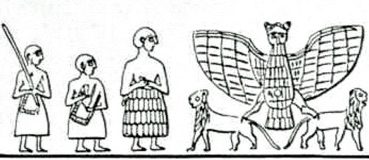
Sketch of the relief on a mace-head dedicated for the life of Enanatum (RIME 1.9.4,19, P431115)
The mace-head, which probably came from Girsu, is now in the British Museum (BM 23287)
The sketch is from Jean Evans (referenced below, Figure 28, Cat. 35, at p. 76)
The sketch illustrated above summarises the iconography on a mace head that carries an iscription that reads as follows:
“To Ningirsu of the E-ninnu [sanctuary of Ningirsu at Girsu]: the workman of Enanatum, ensi of Lagash, named) Barakisumun (who was) the minister (sukkal), dedicated (this mace-head) for the life of Enanatum his master”.
Douglas Frayne (referenced below, 2008, at p. 191) assigned this object to the reign of Enanatum I, the grandson of Ur-Nanshe, who had succeeded his brother, Eanatum. Jean Evans (referenced below, at p. 76) suggested that the largest of the three figures who approach the Anzu bird from its right is probably Barakisumun and noted that he is followed by a two smaller figures, one carrying a vessel for libation and the other clasping a large staff. Sébastien Rey (referenced below, at p. 176) argued that in this iconography, offerings are brought to the Anzu bird, who therefore explicitly acts as Ningirsu’s avatar.
Enmetena
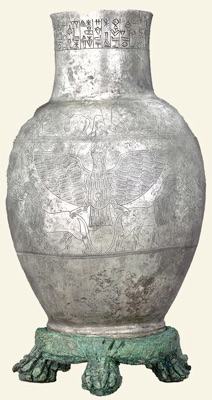
Silver vase of Enmetena, ensi of Lagash, from the temple of Ningirsu at Girsu,
now in the Musée du Louvre (exhibit AO 2674)
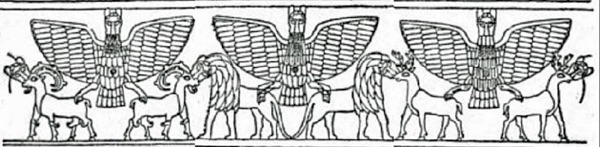
Drawing of the central image above and those that flank it, from the website of ‘Old European Culture’
Interestingly, Enmetena (and hence, presumably, Mesalim):
✴regarded Enlil, the city-god of Nippur, as the ‘father/elder of all the gods’; and
✴naturally assumed that he had authority over the lesser gods Ningirsu and Shara in the matter of the location of the border between their respective territories (albeit that he delegated the matter of the execution of his commands to Ishtaran). As Aage Westenholz (referenced below, 2020, at p. 696) observed:
“Mesilim is said to have acted in accordance with the [command of] ... Ishtaran, [who] was the divine protector of treaties, as indicated by the spelling of his name dKA.DI (god of just verdict).”
Dudu - RIME 1.9.5 28; CDLI, P431145. AO 2354
The second point to make is that the earliest surviving written evidence from Lagash that gives this creature a name and provides specific information about its iconographical meaning dates to the time of the second independent dynasty of Lagash (more than 200 years after the end of the first, in the window of about a century between the Akkadian and the Ur III empires).
First, we should address the confusing matter of the name of this hybrid creature. Sébastien Rey (referenced below, at p. 5) referred to it as:
“... Imdugud (or Anzu), the radiant Thunderbird himself”;
and it is often asserted that Imdugud and Anzu represent its name in Sumerian and Akkadian respectively. Thus, for example, Anne Rebekka Øiseth (referenced below, at p. 28) referred to:
“The terrifying Imdugud bird, usually translated as Thunderbird (and also commonly referred to by its Akkadian name Anzu) ...”
However, as Herman Vanstiphout (referenced below, note 33, at p. 18), for example, observed that:
“The reading of the name of this supernatural bird is still a matter of controversy among specialists.”
His primary concern was with the Sumerian text known as the ‘Matter of Aratta’, which probably dates to the Ur III period, ca. 2100–2000 BC, in which:
“... it is written consistently as IM.DUGUD (‘heavy (storm) cloud’), so that ‘Thunderbird’ seems to be an adequate translation. Still, the consensus is now that it was read as [Anzu(d)], with no known etymology or explanation. In reading ‘Anzud’ [in this translation], I bow to the collective wisdom and arguments of the majority, but I remain convinced that the scribes were thinking of a heavy storm cloud every time they wrote the signs.”
Chikako Watanabe (referenced below, at p. 33), who explicitly avoided ‘the philological argument around the name Imdugud/Anzu observed that it:
“... consists of four signs: AN. IM. DUGUD. and MUSHEN meaning literally:
‘the bird (mushen) of heavy cloud/fog (im.dugud = imbaru ) in the sky (an)’;
which suggests a close association with thick cloud.
In what follows, I shall simply use the word ‘Anzu’ and refrain from relying on philology in the quest to understand what this creature signified in Lagash in the 3rd millennium BC.
As we shall see, although the surviving evidence indicates that many of the other kings of the first dynasty of Lagash (besides Enmetena) commissioned images of the Anzu, its symbolic importance at Lagash and Girsu both pre-dated and post-dated them. For example:
✴King Mesalim of Kish (who exercised hegemony over Lagash and Girsu before the emergence of the first independent dynasty of this city-state) commissioned a ceremonial mace for the temple of Ningirsu at Girsu on which the Anzu was prominently depicted; and
✴Gudea (who belonged to the second dynasty of Lagash) made several references to the Anzu in his commemorations of his rebuilding of this temple.
I discuss all of this evidence in detail below: for the moment, we should note that Enmetana’s silver vase is particularly important for our present analysis because it contains no fewer that four complete images of the Anzu, hovering above pairs of three different animals:
✴twice above a pair of lions (once on the surface shown above and once on the surface behind it);
✴once above a pair of ibexes (to the left in the drawing above); and
✴once above a pair of stags (to the right in the drawing).
These images therefore offer a particularly useful starting point for our analysis of the way in which the Anzu was perceived at Lagash in the middle of the 3rd millennium in BC.
He also noted that:
the stags under an Anzu on the relief from the Temple of Ninhursag at Ur] are the symbolic animals of that goddess (Gudea CyL B X 4, Frg. 5 ii, cf. Heimpel RIA 4 420).
[the] ibex belongs to Enki, who is called dàra-kù- abzu (Gudea Cy/ AXXIV21) and dDàra-abzu (TCL XV10:77,cf.
Green Eridu 194).
The point here is that, as he summarised (at p. 161):
“The Anzu ... is not Ningirsu's symbol, nor that of any of the other gods with whose symbolic animal it is combined. It represents another, more general power, under whose supervision they [i.e., the symbolic animals of particular deities] all operate. This higher power can only be Enlil, [= the chief deity of the Mesopotamian pantheon at this time].”
Interestingly, each of the four lions on the vase is shown attacking the adjacent ibex or stag. Sébastien Rey (referenced below, at p. 296) suggested that this might have been meant to convey:
“...the power that Lagash wielded over [the localities represented by the ibexes and the stags], with the dominant [Anzu] stressing that the exercise of such power is subject to the god’s favour, as is the city-state’s on-going prosperity.”
If we combine this hypothesis with that of Frans Wiggerman, then the iconography on the vase would have represented the power that Ningirsu and Enmetena, as delegates of Enlil, wielded over the localities represented by the ibexes and the stags. It seems to me that the geographical locations of these localities might be found in the inscription (RIME 1.9.3.1, P431075) on the so-called ‘Stele of the Vultures’, which was commissioned by Enmetena’s uncle, Eanatum, to commemorate his victory in a border dispute with his neighbours at Umma:
✴we read here that, after this victory, Eanatum obtained an oath of compliance from the vanquished ‘Man of Umma’ that was sworn on by the lives of Enlil, Ninhursag, Enki and three other deities; and
✴copies of the first three of these oaths were sent by carrier pigeon to, respectively:
•Enlil, king of heaven and earth, in the Ekur at Nippur (lines 263’-267’);
•Ninhursag, his mother, at Kesh (lines 315’-319’); and
•Enki, king of Abzu, at Abzu, which probably indicates Eridu (lines 359’-372’).
However, I acknowledge that there is no supporting evidence that Enmetena ever held power over either Kesh or Eridu.
However, since this legend is known from only two texts from Susa that date to the Old Babylonian Period (ca. 2000 BC), we cannot simply assume that the this text corresponds directly to the oral tradition that must have been reflected in the iconography some 5-7 centuries earlier. For example, Chikako Watanabe (referenced below, at p. 32) has recently analysed the evolution of the iconography of the lion-headed eagle in early Mesopotamia:
“The lion-headed eagle, which comprises a bird of prey with the head of a lion, appears in the earliest pictorial representations shown in seal impressions which date back to the Uruk period. In this early period, the creature is represented in profile flying over captured enemies with wings stretched upright and head lowered; ... During the Early Dynastic period the lion-headed eagle was depicted in frontal view with wings and legs spread wide to stand over a pair of animals, such as
✴ibexes;
✴stags; or
✴lions.
The creature is also depicted on the ‘Stele of the Vultures’ together with a pair of lions’ heads, which are represented below the lion-headed eagle, on top of a net. The net contains naked enemies of Girsu; a large male figure grasps the tail feathers of the lion-headed eagle.”
Chikako Watanabe (referenced below, at p. 34) observed that:
“From the beginning of the 2nd millennium, the storm god is shown more closely associated with another of his animal attributes, the bull. The lion dragon represents Anzû independently, and was at first depicted as a faithful divine servant, as described in the epic of Lugalbanda, in which Anzû makes the clouds dense and roars at the rising sun; the creature blocks enemy forces at the command of Enlil. In Gudea Cylinder A, Anzû is still described as a divine emblem in close association with the god Ningirsu, who is a local form of the divine hero Ninurta in the city-state of Lagash. However, some time during the Ur III period, the role of Anzû changed, and the creature is suddenly counted among the slain enemies of the god Ninurta.”
Steinkeller P., “Urukagina’s Rise to Power”, in:
Cohen Y. et al. (editors), “Drought will Drive You Even Toward Your Foe”, (2023) Leiden and Boston, at pp. 3-36
Seminara S., “The World According to E-anatum: The Narrative of the Events in E-anatum's Royal inscriptions”, 24 (2020) 151-65
Rey S., “Girsu: Home of the Thunderbird”, Current World Archaeology (2019)
Steinkeller P., “Babylonian Priesthood during the Third Millennium BCE: Between Sacred and Profane”, Journal of Ancient Near Eastern Religions, 19 (2019) 112=51
Steinkeller P., “The Birth of Elam in History”, in:
Álvarez-Mon J. et al. (editors), “The Elamite World”, (2018) Oxford and New York, at pp. 177-202
Desset F., “Here Ends the History of Elam: Toponomy, Linguistics and Cultural Identity in Susa and South-Western Iran (ca. 2400-1800 BC)”, Studia Mesopotamica, 4 (2017) 1-32
Marchesi G., “The Inscriptions on Royal Statues (Chapter 4)”, in
Marchesi G. and Marchetti N. (editors), “Royal Statuary of Early Dynastic Mesopotamia”, (2011) Winona Lake, IN, at pp. 155-86
Wang X., ”The Metamorphosis of Enlil in Early Mesopotamia”, (2011) Münster
Wazana N., “Anzu and Ziz: Great Mythical Birds in Ancient Near Eastern, Biblical, and Rabbinic Traditions”, Journal of the Ancient Near Eastern Society, 31:1 (2009) 111-35
Wiggerman F., “Mesopotamian Protective Spirits: The Ritual Texts”, (1992) Gröningen
References:
Pomponio F. “Did Ur-Nanše Defeat Ur?”, in:
Alivernini S. et al. (editors), “‘And I Have Also Devoted Myself to the Art of Music’: Ancient Near Eastern Studies in Honor of Franco D’Agostino, Presented on His 65th Birthday by His Pupils, Colleagues and Friends”, (2025) Münster, at pp. 3-14
Rey S., “The Temple of Ningirsu: the Culture of the Sacred in Mesopotamia”, (2024) University Park, PA
Goodman R., “A New Story of Sumer’s First Cities’, Expedition Magazine, 65:1 (2023) 30-3
Lovisetto G., “Goddesses Visualized in Early Dynastic Mesopotamia”, in:
Babcock S. and Tamur E. (editors), “She Who Wrote: Enheduanna and Women of Mesopotamia, ca. 3400–2000 BC”, (2022) New York, at pp. 46-63
Lecompte C., “A Propos de Deux Monuments Figurés du Début du 3e Millénaire : Observations sur la ‘Figure aux Plumes’ et l’a Prisoner Plaque’”, in:
Arkhipov A. et al. (editors), “Studies in Early Mesopotamia and Syria in Honor of Walter Sommerfeld and Manfred Krebernik”, (2020), Leiden and Boston, at pp. 417-46
Westenholz A., “Was Kish the Center of a Territorial State in the Third Millennium? - and Other Thorny Questions”, in:
Arkhipov I. et al. (editors), “The Third Millennium: Studies in Early Mesopotamia and Syria in Honor of Walter Sommerfeld and Manfred Krebernik”, (2020) Leiden and Boston, at pp. 686-715
Steinkeller P., “Texts, Art and Archaeology: An Archaic Plaque from Mari and the Sumerian Birth-Goddess Ninhursag”, in:
Chambon G. et al. (editors), “Mélanges Assyriologiques en l'Honneur de Dominique Charpin”, (2019) Leuven, Paris and Bristol CT, at pp. 977-1012
Watanabe Ch. E., “Composite Animals in Mesopotamia as Cultural Symbols”, in:
di Paolo S. (editor), “Composite Artefacts in the Ancient Near East: Exhibiting an Imaginative Materiality, Showing a Genealogical Nature”, (2018) Oxford, at pp. 31-8
Suter C., “On Images, Visibility, and Agency of Early Mesopotamian Royal Women”, in:
Lluis F. et al. (editors), “The First Ninety Years: A Sumerian Celebration in Honor of Miguel Civil”, (2017) Boston and Berlin, at pp. 337-62
van Dijk-Coombes R. M., “Lions and Winged Things: A Proposed Reconstruction of the Object on the Right of the Lower Register of the Mythological Side of Eanatum's Stele of the Vultures”, Die Welt des Orients, 47:2 (2017) 198-215
Marchesi G., “Toward a Chronology of Early Dynastic Rulers in Mesopotamia”, in:
Sallaberger W. and Schrakamp I. (editors), “Associated Regional Chronologies for the Ancient Near East and the Eastern Mediterranean. History and Philology: Vol. 3”, (2015) Turnhout, at pp. 139-58
Wilson K. L., “Bismaya: Recovering the Lost City of Adab”, (2012) Chicago IL
Frayne D. R., “The Royal Inscriptions of Mesopotamia, Vol. 1: Presargonic Period (2700-2350 BC)”, (2008) Toronto
Lapinkivi P., “The Sumerian Sacred Marriage and Its Aftermath in Later Sources”, in:
Nissinen M. and Uro R. (editors), “Sacred Marriages: The Divine-Human Sexual Metaphor from Sumer to Early Christianity”, (2008) University Park, PA, at pp. 7-42
Øiseth A. R., “With Roots in the Abzu and Crown in the Sky: Temple Construction Between Myth and Reality: A Study of the Eninnu Temple of the Gudea Cylinders as Divine House and Cosmic Link”, (2007) thesis of the University of Oslo
Vanstiphout H. L. J., “Epics of Sumerian Kings: the Matter of Aratta”, (2004) Leiden and Boston
Evans J., “Mace Head Dedicated for the Life of Enanatum", in:
Aruz J. and Wallenfels R. (editors), “Art of the First Cities: The Third Millennium BC, from the Mediterranean to the Indus”, (2003) New York, at pp. 75-6
Collins P., “The Sumerian Goddess Inanna (3400-2200 BC)”, Papers from the Institute of Archaeology, 5 (1994) 103-18
Postgate, J.N., “Early Mesopotamia: Society and Economy at the Dawn of History” (1994) London and New York
Winter I, J., “After the Battle Is Over: The ‘Stele of the Vultures’ and the Beginning of Historical Narrative in the Art of the Ancient Near East”, Studies in the History of Art, 16 (1985) 11-32
Cooper, J. S., “Reconstructing History from Ancient Inscriptions: The Lagash-Umma Border Conflict”, (1983), Malibu CA
de Sarzec E., “Découvertes en Chaldée: Second Volume Partie Epigraphique et Plances”, (1884) Paris