Empires of Mesopotamia:
First Dynasty of Lagash


Empires of Mesopotamia:
First Dynasty of Lagash
Prior History of Lagash
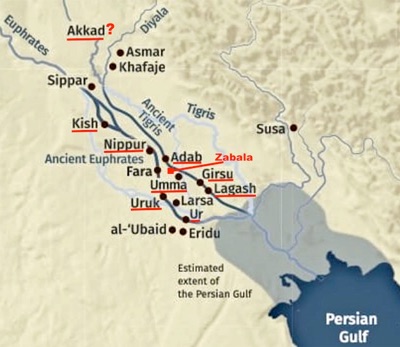
Map of Mesopotamia during the 3rd millennium BC
From the website of the Lagash Archeological Project: my additions in red
Origins of Lagash
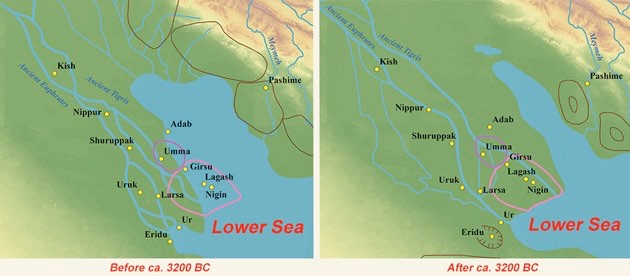
Image from Reed Goodman (referenced below, at p. 32); my additions in red
According to Reed Goodman (referenced below, at p. 32), recent studies of the hydrography on the site of ancient Lagash (as part of the program of excavations by a team from Penn Museum) have revealed that:
“The place where Lagash was first inhabited, [modern Tell al-Hiba] was underwater in the 4th millennium BC, indicating that people could not have settled there until long after the establishment of western cities on the Euphrates, like Ur and Uruk. By the time Lagash emerged from the water, around 3200 BC, it benefited from hundreds of years of cultural development in the western cities, such as the invention of the wheel, the cuneiform writing system and the institutions of formalised religion.”
Archaic Temple of Ningirsu at Girsu
As Sébastien Rey (referenced below, at p. 6) pointed out, although Ningirsu was the city-god of Lagash (modern al-Hiba), his name means ‘Lord of Girsu’. Furthermore, his earliest temple was at Girsu (modern Tello), some 25 km to the west, which seems to have served as its ‘religious capital’ of Lagash. Ernest de Sarzec discovered the site of Girsu in the late 1870s, when, as Rey observed (at pp. 10-11), the excavation of structures on what is now known as Tell K unearthed what:
“... turned out to be a series of shrines containing abundant religious accessories dedicated to Ningirsu that dated from around 3000 BC to 2300 BC. [These] first explorers had brought to light parts of the earliest temple complex devoted to the tutelary deity of Girsu ... [within] an expansive religious precinct [that] was constructed on a large artificial mound made of mud bricks, [so that it] was significantly raised above the surrounding flood plain.”
It became clear during the subsequent excavations that Tell K was the site of two separate temples:
✴the first (the so-called ‘Lower Construction’) seems to have been founded in ca. 3000 BC; and
✴the second, which was built above it some 500 years later by Ur-Nanshe, the earliest-known independent ruler of Lagash (see below), was razed to the ground in ca. 2300 BC, when this ‘Lagash I’ dynasty came to an end.
I will discuss, the Ur-Nanshe temple below: in this section, I will discuss three surviving objects that are associated with its archaic predecessor.
‘Feathered Figure’ Plaque
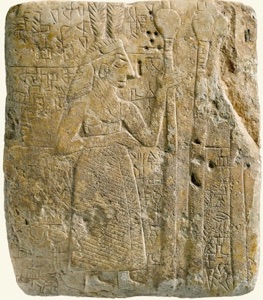
Relief of the ‘Figure aux Plumes’ (Feathered Figure) on an archaic inscribed plaque from Tell K
Now in the Musée du Louvre (AO 221), image from the museum website
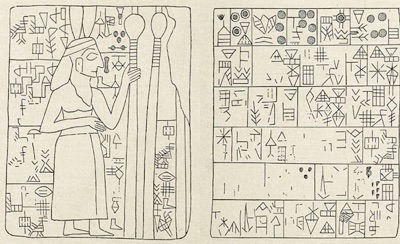
Sketch of both sides of the plaque above (from Wikimedia Commons)
The plaque illustrated above is one of the oldest objects discovered on Tell K: as Sébastien Rey (referenced below, at p. 181) observed, although the archeological context in which it was found is obscure:
“There is no doubt ... that it was originally housed in the ‘Lower Construction’ and was probably fashioned to commemorate [its] construction and inauguration.”
He dated both the ‘Lower Construction’ itself and the putative ‘foundation’ plaque to 2900-2800 BC, although he acknowledged that other datings have been suggested: for example, Camille Lecompte (referenced below, at p. 432) dated the inscription on the plaque (on palaeographic grounds) to 2750-2700 BC. One side of the plaque (usually dubbed the obverse) carries a shallow relief in which a male figure wearing distinctive headgear approaches an entrance defined by a pair of monumental maces. Rey argued that:
✴this figure represents Ningirsu himself and the maces mark the threshold to his temple (see p. 178); and
✴although the position of his hands relative to the maces is hard to establish, the likelihood is that he gestures with his free left hand toward this threshold (see p. 174).
One of the most distinctive features of this image is the nature of Ningirsu’s headgear: as Sébastien Rey (referenced below, at p. 175) observed:
“As soon as the [relief] was found, [this headgear] was interpreted ... as a crown with two large feathers ... Although this interpretation has been questioned, ... it is almost certainly the right one. ... The similarity between the chevron-like form of:
✴the ... feathers [of the lion-headed bird] on the top surface of the [much later mace-head of Mesalim - see below]; and
✴the decorative features of the headdress [of this figure of Ningirsu];
is particularly striking.”
In other words, since the feathers depicted on Mesalim’s Mace-head clearly belong to a bird, then the likelihood is that the very similar ‘decorative features’ on Ningirsu’s headdress are also bird feathers. Camille Lecompte (referenced below, at p. 435) also concluded from similar comparisons that:
“The headgear [of Ningirsu] could ... well turn out to be composed of feathers”, (my translation).
This evidence alone does not necessarily mean that the feathers on Ningirsu’s headdress would have been ‘read’ as those of a lion-headed bird, although, as Rey pointed out (at p 176), it would be:
“... no surprise [if] the sculptors of [this relief] drew on [an] inextricable link between Ningirsu and the [lion-headed bird] that went back to the most archaic times.”
He:
✴pointed out that (as we shall see) the lion-headed eagle remained at the heart of the iconography of Ningirsu at Lagash for centuries; and
✴argued that it cannot be coincidental that this creature was used to decorate at least two Mace-heads, since the mace was a symbol of Ningirsu’s aspect as ‘the heroic god of combat’.
Drawing all these thought together, he argued that the ‘iconographic triad’ used in the ‘Feathered Figure’ relief:
Ningirsu himself;
✴his crown, ‘decorated with feathers of the [lion-headed eagle]’; and
✴the ‘two maces with ovoid heads fixed on long shafts’ that marked the entrance to his temple;
had represented:
“... a core component of [Ningirsu’s] cult ... from as far back as it is possible to go.”
The archaic cuneiform inscriptions on the plaque (which Sébastien Rey translated at pp, 176-7) are, unsurprisingly, difficult to understand in detail:
✴that on the obverse, which surrounds the figure of Ningirsu, apparently recounts a creation myth; and
✴that on the reverse (which contains only text) is split into two parts:
•an inventory of plots of land; followed by
•a hymn of praise to Ningirsu.
Rey summed up (at p. 177 ) as follows:
“This ... extraordinary and unique text ... is one of the oldest recorded literary compositions in human history. Falling into no known or clearly defined generic category, it is, at one and the same time:
✴a sacred temple hymn;
✴a creation myth;
✴a song of praise;
✴an inventory of [Ningirsu’s] fields, orchards and pasture lands; and
✴a document relating to the distribution of the wealth that the estates produce.
At its heart is the god Ningirsu and his house (é.dNingirsu), which clearly connotes the temple as well as his institution at large.”
As we shall see, almost all of the surviving objects from this temple owe their survival to the fact that they were ritually buried when the temple itself was deconsecrated an enclosed in order to provide a platform for Ur-Nanshe’s new temple. However, as Sébastien Rey (referenced below, at p. 217) pointed out:
“The ‘Feathered Figure’, which was not subject to the same treatment, apparently retained its foundational importance ... , and this is hardly surprising, [given its] paramount status. ... By its very nature, it evoked the mythical beginnings of the state for all time, and its import could therefore be seen as elemental.”
He also noted (at p. 286) that Ur-Nanshe must have transferred the plaque to his new temple, since it was finally ritually buried at the time of this temple’s rebuilding by Enmetena, Ur-Nanshe’s great-grandson.
Mace-Head of Mesalim, King of Kish
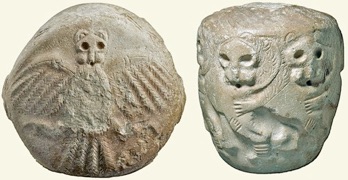
Inscribed Mace-head of Mesalim, King of Kish (RIME 1.8.1.1; P462181),
from the site of the Temple of Ningirsu at Girsu, now in the Musée du Louvre (AO 2349)
Images from the museum website
As we shall see, the object illustrated above, which was also discovered on the site of the temple on Tell K, must have pre-dated the reign of Ur-Nanshe and so must have originally been placed in the ‘Lower Construction’. Sébastien Rey (referenced below, at p. 209) characterised it as:
“... an oversized and therefore symbolic limestone votive Mace-head ... that is decorated with reliefs ...”
He described the figure on the flat, un-pierced upper surface as:
“... a lion-headed eagle with outstretched wings.”
As mentioned above, Rey stressed (at p. 175) the striking similarity between the chevron-like feathers in
✴this image; and
✴Ningirsu’s crown in the ‘Feathered Figure’ plaque;
to the extent that he described this crown as decorated with the feathers of the lion-headed eagle. he also observed (at p. 176) that:
“As is clear from the ‘Mace of Mesalim’, ... the use of the [lion-headed eagle] as a chief emblem of [Ningirsu] was well-established by the age of [Mesalim.
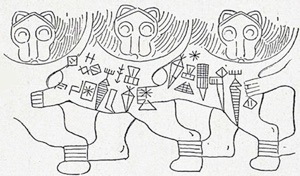
Sketch of two of the six lions in the frieze around the Mace-head of Mesalim (see above)
Adapted from Ernest de Sarzec (referenced below, XXXIV)
The frieze that runs around the curved surface of the mace contains the figures of six half-erect leaping lions, each of which seems to be to be chasing and grasping the one in front of it. Importantly, the short cuneiform inscription carved across two of these lions reads:
“Mesalim, king of Kish, temple builder for the god Ningirsu, (dedicated ?) this mace to/for the god Ningirsu [when] Lugal-sha-engur (was) ensi of Lagash”, (RIME 1.8.1.1; CDLI, P462181).
In other words, Mesalim, king of Kish, rebuilt (or, more probably, restored) the archaic temple of Ningirsu on Tell K when :
✴he exercised hegemony over Lagash and Girsu; and
✴the otherwise unknown Lugal-sha-engur exercised delegated authority (as ensi of Lagash).
Furthermore, we might reasonably assume that, by this time, ‘Lagash’ represented a single polity that included (at least) both Lagash itself and Girsu: Sébastien Rey (referenced below, at p. 150) tentatively dated the mace-head to ‘some time between 2600 and 2500 BC’.
This inscription should be considered alongside Mesalim’s two other surviving inscriptions, both of which come from the Esar temple at Adab (between Kish and Lagash):
✴One, which was found on fragments of two stone bowls, records that:
“Mesalim, king of Kish, sent over this bur mu-gi4 (stone bowl, used for the burgi ritual) in the E-SAR [when] Nin-KISAL-si (was) ensi of Adab”, (RIME 1.8.1.2; CDLI, P462182).
✴The other, which was found on the inside of the upper part of a decorated chlorite vase, records that:
“Mesalim, king of Kish, beloved son of Ninhursag [dedicated this vase ??] ...”, (RIME 1.8.1.3; CDLI, P431033).
Although some scholars (see, for example, Douglas Frayne, referenced below, 2008, at p. 20) suggest that this temple at Adab was dedicated to Inanna, Karen Wilson (referenced below; see, for example, Table 9.1, at p. 100) has shown that the archeological evidence (which includes that from Mesalim’s vase) indicates that it was dedicated to Ninhursag (who is sometimes named as Dingirmah). Taken together, these three inscriptions show that, as Nicholas Postgate (referenced below, at p. 30) observed:
✴both:
•Lugal-sha-engur, ensi of Lagash; and
•Nin-kisal-si, ensi of Adab;
acknowledged the hegemony of Mesalim, king of Kish; and
✴Mesalim, as overlord, made a point of honouring the deities who ‘owned’ their respective city-temples.
Furthermore, a later ruler of Lagash, Enmetena (Ur-Nansh’s great grandson), looked back on Mesalim’s role in the establishment of the border between Lagash and Umma in the following terms:
“Enlil, lugal kur-kur-a (king of all lands), ab-ba dingir-dingir-re2-ne-ke4 (father/elder of all the gods) ... demarcated the border between Ningirsu and Shara [the city god of Umma]. Mesalim, king of Kish, at the command of [the god] Ishtaran, demarcated this border and erected a stele there”, (RIME 1.9.5.1; CDLI, P431117, lines 1-12).
It is clear from this later testimony that Mesalim’s authority as hegemon extended to Umma, and that his role in the establishment of the boundary between Lagash and Umma was long-remembered, at least at Lagash.
We can now return to the significance of the mace-head of Mesalim in its proper historical context: this hugely powerful king of Kish, who exercised hegemony over much of southern Mesopotamia (including Lagash/Girsu):
✴chose to dedicate a beautiful ceremonial mace-head to Ningirsu, a god of war and the city god of Lagash/Girsu, in his hallowed temple; and
✴decorated this votive object with a figure of the lion-headed eagle, thereby echoing the iconography of the inaugural ‘Feathered Figure’ plaque, which was almost certainly still prominently displayed in its sanctum sanctorum.
As we shall see, mesalim’s mace-head was also housed in this hallowed temple and when (perhaps a century or so later) Ur-Nanshe deconsecrated this temple and preserved it under the an elevated platform on which he built his new Ningirsu temple, he:
✴transferred the ‘Feathered Figure’ plaque to his new temple; and
✴ritually buried Mesalim’s mace-head under the elevated platform so that it (like the original temple) was preserved for posterity.
Spearhead of Lugalnamnirshum, King of Kish

Large copper spearhead inscribed with the name of Lugalnamnirshum, king of Kish (RIME 1.8.2.1: CDLI, P462183)
From the original Ningirsu temple at Girsu, now in the Musée du Louvre (AO 2675): image from museum website)
The over-sized copper spearhead illustrated above, which was also discovered on Tell K, carries an inscription on its neck that was only partially legible until 1994, when it was rescued from a layer of corrosion, revealing that it had been dedicated (presumably to Ningirsu) by Lugalnamnirshum, king of Kish (see, for example, Douglas Frayne, referenced below, 2008, at p. 73). According to Gianni Marchesi (referenced below, 2015, at pp. 144-5, Uruk entry 4):
“This spearhead was associated with the temple of Ningirsu built by Urnanshe and destroyed during the reign of his successor, A-kurgal (sic). From the same archaeological context comes another noteworthy artefact: a copper bull’s head bearing a dedication to the god Ningirsu by ‘Lugalsi, the chief lamentation-priest of Uruk”.
However, Sébastien Rey (referenced below, at p. 209) pointed out that a number of scholars have been misled by an early, flawed description of the find-spot of this object, which apparently placed it inside Ur-Nanshe’s temple. However, he pointed out, it was:
“... almost certainly found in the mass of mud-bricks below the Ur-Nanshe building, ... in the same [stratigraphic] horizon as the ‘Mace of Mesalim’...”
Sébastien Rey (as above) pointed out that the difficulties arising from the confusion about the find spot of this spearhead:
“... has been further compounded by the theory [as expressed by Gianni Marchesi in the passage referenced above] that kings of Uruk might perhaps have assumed the catch-all title ‘king of Kish’, such that Lugalnamnirshum ... [might actually have been] a king of Uruk.”
I will return to this point in the context of the copper bull’s head mentioned by Marchesi, which certainly had been dedicated in Ur-Nanshe’s temple by a senior priest from Uruk. For the moment, we cane reasonably accept Rey’s concusion (at p. 210) that Lugalnamnirshum:
“... was doubtless one of Mesalim of Kish’s successors, and, therefore, in all likelihood, another foreign overlord of Girsu [and Lagash] in the period before Ur-Nanshe ascended to power.”
In other words, the reign of Ur-Nanshe, the first independent ruler of Lagash, post-dated the reigns of at least two Kishite kings who had exercised hegemony over the city, Mesalim and Lugalnamnirshum.
Lagash and the Kiengi League
Lagash first appears in our surviving sources as an independent actor in the ED IIIa or Fara period (ca. 2600 - 2450 BC); this second name for the period relates to a large collection of administrative, lexical and literary texts discovered at Shuruppak (modern Fara), all of which seem to belong to the period in question. Importantly for our purposes, Lagash appears in two administrative ‘Fara texts’ (WF 92 (CDLI, P011049) and WF 94 (CDLI, P011051) from Shuruppak that describe the mobilisation of troops from six Sumerian cities (Uruk, Adab, Nippur, Lagash, Shuruppak and Umma) in an alliance directed against an unnamed enemy. The conventional view is that:
✴this alliance was led by Kish at a time when that city still exercised hegemony over much of southern Mesopotamia; and
✴its target was Ur (which is not named among the allies);
but Piotr Steinkeller (in papers published in 2013 and 2024, both referenced below) argued that:
✴it was led by Uruk, at a time when that city had displaced Kish as the leading hegemon in southern Mesopotamia; and
✴its target was Kish.
Among his arguments for this hypothesis, he pointed out that:
✴nothing in the surviving Fara texts indicates that Kish led a military alliance of Sumerian cities against anyone (see note 9, at p. 7); and
✴the absence of Ur from the Kiengi League (and its almost total absence from the ‘Fara texts’ more generally) might simply indicate that it was directly subject to Uruk at this time, which would mean that:
“... its status would have been not unlike that [which] it enjoyed later in the ED IIIb period, when ... it was a dependency of Uruk, with Uruk’s ruler exercising a dual kingship over these two city-states”, (Piotr Steinkeller, referenced below, 2024, at p. 11).
This fundamental difference in relation to the likely date of Lagash’s involvement in the Kiengi League makes it extremely difficult to establish the circumstances in which the city achieved its independence from Kish: all we really know is that the earliest independent ruler who is documented in our surviving sources was named Ur-Nanshe (see below). Interestingly, Piotr Steinkeller (referenced below, 2024, at pp. 22-3) dated this ruler to the Fara Period on the basis of the the orthography/paleography of his inscriptions, and argued (in note 33, at p. 11) that it is therefore:
“... conceivable that Ur-Nanshe himself, or alternatively his son A-kurgal, participated in the postulated campaign [of the Kiengi League] against Kish.”
I will explore this hypothesis in the following section, which deals with the reign of Ur-Nanshe.
Ur-Nanshe
As Piotr Steinkeller (referenced below, 2019, p. 122) observed, Ur-Nanshe is:
“... the first ruler of Lagash for whom extensive historical information survives ... He appears to have been a usurper, but the specifics of his rise to power remain uncertain.”
He added (at note 25) that:
“Ur-Nanshe’s background is obscure. In his inscriptions, he calls himself ... ‘son of Gunidu, son of Gursar’, Since his father ... is never identified as a ruler of Lagash, ... it appears almost certain that Ur-Nanshe [himself] was an outsider who had somehow succeeded in taking over the throne of Lagash. The interpretation of the epithet “ ‘son’ of Gursar’ is notoriously difficult.: ... Gursar [could be] either the name of Ur-Nanshe’s grandfather/ancestor or a toponym. ... [In my opinion], Gursar was [probably] Ur-Nanshe’s eponymous ancestor, a solution that (if correct) would strengthen the assumption that Ur-Nanshe [himself] was a homo novus.”
However, Sébastien Rey (referenced below, at pp. 152-3) argued that Gursar was probably Ur-Nanshe’s birthplace and located ‘in the vicinity of Nigin, which was:
“... absorbed into Ur-Nanshe’s unified territory, though the triad of cities (Girsu, Lagash and Nigin) seem each to have maintained their own traditions and local social systems.”
He suggested (at p. 217) that this was why he:
“... wished to introduce Nanshe, as both the patron goddess of Nigin and his namesake, into the [pantheon of Lagash].”
Francesco Pomponio (referenced below, 2025, at pp. 3-4) observed that, in his 40 or so surviving inscriptions, Ur-Nanshe claims to have:
✴rebuilt the walls of Lagash;
✴built or rebuilt 19 buildings, almost all of them of a religious character (notably including his rebuilding of the temple of Ningirsu at Girsu and his foundation of the Ibgal temple of Inanna in Lagash);
✴commissioned 12 statues of deities;
✴excavated 10 canals; and
✴organised the arrival of ships from Dilmum carrying timber as tribute.
Pomponio argued (at p. 4) that this suggests that Ur-Nanshe had risen to power after a period of crisis in which the state of Lagash had been devastated, and that his subsequent reign was probably both long and peaceful. (Note, however, that, as Sébastien Rey (referenced below, at p. 217) observed, there is no surviving archeological of epigraphical evidence for this putative devastation).
Until very recently, a single inscription (RIME 1.9.1.6b, CDLI, P431040) has been assumed to describe an otherwise-unrecorded war victory of Ur-Nanshe over a coalition of the cities of Ur and Umma, and (given the character of Ur-Nanshe’s other inscriptions) this has given rise to some perplexity: while a war between Lagash and Umma might have been expected, an otherwise-unrecorded victory of Lagash over both Umma and Ur would be something of a surprise. I will therefore start this section with a summary of Pomonio’s paper, which is entitled: “Did Ur-Nanshe Defeat Ur ?”.
Ur-Nanshe’s Putative Victory over Ur and Umma
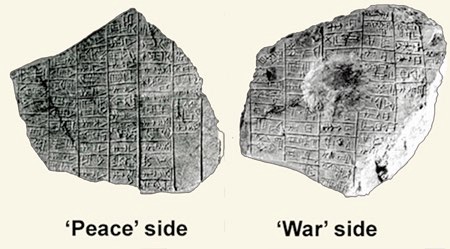
Inscriptions on door socket (RIME 1.9.1.6b, CDLI, P431040) from ‘the area of the Bagara temple’ in Lagash,
now in the Iraq Museum: image from CDLI (P222390)
As Francesco Pomponio (referenced below, 2025, at pp. 6-7) observed, the inscription (RIME 1.9.1.6b, CDLI, P431040) is on a a limestone slab (illustrated above), which was excavated at Tell al-Hiba in 1975-6, together with a few inscriptions of two later rulers of Lagash (Eanatum, Ur-Nansh’e grandson, and the mush later Gudea). Pomponio described the ‘Ur-Nanshe’ text as:
“... a copy of one or two royal inscriptions [that] is written on both faces of a broken slab, which must have served as a door socket and, being broken, was re-used for a scribal exercise on stone.”
He pointed out (at p. 7) that, since the time of this discovery, it has been recognised that the texts on the two sides of the slab are very different: as he observed (at p. 10):
✴the text on the so-called ‘peace side’ (lines 1-61) is:
“... a copy of a plaque of Ur-Nanshe, similar to many inscriptions of this king”; but
✴the text on the ‘war side’ (lines 62-105):
“... belongs to a wholly different category of texts, of which no specimen ... has [yet] been discovered with Ur-Nanshe as its author. In all probability, it was copied from a stele on which a scene of war or a parade of prisoners was carved, flanking or otherwise accompanying the inscription.”
It is this ‘war side’ text that is of interest for our present analysis.
The most important point to make here is that, while the ‘peace side’ is unambiguously devoted to the achievements of ‘Ur-Nanshe, king of Lagash’, he is not named at any point in the surviving text on the ‘war side’: for example, the first readable lines of this text (lines 64-8) tell us only that three prominent men were involved in a war:
✴... of Lagash;
✴the man of Ur; and
✴the man of Umma.
The usual completion/ translation of the following text can be summarised as follows:
✴The man of Lagash first:
•defeated the man of Ur;
•captured 5 senior officers, 3 of whom are named; and
•heaped up burial mounds (lines 69-86); and
✴then:
•defeated the man of Umma;
•captured 5 named senior officers as well as Pabilgaltuku, the ensi of Umma; and
•heaped up burial mounds for the man of Umma (lines 87-105).
As Pomponio pointed out (at p. 11), this account raises another problem (apart not naming anyone from Lagash): he asked rhetorically:
“[Why], only in this inscription, does ... [this commander of Lagash] define himself as ‘man’ (lu2) of Lagash, instead of lugal or ensi2, [thereby putting] himself on the same par with his [putative] vanquished enemies?
He then pointed out that this problem goes away if we assume that, in the passage in which the ‘man of Lagash’ is named, he is an object (like the man of Ur) rather than the subject, so that the passage in question would read:
“(He) defeated the man of Lagash (and) the man of Ur”.
In other words, in Pomponio’s opinion, the likelihood is that the original text described a war in which a now-unknown ruler defeated three allied armies led by three commanding officers, who are referred to as:
✴the man of Lagash;
✴the man of Ur; and
✴the man of Umma.
He reasonably assumed (at p. 12) that:
“... [the] name and title(s) [of this now unknown enemy] would have been written in the first column of the ... inscription.”
The implication is clear: it is at least possible that this text described the events that led to the devastation of Lagash and the subsequent emergence of Ur-Nanshe onto the world stage.
Piotr Steinkeller (referenced below, 2024, note 33, at p. 11 ), who was writing before the publication of Pomponio’s paper, had been troubled by this inscription: he observed (in note 33, at p.11) that:
“It is otherwise known that Ur-Nanshe was involved in military conflicts with Umma and Ur, [as suggested by the ‘war side’ of this inscription]. If Umma and Ur indeed were subjects of Uruk at that time [which was at the heart of his hypothesis -see above], this would have made Lagash an enemy of Uruk.”
He reconciled this text to his hypothesis by arguing that:
“... since political alliances must have been subject to frequent change in the south, this information is of little value. It is also likely that inter-city-state conflicts continued even in the presence of hegemonic powers, such as those of Kish or Uruk.
However, it seems to me that it is also possible that:
✴the ‘war side’ of this inscription did indeed describe the invasion of Lagash, Ur and Umma by Uruk; and
✴on this occasion, Ur-Nanshe fought on the side of Uruk.
If so, then this would explain the circumstances in which Ur-Nanshe became king of Lagash.
Ur-Nanshe and the Stele of Inanna (?)

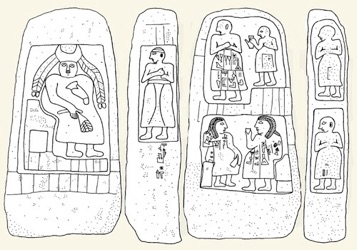
Four-sided inscribed stele from Lagash (RIME 1.9.1.6a, P431039), now in the Iraq Museum (IM 61404):
Left: relief of goddess (Inanna ?): image from Wikimedia
Right: sketch of reliefs on all four sides by Claudia Suter (referenced below, Figure 1, at p. 346)
My additions in red: figure identifications from Licia Romano (referenced below, Figure 1, at p. 184)
Almost all of Ur-Nanshe’s inscriptions focus on his temple building and other religious and civic projects, and 10 of these record his building of the Ibgal temple of Inanna at Lagash. However, the inscription on the stele illustrated above is the only one of them in which he mentions only the Ibgal temple and, moreover, it is mentioned twice:
✴the caption under Ur-Nanshe (surface a; lines 1-5) records that:
“Ur-Nanshe, son of Gunidu, ensi of Lagash, built the Ibgal [= oval temple of Inanna at Lagash]”; and
✴ this information is repeated at the start of the main text on this side, which runs from right to left between the four royal figures (surface e; lines 1-7).
Interestingly, this is also the only one of the many surviving inscriptions of Ur-Nanshe in which he used the title ensi: in all of the others, he is described as lugal (king) of Lagash.
Unfortunately, the caption under the seated goddess on the obverse is now illegible. Giovanni Lovisetto (referenced below, at pp. 54-5) described the iconography of this image as follows:
“The enthroned divine figure is larger than the others: she holds a branch of dates and possibly a cup, while her extraordinarily long and voluminous hair falls from a (possibly horned) headdress over her shoulders. ... Interestingly, the throne and her feet are placed on a sort of a podium, possibly signalling that this is a depiction of a statue, in front of which the five male figures [on the reverse and the two sides] are performing a libation ritual, perhaps during the inauguration of the Inanna temple itself. ... Even though the name of the goddess is not preserved in the inscription, the reference to the Ibgal and the fact that the stele was found nearby have led most scholars to identify this figure as Inanna.”
The inscription under the man who approaches Inanna from her left is also now illegible, although he was probably an important official:
✴Licia Romano (referenced below, at p. 185) suggested that:
“... his dress is an attribute typical of high-rank military officials or of the king himself as chief of the army; while
✴Giovanni Lovisetto (referenced below, at p. 54) characterised him as ‘a high priest’, presumably because he assumed that all of the male figures depicted on the stele were ‘performing a libation ritual’.
If we assume that Lovisetto is correct, then we could go further and identify this man as Lugalsi, the chief lamentation-priest of Uruk (= the man who had dedicated a pair of bulls’ heads to Ningirsu at Ur-Nanshe’s new temple to this god at Girsu (as discussed below), whose full title would have been chief lamentation-priest of the goddess Inanna.
Interestingly, Francesco Pomponi (referenced below, 2025, at p. 6) observed that, if we put the ‘war side’ of RIME 1.9.1.6b to one side, the only surviving mention of a military project of Ur-Nanshe comes in the inscription under discussion here, which:
“... in the space of not more than seven lines [see surface 2, lines 11’-17’], recorded that Ur-Nanshe captured one or more enemies (kings or states), whose names [are no longer legible].”
At the risk of piling one unproven hypothesis on another, I wonder whether Ur-Nanshe achieved these military successes at the time of his putative alliance with Uruk, and that he built the Ibgal at Lagash soon after the city fell to Uruk, at which time, he might have served as the city’s governor.
Ur-Nanshe and the Archaic Ningirsu Temple at Girsu
As Sébastien Rey (referenced below, at p. 14) observed:
“With the ascent to the throne of Ur-Nanshe, some 500 years after the epoch of the ‘Lower Construction’, the politico-religious landscape of Girsu-Lagash underwent numerous profound changes.”
As we shall see, the new temple of Ningirsu that he built on Tell K was at its heart of these profound politico-religious changes. However, as Rey also observed (at p. 212), in planning the major new complex, he:
“... paid due regard to long-established traditions. The [archaic temple] was ritually decommissioned, as befitted the holiest site dedicated to the city’s chief god, Ningirsu ...”
He similarly observed (at p. 217) that Ur-Nanshe:
“... painstakingly entombed the the deconsecrated temple, whose walls were preserved and left standing ...”
More specifically (as he explained at p. 213), he built a three-step platform for his new temple:
“... sealing and enveloping the old temple with a huge mass of substructural deposits that was made principally of a solid core of ... mud bricks.”
As we have seen, Ur-Nanshe also ‘paid due regard’ to a number of sacred objects that had adorned the archaic temple. For example, he must have transferred the ‘hallowed ‘Feathered Figure’ plaque to his new temple (since it was presumably on display before it was finally ritually buried at the time of that temple’s rebuilding by Enmetena, his great-grandson). However, the mace of Mesalim and the spearhead of Lugalnamnirshum were apparently both ritually buried in the lowest level of the mud brick substructure under the platform that covered his new temple.; as Sébastien Rey (referenced below, at p. 210) observed, they belonged to:
“... a group of similarly ancient relics that [had probably been] safeguarded and displayed as ex-votos inside the shrine of the ‘Lower Construction’ before ... being carefully disposed of when [this] temple was deconsecrated and sealed.”
He also remarked that Ur-Nanshe’s respectful treatment of both of these ‘Kishite’ objects suggests that, at the time of Ur-Nanshe, Lugalnamnirshum’s status was comparable to that of Mesalim, whom he described as:
“... a foreign overlord from a previous epoch who was subsequently venerated almost as a legendary figure.”
It seems to me that Ur-Nanshe’s respectful treatment of these ‘Kishite’ objects would have been extraordinary if he had recently ‘liberated’ Lagash from the hegemony of Kish.
Ur-Nanshe’s Ningirsu Temple at Girsu
Sébastien Rey (referenced below, at p. 213) observed that, in building his new temple on the three-stepped platform that encased and preserved its archaic predecessor, Ur-Nanshe:
“... did not simply ... add a storey to an existing building. On the contrary, by constructing a temple on the newly-established [platform], he [significantly] raised the sacred level (the divinely-charged abode of the gods) ... and, in so doing, dramatically changed the character of the entire upper surface of the tell.”
Thus, while he ‘paid due regard’ to the hallowed past, he also created a monumental sacred complex that dominated the surrounding plain, projecting the promise of the ‘brave new world’. Ur-Nanshe’s authorship of this project was commemorated a number of foundation pegs and tablets, many of which were found in five separate deposits (discussed below).
Foundation Objects
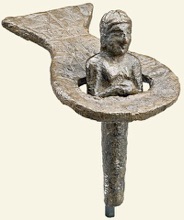
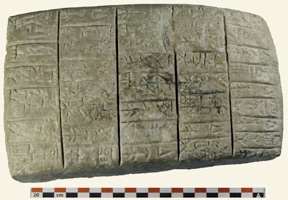
Left: Foundation figurine and collar from Tell K at Girsu:inscription RIME 1.9.1.7; CDLI, P431041
Right: Foundation tablet from Tell K at Girsu, with inscription RIME 1.9.1.11; CDLI, P431045
Both objects now in the Musée du Louvre (AO 314 and AO 3179 respectively; images from the museum website
As Christina Tsouparopoulou (referenced below, at p. 193) observed:
“The first known Mesopotamian inscribed foundation deposits were commissioned under the ruler Ur-Nanshe. In the area around [what the excavators had dubbed the ‘Maison des Fruits’] on Tell K, [at least 5] sets of foundation offerings were deposited, seemingly circling the structure. ... Most of [the deposits] were just below the then-modern surface of the tell.”
The objects found in these deposits were of two kinds:
✴Douglas Frayne (referenced below, 2008, at p. 93) catalogued a number of copper pegs and collars (including AO 314, illustrated above):
•the pierced, fish-shaped collars would have been laid flat on the mud brick surface; and
•the pegs which are in the form of anthropomorphic figurines, would have been pushed through the piercing and into the
These objects carried the inscription:
“Ur-Nanshe, king of Lagash, son of Gunidu, built the esh,girsu (sanctuary of Girsu)”, (RIME 1.9.1.7; CDLI, P431041).
✴Frayne (as above) also catalogued (at pp. 95-105) 10 foundation tablets (including AO 3179, illustrated above), each of which would originally have been supported by the head of a figurine and the ‘tail’ of its collar. As he observed (at p. 93):
“The texts on [these] foundation tablets (... inscriptions RIME 1.9.1.9–18) differ from that on the peg and [collar] (although they are clearly related to it), and also from each other ...”
Sébastien Rey (referenced below, at p. 216) observed that:
“The inscriptions of Ur-Nanshe’s foundation tablets each present nuanced, slightly different accounts of his colossal [politico-religious and civic] project ... [and] give a flavour of the rich legacy that [he] was in the process of creating.”
They all record his construction of a number of temples and , in all but the last two, they include the esh,girsu (sanctuary of Girsu). Thus, for example, one of them(which Rey translated at p. 217) recorded that:
“Ur-Nanshe, king of Lagas, son of Gunidu, son of Gursar:
built the temple of the goddess Nanshe;
formed the statue ‘the goddess Nanshe is a mighty lady’;
built the esh,girsu (sanctuary of Girsu);
formed a statue of Shulshaga;
built the Ibgal;
formed a statue of Lugal.urtur;
formed a statue of the god Lugal.URUAx KAR;
built Ki-NIR;
formed (a statue of) Nin.REC107-esh;
formed (a statue of) Ningidru;
built the temple of the goddess Gatumdu;
formed a statue of the goddess Gatumdu;
built the Bagara;
built the E-dam;
built Abzu-e; and
built Tirash”, (RIME 1.9.1.11; CDLI, P431045).
He observed (at p. 217) that this and the other inscriptions on surviving foundation tablets clearly demonstrate that he:
“... used the unifying force of religion to help consolidate and reshape the already-established Girsu-Lagash alliance. This is reflected in the stress placed, not just on the worship of Ningirsu, but on [his] construction of temples and creation of statues for a pantheon of Lagash deities.”
Sébastien Rey (referenced below, at p. 14) observed that:
“To reflect these changes in the territory’s political and religious organisation, Ur- Nanshe added a new name to the time-honoured epithet (é.dNingirsu) recorded on the ‘Feathered Figure’ [plaque), and the complex was now also known as é.dNingirsu, meaning the ‘sanctuary of Girsu’. This stressed the role of the god’s sacred city (the extensive area of more and less substantial sacred mounds and buildings of which Girsu was formed) as the religious centre of Ur- Nanshe’s enlarged and re- established state, ... [which now embraced] Girsu, Lagash and Ur- Nanshe’s native home of Nigin as a single political entity.”
As he pointed out, Ur-Nanshe did still use the the old title: for example, a brick (ESH 393) from that is now in the archeological museum of Istanbul, bears the inscription:
“Ur-Nanshe, king of Lagash, son of Gunidu, built the é.dNingirsu”, (RIME 1.9.1.19; CDLI, P431053).
However, he argued that:
“It is important to note that .., [these names] were alternates that were never used together in a single Ur- Nanshe inscription. Accordingly, although their specific connotations were different, with one epithet stressing the temple’s age- old primal sanctity and the other highlighting the new order ushered in by Ur- Nanshe, they were considered to be equivalents, and both could be used to designate the Ur- Nanshe religious complex on Tell K.”
Buried Artefacts
As Sébastien Rey (referenced below, at p. 229) observed, unlike the archaic temple (which had been preserved after its deconsecration), Ur-Nanshe’s temple was largely demolished in the reign of his great grandson, Enmetena (in order to make way for yet another new temple) and only about a meter wall survived below the destruction level, However, Rey derived a good deal about Ur-Nanshe’s temple from what he dubbed ‘an exceptional hoard of artefacts’ that were found at roughly the Ur-Nanshe floor level in the area that would have surrounded the temple’s walls. These objects, which had presumably been displayed in Ir-Nanshe’s temple and then buried at the time of its demolition, include:
✴the ‘Feathered Figure’ plaque (discussed above); and
✴a number of objects discussed below:
•the genealogical plaques of Ur-Nanshe;
•two copper bulls’ heads; and
•a number of lion’s heads made of stone.
Genealogical Plaques of Ur-Nanshe
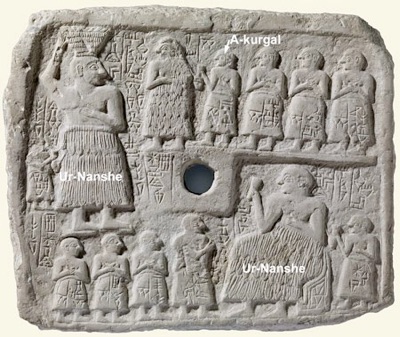
Pierced relief of Ur-Nanshe from his Ningirsu temple at Girsu (RIME 1.9.1.2, P431035)
Now in the Musée du Louvre (AO 2344); image from museum website
The pierced limestone relief illustrated above is the best-preserved of four ‘genealogical’ plaques of Ur-Nanshe that were (or were probably) placed in his new temple. They are so-called because they depict Ur-Nanshe alongside other figures, all identified by inscription, most of whom are members of his immediate family (which included at least nine sons: Akurgal, who succeeded him; Addatur; Anikurra; Anita, who was apparently also his cup bearer; Anupa; Gula; Lugalezen; Menu; and Mukurmushta). Sébastien Rey (referenced below) illustrated all four of them as Figure 89, at p. 231), with the one illustrated here as his example A:
✴the inscription on ‘example A’ begins:
“Ur-Nanshe, lugal (king) of Lagash, son of Gunidu, son of Gursar, built the é.dnin.gir.su (House of Ningirsu)”, (RIME 1.9.1.2; CDLI, P431035, lines 1-6); and
✴the other three examples carried the same inscription, except that none of them named Ur-Nanshe’s grandfather, Gursar.
Interestingly, this is another case in which Ur-Nanshe used the archaic name for his temple. He is illustrated twice in ‘example A’:
✴in the upper register, where he carries a basket of bricks on his head (a motif that is repeated in Rey’s example D); and
✴in the lower register, where he is enthrone and raises a beaker in his right hand.
It seems likely that the ‘crown of bricks’ symbolises Ur-Nanshe’s building of the new temple, and that the beaker suggests an inaugural libation or celebration.
It seems to me that we should regard four ‘genealogical’ plaques from Ur-Nanshe’s new temple to Ningirsu at Girsu as an iconographical development of the reliefs on the sides and reverse of the putative ‘Stele of Inanna’ (discussed above):
✴he was ensi of Lagash in the latter, but he is now lugal of Lagash; and
✴he had 2-3 sons in the latter, but now he has at least 9.
It is also hard to escape the conclusion that, while Ur-Nanshe paid all due respect to the original Ningirsu temple, he used this replacement of it to ‘announce’ the start of a new era under a new, independent, dynastic king of Lagash (who came to power with a small ‘battalion’ of sons to hel protect his realm and to facilitate his dynastic succession.
Sébastien Rey (referenced below, at p. 276) argued that the fact that these plaques were found in excellent condition suggests that they had had an important religious status, which means that they had probably been prominently displayed in Ur-Nanshe’s temple and then been ‘ritually desacralised’ when the temple itself was demolished and:
“... buried in the sacred mound, which ... was not raw earth but [rather] a hallowed artificial. creation that was considered to be blessed in its entirety.”
Copper Bulls’ Heads
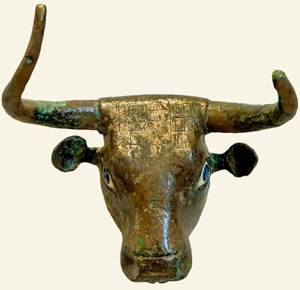
Inscribed copper bull’s head from Ur-Nanshe’s Ningirsu temple at Girsu,
now in the Musée du Louvre (AO 2676): image from Wikipedia
As Sébastien Rey (referenced below, at pp. 279-81) observed, Enmetena also ritually buried a pair of copper bull’s heads that presumably came from Ur-Nanshe’s temple, one of which (illustrated above) carries an inscription on its forehead that reveals that it had been dedicated to Ningirsu by:
“Lugalsi, gala-mah (the chief lamentation-priest) of Uruk”, (see Gianni Marchesi, referenced below, 2011, note 244, at p. 124).
Rey (as above) suggested (at p. 280) that these heads had probably served as ornaments on instruments (probably lyres) played on liturgical occasions, and (at p. 281) that:
“... they were [dedicated] by Lugalsi to form part of the ... cultic apparatus [of Ur-Nanshe’s temple].”
Gianni Marchesi (as above) wrongly assumed that they had been found in the ‘same archaeological context’ as the spear-head of Lugalnamnirsumma (see above). He therefore argued that:
“[Since]:
✴it is very unusual to find objects dedicated by ‘foreigners’ in Lagash (the only other known example is the mace of Mesalim, king of Kish ) ...; and
✴the ED IIIb kings of Uruk, used to style themselves ‘king of Kish’;
it is likely that Lugalnamnirsumma, like [Lugalsi], the lamentation priest ... , was also from Uruk. The presence of these officials’ inscriptions in the temple of Ningirsu may reflect a period of political weakness at Lagash, during which the city-state fell under the hegemony of Uruk.”
In fact, as we have seen:
✴both Mesalim and Lugalnamnirsumma were (or were almost certainly) ‘actual’ kings of Kish;
✴they had both made their dedications to Ningirsu in the archaic temple at Girsu as the overlords of Lagash/ Girsu;
✴when Ur-Nanshe had deconsecrated and enveloped the archaic temple, he had ritually buried these dedicated objects under the sacred mound at what the archeologists dubbed the ‘Ur-Nanshe level’.
In view of this, the dedication of these bulls’ heads by a ‘foreigner’ (Lugalsi, chief lamentation-priest of Uruk) is even more ‘unusual’ than Marchesi thought. As we have seen, he suggested that their presence at Girsu:
“... may reflect a period of political weakness at Lagash, during which the city-state fell under the hegemony of Uruk”.
However, I suggest that the fact that they were also sufficiently important to merit ritual burial by Enmetena suggests that they were dedicated in Ur-Nanshe’s temple at a time at which Uruk and Lagash were allies.
Lion’s Heads
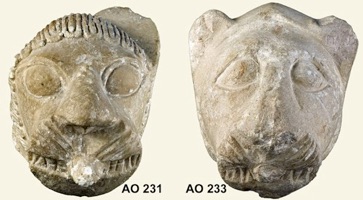
Two limestone lions’ heads from Ur-Nanshe’s Ningirsu temple at Girsu,
Both now in the Musée du Louvre (AO 231 and AO 233); images from the museum website
Sébastien Rey (referenced below, at pp. 281) recorded that five small lions’ heads were found together at the Ur-Nanshe level in the SE side of the temple:
✴three that are now in the Musée du Louvre
•two made from limestone;
-AO 231; and
-AO 233, which is inscribed with the name of Ur-Nanshe (RIME 1.9.1.24b; CDLI, P431059);
•one, AO 232, which is fragmentary, is made from alabaster; and
✴two that are now in the archeological museum of Istanbul:
•ESH 456, which is inscribed with what is now a fragmentary inscription of Ur-Nanshe (RIME 1.9.1.25; CDLI, P431060); and
•ESH 458, which carries an inscription((RIME 1.9.2.2a; CDLI, P432072) that Douglas Frayne (referenced below, 2008, at p. 122) attributed to his son, Akurgal.
Rey observed that these lion heads probably had some connection with Ningirsu and, given their small size (they are all only about 10cm high) and the fact that some of them had inscriptions.they might:
“... have been ornamental elements ... [and] could have been designed to adorn a range of sacred appurtenances inside the sanctum sanctorum.”
Ur-Nanshe and the Lion-Headed Eagle
Archaic Stamped Bricks from Tell K
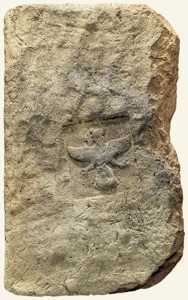
Archaic stamped brick from Tell K, now in the Musée du Louvre (AO 398); image from the museum website.
Sébastien Rey (referenced below, at p. at p. 14) noted that a small number of surviving archaic bricks from Tell K are stamped with an image of a lion-headed eagle with outstretched wings. He argued that these bricks:
“... doubtless originate from one of the ... ancient iterations [of the Ningirsu temple]. Unfortunately, none [of them] were found in situ, but they testify to the antiquity of the fusion of the god [Ningirsu] and [this] mythical hybrid bird.”
He suggested (at p. 632) that, for example, the rectangular brick illustrated above might be one of those from the Ur-Nanshe temple, since:
“It is assumed from its appearance to be archaic, perhaps Early Dynastic, ... and this seems to be further confirmed by its preserved dimensions, ... which are close to those of the bricks used by Ur-Nanshe.”
Other Archaic Images from Girsu
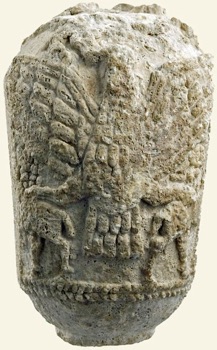
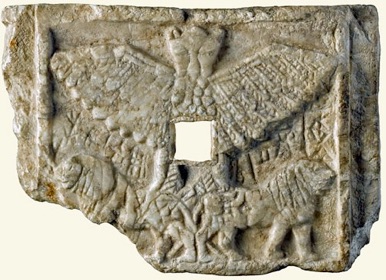
Left: Ovoid alabaster Mace-head from Tell K, with reliefs of two lion-headed eagles, each grasping a pair of animals
Now in the Musée du Louvre (AO 237); image from museum website
Right: Inscribed pierced plaque of Ur-Nanshe (RIME 1.9.1.26; CDLI, P431061) from Girsu
Now in the Musée du Louvre (AO 2783); image from museum website
According to André Parrot (reference below, at p. 101), the excavators of Tell K recorded that the alabaster Mace-head illustrated above on the left was found ‘near the Ur-Nanshe temple’. Interestingly, the relief around the curved surface depicts two lion-headed eagles (back to back), each grasping a pair of four-legged animals walking in opposite directions. These animals have been variously identified:
✴Parrot himself (who reproduced a sketch of the relief as Figure 21h, at p. 85) identifies them as ’deer or ibexes’;
✴the museum identifies them as ‘deer’; and
✴Renate van Dijk-Coombes (referenced below, at p. 203) identifies them as ‘goats and antelope’.
However, given the apparent similarity between the grasped animals this image and those in the relief on the right (discussed below), I suggest that it is at least possible that they are lions.
Turning now to the pierced plaque illustrated above on the right: as Douglas Frayne (referenced below, 2008, at p. 112) observed, this is one of:
“Three very similar wall plaques of Ur-Nanshe from Girsu, [all of which] depict [a lion-headed eagle with its wings outstretched], standing on two lions.”
The inscription (RIME 1.9.1.26; CDLI, P431061) on this example reads:
“For Ningirsu: Ur-Nanshe, king of Lagash, son of Gunidu, built the E-Tirash [a shrine dedicated to Ningirsu at the now-unknown Tirash]”.
Frayne (as above) argued that:
“While only part of the titulary of Ur-Nanshe is preserved on the other two plaques, [each of them] very likely bore the same or a similar inscription.”
Thus, the relief and its inscription securely indicate that Ur-Nanshe associated Ningirsu with the motif of a lion-headed eagle with outspread wings grasping a pair of lions. Douglas Frayne (as above), who assumed that the plaques were commissioned for the Ningirsu shrine at Tirash observed that:
“The finding of these plaques at Girsu is not evidence (as it might appear at first glance) for the location of Tirash at Girsu: the pieces may have been fabricated at Girsu [for transportation] to Tirash, or they may be ‘strays’ from Tirash itself.”
This is reasonable since Ur-Nanshe commemorated his building of Tirash itself in a number of his surviving inscriptions (including RIME 1.9.1.11; CDLI, P431045, on a foundation slab discussed above.). As Andrew George (referenced below, entry 1097, at p. 150) observed, this Nigirsu shrine at Tirash was mentioned by later rulers of Lagash and was documented in the Ur III period ‘among other cult centres near Lagash’.
The important point here is that Ur-Nanshe followed Mesalim in association the lion-headed eagle with Ningirsu, but he made an important iconographical change:
✴on Mesalim’s mace-head, this mythical bird is depicted above a frieze of six half-erect leaping lions, each of which seems to be to be chasing and grasping the one in front of it; while
✴in Ur-Nashe’s plaques, it grasped the haunches of a pair of walking lions.
It is possible (although this is speculative) that Ur-Nanshe wished (for whatever reason) to associate Ningirsu with both Girsu and Lagash. Be that as it may, this iconographic change was not a one-off occurrence:
✴as we shall see, the iconography of a lion-headed eagle grasping a pair of lions was used in the reigns of all of Ur-Nanshe’s immediate successors, and always in a context involving Ningirsu; and
✴as we have seen (in section above on the ‘Mace-Head of Mesalim’ above) in one case in particular (a second Mace-head from the reign of Enanatum I, Ur-Nanshe’s grandson), this iconographical motif was almost certainly used as an emblem or avatar of Ningirsu.
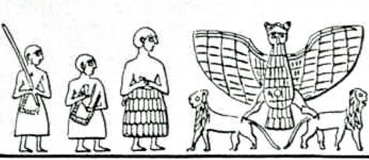
Sketch of the relief on a mace-head dedicated by Bara-kisumun for the life of Enanatum (RIME 1.9.4,19, P431115)
The mace-head, which probably came from Girsu, is now in the British Museum (BM 23287)
The sketch is from Jean Evans (referenced below, Figure 28, Cat. 35, at p. 76)
Sébastien Rey (referenced below, at p 176) pointed out, it would be:
“... no surprise [if] the sculptors of [this relief] drew on [an] inextricable link between Ningirsu and the [lion-headed bird] that went back to the most archaic times. ... As is clear from the ‘Mace of Mesalim’, ... the use of the [lion-headed eagle] as a chief emblem of [Ningirsu] was well-established by the age of [Mesalim. That] the association [remained fundamental for decades is evidenced by] a second Mace-head [from the reign of Enanatum I, Ur-Nanshe’s grandson] which was [also] dedicated to Ningirsu: [as shown in the sketch above, the relief on this late Mace-head] shows offerings being brought to [a lion-head eagle that almost certainly] acts as [Ningirsu’s] avatar.”
Relief from the Temple of Ninhursag at Tell Ubaid
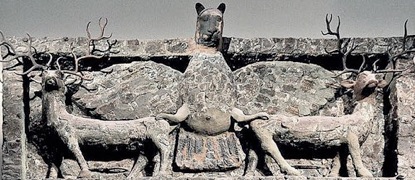
Copper relief of a lion-headed eagle grasping two stags, from the temple of Ninhursag at Tell Ubaid
Now in the British Museum (BM 114308); image from Wikimedia
The relief illustrated above, which apparently originally decorated the facade of the temple, depicted an upright lion-headed eagle (known as the Anzu bird) with outspread wings, grasping a pair of stags. As Piotr Steinkeller (referenced below, 2019a, at p. 996) pointed out, this image belongs to a group:
“... of Pre-Sargonic images in which deer (or, alternatively, gazelles and ibexes) are juxtaposed with the lion-headed eagle, who was the alter-ego of Ningirsu/Ninurta. Since [Ningirsu/ Ninurta] counted as Ninhursag’s son, one may be confident that, in these representations, the deer/gazelles/ibexes signify the goddess. ... Since [the relief above] was a centrepiece of Ninhursag’s own temple [at Tell Ubaid], its pairing of [the Anzu bird] with the stags ... (rather than with the usual lions, which reference Ningirsu/Ninurta’s martial aspect) must be intentional, with the stags standing for the goddess.”
In fact, we cannot assume that, at the time of the installation of this relief, Ninhursag was regarded as the mother of Ningirsu: as Steinkeller himself noted (at p. 988), our earliest source for this relationship is from the Sumerian literary tradition of the Old Babylonian period, when Ningirsu/ Ninurta was indeed characterised a son of Enlil and Ninhursag. However:
✴there is no reason to doubt that the Anzu bird was regarded as a representation of Ningirsu at this time (see below); and
✴it remains likely that the stags that this ‘alter-ego’ of Ningirsu grasps do indeed represent either Ninhursag herself or (more probably) her temple at Tell Ubaid.
Example of This Iconography from Girsu
As we have seen above, Piotr Steinkeller characterised the Anzu bird as the ‘alter-ego’ of Ningirsu, the city god of Lagash/Girsu (whose name means ‘Lord of Girsu’).
Sébastien Rey (referenced below):
✴similarly referred to the Anzu Bird as the ‘chief emblem’ and the ‘avatar’ of Ningirsu (see p. 176); and
✴observed (at p. 8) that:
“... Ningirsu is very often pictured with an [Anzu bird], or even symbolised by an image of this supernatural creature, who appears as a representative aspect of his divinity. Invoking the myth that unites the god and the fabulous bird, [its] outstretched wings and irresistible talons, which are capable of seizing the fiercest predators, act in large part as a metaphor for the god’s taming of the Mesopotamian wilderness.”
Again, I think that it is probably misleading to interpret this relief in the light of much later literary traditions: in this case, the myth that united Ningirsu with the Anzu bird dates to the Old Babylonian period (see, for example Stephanie Dalley (referenced below, at p. 203 and pp. 222-7). It was presumably inspired (at least in part) by images and perhaps local legends from Lagash/Girsu:
✴the earliest surviving image of the lion-headed eagle is on a mace-head that King Mesalim of Kish (the overlord of Lagash at some time before the reign of Ur-Nanshe) dedicated to Ningirsu at his ‘original’ temple at Girsu, in which the Anzu bird is associated with a frieze of six lions; and
✴the relief under discussion here is the first of a series of objects associated with later independent rulers of Lagash that feature the iconography of the upright Anzu bird grasping a pair of lions.
I think that Ur-Nanshe’s plaques at Girsu celebrated Ningirsu’s patronage of and support for Ur-Nanshe and his authority over Ur-Nanshe’s new city-state of Lagash, Girsu and Nigin (symbolised by the pair of lions).
Likely Date of the Reign of A’anepada: Analysis and Conclusions
The similarities between:
✴objects discovered at Ur-Nanshe’s new Ningirsu temple at Girsu; and
✴those discovered on the site of A’anepada’s Ninhursag temple at Tell Ubaid;
could have been the result of cultural interaction between two broadly contemporary rulers, in which case (given the importance of the temple at Girsu), it would be reasonable to assume that A’anepada had followed Ur-Nanshe’s lead when ‘furnishing’ his temple at Tell Ubaid. However, given:
✴the strong tradition of the ‘Anzu-bird iconography’ at Girsu/Lagash; and
✴its use there as an emblem of Ningirsu, the Lord of Girsu;
I find it hard to believe that A’anepada commissioned the relief of this bird grasping a pair of stags for his ‘new’ temple at Tell Ubaid. In other words, it is arguably more likely Ur-Nanshe or a later ruler of Lagash gained control of A’anepada’s temple, an event that was commemorated in the iconography of the relief on its facade.
We might be able to take this idea further by considering the possibility (suggested by Petr Charvat - see above) that Ur was ‘reduced to ashes by enemy action’ after the reign of Mesanepada, as evidenced by an inscription (RIME 1.9.1.6b; CDLI, P431040) on two sides of a broken slab from Lagash. Francesco Pomponio (referenced below):
✴observed that this slab had probably served as a door socket before it was re-used for ‘a scribal exercise on stone’ (see p. 7); and
✴established that it carried copies of two separate inscriptions: as he observed (at p. 10):
•the text on the so-called ‘peace side’ (lines 1-61) is:
“... a copy of a plaque of Ur-Nanshe, [the first independent king of Lagash as far as we know], similar to many inscriptions of this king”; but
•the text on the ‘war side’ (lines 62-105):
“... belongs to a wholly different category of texts, of which no specimen ... has [yet] been discovered with Ur-Nanshe as its author. In all probability, it was copied from a stele in which a scene of war or a parade of prisoners was carved, flanking or otherwise accompanying the inscription.”
It is this ‘war side’ text that is of interest for our present analysis. Pomponio pointed out (at pp. 8-9) that, if we take only the internal evidence from this inscription (in which Ur-Nanshe is not actually mentioned), then all we can sat is that:
✴it describes a war that involved three armies led (respectively) by men named as:
•the man of Lagash;
•the man of Ur; and
•the man of Umma; and
✴the fate of Lagash is unspecified but the armies from Ur and Umma were defeated in turn.
It is usually assumed that Lagash defeated Ur and then Umma. However, as Pomponio argued (at p. 11) that, if this were the case, then it is difficult to find:
“An explanation of the use of the [title ‘man of Lagash’] by a [victorious] king of Lagash ... But the problem [disappears] if we assume that the ‘war side’ is not the work of Ur-Nanshe, or even of another [ruler] of Lagash.”
However, it seems to me that this problem can also be solved if we consider that Ur-Nanshe could well have been involved in the defeat of ‘the man of Lagash’ before he became king of that city: after all, as Piotr Steinkeller (referenced below, 2019b, pp. 122-3) observed, Ur-Nanshe, who names himself in his inscriptions as ‘son of Gunidu, son of Gursar’ is:
“... the first ruler of Lagash for whom extensive historical information survives ... He appears to have been a usurper, but the specifics of his rise to power remain uncertain.”
Perhaps his rise to power was the direct result of the part he played in the defeat of the man of Lagash, the man of Ur and the man of Umma suggested by RIME 1.9.1.6b. If so, it is also at least possible that this victory also brought him control (however temporary) of the Ninhursag temple that A’anepada had built or rebuilt at Tell Ubaid.
I accept that:
✴it is most unlikely that the famously unwarlike Ur-Nanshe played the leading role in this putative victory; and
✴there is no surviving evidence that he ever exercised any control over either Ur or Umma.
However, as Sébastien Rey (referenced below, at pp. 279-81) observed:
✴Enmetena (Ur-Nanshe’s grandson) ritually buried a pair of copper bull’s heads that came from Ur-Nanshe’s temple of Ningirsu at Girsu; and
✴one of them carries an inscription on its forehead that reveals that it had been dedicated to Ningirsu by:
“Lugalsi, gala-mah (the chief lamentation-priest) of Uruk”, (see Gianni Marchesi, referenced below, 2011, note 244, at p. 124 for the translation).
Perhaps Ur-Nanshe played a significant part in a successful Uruk-led campaign against Lagash, Ur and Umma, after which he was able to claim the kingship of Lagash and also acquire territory at Tell Ubaid (although control over Ur itself would presumably have fallen to Uruk). If so, then we could reasonably assume that this campaign was fought during the reign of A’anepada and probably marked the end to the dynasty that had been founded by his grandfather Meskalmadu.
This brings us back to the likely date of A’anepada’s reign, which arguably was broadly contemporary with that of Ur-Nanshe. Recently, Piotr Steinkeller (referenced below, 2024, at pp. 22-3) presented an analysis of the:
“... evidence available to us in that respect is the orthography/paleography of Ur-Nanshe’s texts as compared with those of his successors at Lagash and that of the Fara [texts]. ... This evidence forces us to conclude that the reign of Ur-Nanshe was contemporaneous with the Fara [texts]. Even if this reign was slightly later than those materials (a possibility that cannot be excluded), it still firmly belonged to the ED IIIa period, as it is usually defined by the archaeologists and philologists alike.”
References:
Pomponio F. “Did Ur-Nanše Defeat Ur?”, in:
Alivernini S. et al. (editors), “‘And I Have Also Devoted Myself to the Art of Music’: Ancient Near Eastern Studies in Honor of Franco D’Agostino, Presented on His 65th Birthday by His Pupils, Colleagues and Friends”, (2025) Münster, at pp. 3-14
Rey S., “The Temple of Ningirsu: the Culture of the Sacred in Mesopotamia”, (2024) University Park, PA
Steinkeller P., “Campaign of Southern City-States against Kiš as Documented in the ED IIIa Sources from Šuruppak (Fara)”, Journal of Cuneiform Studies, 76 (2024) 3-26
Tsouparopoulou C., “The Early Dynastic ‘Maison des Fruits’ at Tell K in Tello (Ĝirsu)”, Bulletin of the American Society of Overseas Research, 391 (2024) 191-225
Goodman R., “A New Story of Sumer’s First Cities’, Expedition Magazine, 65:1 (2023) 30-3
Lovisetto G., “Goddesses Visualized in Early Dynastic Mesopotamia”, in:
Babcock S. and Tamur E. (editors), “She Who Wrote: Enheduanna and Women of Mesopotamia, ca. 3400–2000 BC”, (2022) New York, at pp. 46-63
Lecompte C., “A Propos de Deux Monuments Figurés du Début du 3e Millénaire : Observations sur la ‘Figure aux Plumes’ et l’a Prisoner Plaque’”, in:
Arkhipov A. et al. (editors), “Studies in Early Mesopotamia and Syria in Honor of Walter Sommerfeld and Manfred Krebernik”, (2020), Leiden and Boston, at pp. 417-46
Westenholz A., “Was Kish the Center of a Territorial State in the Third Millennium? - and Other Thorny Questions”, in:
Arkhipov I. et al. (editors), “The Third Millennium: Studies in Early Mesopotamia and Syria in Honor of Walter Sommerfeld and Manfred Krebernik”, (2020) Leiden and Boston, at pp. 686-715
Steinkeller P., “Babylonian Priesthood during the Third Millennium BCE: Between Sacred and Profane”, Journal of Ancient Near Eastern religions”, 19 (2019) 112–51
Watanabe Ch. E., “Composite Animals in Mesopotamia as Cultural Symbols”, in:
di Paolo S. (editor), “Composite Artefacts in the Ancient Near East: Exhibiting an Imaginative Materiality, Showing a Genealogical Nature”, (2018) Oxford, at pp. 31-8
Suter C., “On Images, Visibility, and Agency of Early Mesopotamian Royal Women”, in:
Lluis F. et al. (editors), “The First Ninety Years: A Sumerian Celebration in Honor of Miguel Civil”, (2017) Boston and Berlin, at pp. 337-62
van Dijk-Coombes R. M., “Lions and Winged Things: A Proposed Reconstruction of the Object on the Right of the Lower Register of the Mythological Side of Eanatum's Stele of the Vultures”, Die Welt des Orients, 47:2 (2017) 198-215
Marchesi G., “Toward a Chronology of Early Dynastic Rulers in Mesopotamia”, in:
Sallaberger W. and Schrakamp I. (editors), “Associated Regional Chronologies for the Ancient Near East and the Eastern Mediterranean. History and Philology: Vol. 3”, (2015) Turnhout, at pp. 139-58
Steinkeller P., “An Archaic “Prisoner Plaque” from Kiš”, Revue d'Assyriologie et d'Archéologie Orientale, 107 (2013) 131-57
Wilson K. L., “Bismaya: Recovering the Lost City of Adab”, (2012) Chicago IL
Frayne D. R., “The Royal Inscriptions of Mesopotamia, Vol. 1: Presargonic Period (2700-2350 BC)”, (2008) Toronto
Lapinkivi P., “The Sumerian Sacred Marriage and Its Aftermath in Later Sources”, in:
Nissinen M. and Uro R. (editors), “Sacred Marriages: The Divine-Human Sexual Metaphor from Sumer to Early Christianity”, (2008) University Park, PA, at pp. 7-42
Øiseth A. R., “With Roots in the Abzu and Crown in the Sky: Temple Construction Between Myth and Reality: A Study of the Eninnu Temple of the Gudea Cylinders as Divine House and Cosmic Link”, (2007) thesis of the University of Oslo
Vanstiphout H. L. J., “Epics of Sumerian Kings: the Matter of Aratta”, (2004) Leiden and Boston
Evans J., “Mace-head Dedicated for the Life of Enanatum", in:
Aruz J. and Wallenfels R. (editors), “Art of the First Cities: The Third Millennium BC, from the Mediterranean to the Indus”, (2003) New York, at pp. 75-6
Collins P., “The Sumerian Goddess Inanna (3400-2200 BC)”, Papers from the Institute of Archaeology, 5 (1994) 103-18
Postgate, J.N., “Early Mesopotamia: Society and Economy at the Dawn of History” (1994) London and New York
George A., “House Most High: The Temples of Ancient Mesopotamia”, (1993) Winona Lake, IN
Winter I, J., “After the Battle Is Over: The ‘Stele of the Vultures’ and the Beginning of Historical Narrative in the Art of the Ancient Near East”, Studies in the History of Art, 16 (1985) 11-32
Cooper, J. S., “Reconstructing History from Ancient Inscriptions: The Lagash-Umma Border Conflict”, (1983), Malibu CA
Parrot A., “Tello; Vingt Campagnes de Fouilles (1877-1933)”, (1948) Paris
de Sarzec E., “Découvertes en Chaldée: Second Volume Partie Epigraphique et Plances”, (1884) Paris