Empires of Mesopotamia:
First Dynasty of Lagash
III: Enmetena


Empires of Mesopotamia:
First Dynasty of Lagash
III: Enmetena
In Construction
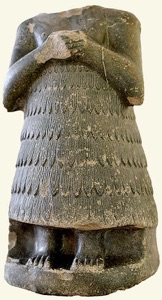
Now -headless diorite statue of Enmetena from Ur, identified by inscription (RIME 1.9.5.17; CDLI, P431134)
Was in the Iraq Museum (IM 000005; cast CBS 15890), image from the Website of the World History Encyclopedia
The second point to make is that the earliest surviving written evidence from Lagash that gives this creature a name and provides specific information about its iconographical meaning dates to the time of the second independent dynasty of Lagash (more than 200 years after the end of the first, in the window of about a century between the Akkadian and the Ur III empires).
First, we should address the confusing matter of the name of this hybrid creature. Sébastien Rey (referenced below, at p. 5) referred to it as:
“... Imdugud (or Anzu), the radiant Thunderbird himself”;
and it is often asserted that Imdugud and Anzu represent its name in Sumerian and Akkadian respectively. Thus, for example, Anne Rebekka Øiseth (referenced below, at p. 28) referred to:
“The terrifying Imdugud bird, usually translated as Thunderbird (and also commonly referred to by its Akkadian name Anzu) ...”
However, as Herman Vanstiphout (referenced below, note 33, at p. 18), for example, observed that:
“The reading of the name of this supernatural bird is still a matter of controversy among specialists.”
His primary concern was with the Sumerian text known as the ‘Matter of Aratta’, which probably dates to the Ur III period, ca. 2100–2000 BC, in which:
“... it is written consistently as IM.DUGUD (‘heavy (storm) cloud’), so that ‘Thunderbird’ seems to be an adequate translation. Still, the consensus is now that it was read as [Anzu(d)], with no known etymology or explanation. In reading ‘Anzud’ [in this translation], I bow to the collective wisdom and arguments of the majority, but I remain convinced that the scribes were thinking of a heavy storm cloud every time they wrote the signs.”
Chikako Watanabe (referenced below, at p. 33), who explicitly avoided ‘the philological argument around the name Imdugud/Anzu observed that it:
“... consists of four signs: AN. IM. DUGUD. and MUSHEN meaning literally:
‘the bird (mushen) of heavy cloud/fog (im.dugud = imbaru ) in the sky (an)’;
which suggests a close association with thick cloud.
In what follows, I shall simply use the word ‘Anzu’ and refrain from relying on philology in the quest to understand what this creature signified in Lagash in the 3rd millennium BC.
As we shall see, although the surviving evidence indicates that many of the other kings of the first dynasty of Lagash (besides Enmetena) commissioned images of the Anzu, its symbolic importance at Lagash and Girsu both pre-dated and post-dated them. For example:
✴King Mesilim of Kish (who exercised hegemony over Lagash and Girsu before the emergence of the first independent dynasty of this city-state) commissioned a ceremonial mace for the temple of Ningirsu at Girsu on which the Anzu was prominently depicted; and
✴Gudea (who belonged to the second dynasty of Lagash) made several references to the Anzu in his commemorations of his rebuilding of this temple.
I discuss all of this evidence in detail below: for the moment, we should note that Enmetana’s silver vase is particularly important for our present analysis because it contains no fewer that four complete images of the Anzu, hovering above pairs of three different animals:
✴twice above a pair of lions (once on the surface shown above and once on the surface behind it);
✴once above a pair of ibexes (to the left in the drawing above); and
✴once above a pair of stags (to the right in the drawing).
These images therefore offer a particularly useful starting point for our analysis of the way in which the Anzu was perceived at Lagash in the middle of the 3rd millennium in BC.
He also noted that:
the stags under an Anzu on the relief from the Temple of Ninhursag at Ur] are the symbolic animals of that goddess (Gudea CyL B X 4, Frg. 5 ii, cf. Heimpel RIA 4 420).
[the] ibex belongs to Enki, who is called dàra-kù- abzu (Gudea Cy/ AXXIV21) and dDàra-abzu (TCL XV10:77,cf.
Green Eridu 194).
The point here is that, as he summarised (at p. 161):
“The Anzu ... is not Ningirsu's symbol, nor that of any of the other gods with whose symbolic animal it is combined. It represents another, more general power, under whose supervision they [i.e., the symbolic animals of particular deities] all operate. This higher power can only be Enlil, [= the chief deity of the Mesopotamian pantheon at this time].”
Interestingly, each of the four lions on the vase is shown attacking the adjacent ibex or stag. Sébastien Rey (referenced below, at p. 296) suggested that this might have been meant to convey:
“...the power that Lagash wielded over [the localities represented by the ibexes and the stags], with the dominant [Anzu] stressing that the exercise of such power is subject to the god’s favour, as is the city-state’s on-going prosperity.”
If we combine this hypothesis with that of Frans Wiggerman, then the iconography on the vase would have represented the power that Ningirsu and Enmetena, as delegates of Enlil, wielded over the localities represented by the ibexes and the stags. It seems to me that the geographical locations of these localities might be found in the inscription (RIME 1.9.3.1; CDLI, P431075) on the so-called ‘Stele of the Vultures’, which was commissioned by Enmetena’s uncle, Eanatum, to commemorate his victory in a border dispute with his neighbours at Umma:
✴we read here that, after this victory, Eanatum obtained an oath of compliance from the vanquished ‘Man of Umma’ that was sworn on by the lives of Enlil, Ninhursag, Enki and three other deities; and
✴copies of the first three of these oaths were sent by carrier pigeon to, respectively:
•Enlil, king of heaven and earth, in the Ekur at Nippur (lines 263’-267’);
•Ninhursag, his mother, at Kesh (lines 315’-319’); and
•Enki, king of Abzu, at Abzu, which probably indicates Eridu (lines 359’-372’).
However, I acknowledge that there is no supporting evidence that Enmetena ever held power over either Kesh or Eridu.
However, since this legend is known from only two texts from Susa that date to the Old Babylonian Period (ca. 2000 BC), we cannot simply assume that the this text corresponds directly to the oral tradition that must have been reflected in the iconography some 5-7 centuries earlier. For example, Chikako Watanabe (referenced below, at p. 32) has recently analysed the evolution of the iconography of the lion-headed eagle in early Mesopotamia:
“The lion-headed eagle, which comprises a bird of prey with the head of a lion, appears in the earliest pictorial representations shown in seal impressions which date back to the Uruk period. In this early period, the creature is represented in profile flying over captured enemies with wings stretched upright and head lowered; ... During the Early Dynastic period the lion-headed eagle was depicted in frontal view with wings and legs spread wide to stand over a pair of animals, such as
✴ibexes;
✴stags; or
✴lions.
The creature is also depicted on the ‘Stele of the Vultures’ together with a pair of lions’ heads, which are represented below the lion-headed eagle, on top of a net. The net contains naked enemies of Girsu; a large male figure grasps the tail feathers of the lion-headed eagle.”
Chikako Watanabe (referenced below, at p. 34) observed that:
“From the beginning of the 2nd millennium, the storm god is shown more closely associated with another of his animal attributes, the bull. The lion dragon represents Anzû independently, and was at first depicted as a faithful divine servant, as described in the epic of Lugalbanda, in which Anzû makes the clouds dense and roars at the rising sun; the creature blocks enemy forces at the command of Enlil. In Gudea Cylinder A, Anzû is still described as a divine emblem in close association with the god Ningirsu, who is a local form of the divine hero Ninurta in the city-state of Lagash. However, some time during the Ur III period, the role of Anzû changed, and the creature is suddenly counted among the slain enemies of the god Ninurta.”
References:
Rey S., “The Temple of Ningirsu: the Culture of the Sacred in Mesopotamia”, (2024) University Park, PA
Watanabe Ch. E., “Composite Animals in Mesopotamia as Cultural Symbols”, in:
di Paolo S. (editor), “Composite Artefacts in the Ancient Near East: Exhibiting an Imaginative Materiality, Showing a Genealogical Nature”, (2018) Oxford, at pp. 31-8
Øiseth A. R., “With Roots in the Abzu and Crown in the Sky: Temple Construction Between Myth and Reality: A Study of the Eninnu Temple of the Gudea Cylinders as Divine House and Cosmic Link”, (2007) thesis of the University of Oslo
Vanstiphout H. L. J., “Epics of Sumerian Kings: the Matter of Aratta”, (2004) Leiden and Boston