Empires of Mesopotamia:
First Dynasty of Lagash
II: Akurgal, Eanatum, Enanatum I
Topic: Eanatum’s Divine Patrons


Empires of Mesopotamia:
First Dynasty of Lagash
II: Akurgal, Eanatum, Enanatum I
Topic: Eanatum’s Divine Patrons
In Construction
Reliefs on the Mythical Side of the Stele
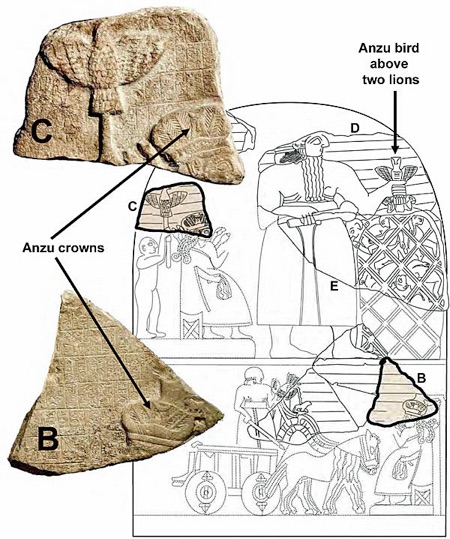
Surviving reliefs from the mythical side of the ‘Stele of the Vultures‘
Image from Giovanni Lovisetto (referenced below, Figure 15, at p. 59)
Reconstruction of missing reliefs from Licia Romano (referenced below, 2007, Figure 1, at p. 21)
Sébastien Rey (referenced below, at pp. 243-58) has recently published a re-evaluation of the reliefs and inscriptions on this stele, together with an analysis of its historical and archeological significance. He argued (at pp. 246-8) that, on the mythological side:
✴in the upper register:
•the large male figure standing at the centre, who holds:
-a mace in his right hand; and
-in his left hand, a casting-net full of naked prisoners of war that is topped by Ningirsu’s emblem, a lion-headed eagle (= the Anzu bird) grasping two lions;
is almost certainly Ningirsu himself; and
•the small head of the figure behind him in front of a battle standard belonged to a goddess whom he identified as Ninhursag; and
✴in the lower register:
•the chariot was probably driven by Ningirsu (albeit that only part of his skirt now survives); and
•the small head to the right probably belonged to the same goddess as the one in the upper register.
He also argued (at p. 247) that, although in reconstructions of both registers, the goddess is often depicted as standing (see, for example, the drawing by Elizabeth Simpson, reproduced in Irene Winter, referenced below, Figure 3, at p. 13):
“... it should probably be assumed that [she] was shown seated, [as in the reconstruction above], possibly on a throne decorated [with symbols of her usual attributes].” I shall return to the identity of this goddess below.
Eanatum’s Divine Patrons
At the start of the inscription on the ‘Stele of the Vultures’, we read that:
“ ... the ensi of Umma committed an aggressive act: he pressed into Lagash, up to its frontier. Akurgal, king of Lagash, son of Ur-Nanshe, king of Lagash ... The ... Lion of the Heart of the Princely Way, Ningirsu, in his (own) voice, made a claim(?) within the wind:
‘Umma, my settled grasses, my own possessions, in the field of the Gu'edena, Lagash shall ... its .... Lord Ningirsu, the hero of Enlil, ... does proclaim(?).’
Ningirsu implanted the semen of Eanatum in the womb ... He (Ningirsu) rejoiced over him (Eanatum).
✴Inanna:
•took a place at his side;
•named him: ‘the one who is fitting for the Eanna of Inanna of the Great Oval; and
•seated him on the right knee of Ninhursag.
✴Ninhursag extended her right breast to him.
✴Ningirsu, the one who had implanted his semen in the womb, rejoiced.
Ningirsu, laid his giant hand (five cubits, one span!) upon him and, with great joyfulness, gave him the kingship of Lagash”, (RIME 1.9.3.1; CDLI, P431075, lines 9’-82’).
Thus, it seems that: ‘cometh the hour; cometh the man’: Ningirsu’s response to the threat from Umma was to arrange for the the birth of a son, Eanatum, and to appoint:
✴Inanna as what we might call his godmother; and
✴Ninhursag as his wet nurse (although, as we shall see, Eanatum later referred to her as ‘my mother’).
Ningirsu then declares Umma as his enemy because its leader has misappropriated the Gu’edena and appears to the (apparently now fully grown) Eanatum in a dream:
“To him who lay sleeping, to him who lay sleeping, [Ningirsu] came to stand by his head. To Eanatum, who lay sleeping, his beloved king, Ningirsu, came to stand by his head. ... [Ningusu then spoke to the sleeping Eanatum]:
‘... Umma, like Kish, shall therefore wander about and shall surely be removed by means of ones seized by anger(?):
✴On your right side, I shall let Utu come forth upon you.
✴... on your forehead.
... Enanatum, .... I shall smite him and I shall make their myriad corpses stretch to the horizon. Umma ... They [presumably the people of Umma] shall raise a hand against him and they shall kill him in the heart of Umma”, (RIME 1.9.3.1; CDLI, P431075, lines 121’-150’).
The surviving text is silent on two interesting aspects of this now-fragmentary account of Eanatum’s dream:
✴why did Kish feature in it (pparently as an ally of Umma); and
✴were any of the leading men of Umma killed in the heart of their city after their defeat.
This is dream seems to be the prelude to Eanatum’s victory over Umma, after which, its ruler was forced to swear on the casting nets of Enlil, Ninhursag, Enki, Sin and Utu to respect Ningirsu’s rights (as mentioned above). Furthermore, he alerted each of these gods to the existence of these oaths by sending messages carried by:
✴two doves to Enlil, king of heaven and earth, at the Ekur in Nippur (lines 263’-267’);
✴two doves to ‘my mother’, Ninhursag at Kesh, (lines 315’-318’);
✴two doves to Enki, king of the Abzu, (lines 368’-372’);
✴four doves to Sin, ‘my king’, the impetuous calf of Enlil, (lines 428’-438’); and
✴two doves to Utu, king of vegetation, at the Ebabbar at Larsa, (lines 488’-490’).
In each of these cases, the deity in question was instructed that, should the oath be broken§, he/she should send his/her casting net down from the sky to envelop Umma. Interestingly the situation with the earth goddess Ninki is slightly different (possibly because she did not have a casting net): the text explaining how she was sent the news is now lost, but, in the event that the oath was broken, she was instructed to release snakes from the ground and make them sink their fangs into the feet of (presumably the people of) Umma (lines 513’-563’).
Finally, we come to the list of Eanatum’s ‘foreign victories’ (discussed above). This was prefaced by the following list of his divine patrons:
“Eanatum, lugal (king) of Lagash:
✴given strength/power by Enlil;
✴fed wholesome milk by Ninhursag;
✴given a good name by Inana;
✴given wisdom by Enki;
✴chosen by the heart of Nanshe, the powerful mistress, kur gu2 gar-gar (the subjugator of the lands) of Ningirsu;
✴the beloved of Dumuzi-Abzu;
✴nominated by Hendursag;
✴beloved friend of Lugaluru;
✴beloved husband of Inanna”, (lines 564’-605’).
In this context, we should also consider another inscription of Eanatum (RIME 1.9.3.10; CDLIP431085), which is on a fragmentary vase from Lagash that is now apparently in the Iraq Museum) records Eanatum’s construction of a structure for Ningirsu that he dubbed the E-za (Stone House):
“For the god Ningirsu, warrior of the god Enlil: Eanatum, ensi of Lagash:
✴á-sum-ma (granted power by) Ningirsu;
✴[the one] who restored to Ningirsu his beloved Gu’edena;
✴[the one] who subjugates the lands for Ningirsu;
... built the E-za (Stone House) for the god Ningirsu out of silver and lapis lazuli. He [also] built for him a storehouse, a building of alabaster stone, and amassed piles of grain for him (there). Eanatum:
✴[the one to whom] Ningirsu granted the gidru (sceptre).
His personal god is Sul-MUSHxPA.”
Identity of the Goddess of Fragments B and C
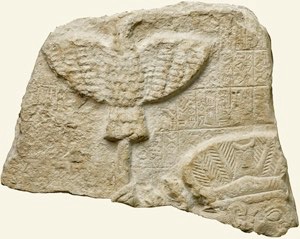
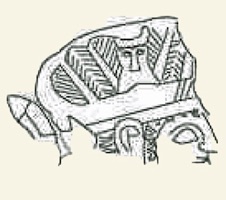
Relief on the obverse of fragment C of the ‘Stele of the Vultures’: head of a goddess in front of an eagle standard
Left: image of the relief, from the website of the Musée du Louvre (AO 50):
Right: Sketch of the head of the goddess, from Licia Romano (referenced below, 2008, Figure 2c, at p. 52)
Sébastien Rey (referenced below, at p. 246) asserted (at p. 246) that the seated goddess is:
“... his mother, Ninhirsag, .... the Lady of the Mountain.[who] is closely associated with her son in all the myths relating to [him], and she appears in fragments B and C wearing [an Anzu] crown.”
He also observed (at p. 247) that:
“... the tips of some mace heads [are visible] behind her shoulders [in fragment B], a set of motifs that can also be made out ... on fragment C.”
He argued (at p. 246) that the identification of this goddess as Ninghursag is strengthened by the fact that, in fragment C, she is seated in front of a standard topped with ‘another [Anzu bird] or an eagle’, but, as Piotr Steiinkeller (referenced below, 2019, at p. 1000, note 63) observed, it is clear from photographs that the bird’s head on this standard is not that of IM-dugud (=Anzi bird).
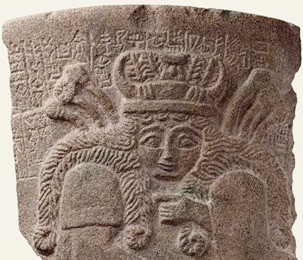
Fragment of a stone vessel of unknown provenance (detail)
Now in the Staatliche Museen zu Berlin, Vorderasiatisches Museum (VA 7248)
Having said that, Steinkeller (as above) argued that the identification of the goddess depicted on the obverse of the ‘Stele of the Vultures’:
“... as Ninhursag is assured by the fact that there is a head of IM-dugud [=Anzu bird] drawn within the goddess’s crown. The same feature, which obviously references Ninigirsu/Ninurta as Ninhursag’s son, appears also in the representation of a seated goddess on an inscribed Lagash bowl made of stone [illustrated above]. Because of this, the goddess [depicted on the ‘Stele of the Vultures’] needs to be identified as Ninhursag.”
Actually, although the fact that goddess depicted in VA 7248 wears an Anzu crown does almsot certainly mean that this vase came from Lagash, it does not automatically identify her as Ninhursag. The now-fragmentary inscription (RIME 1.09.05.25; CDLI, P431142) allows us to assume that the vase was dedicated by a ruler of Lagash who had built:
✴the E’engura (temple) of the Zulum for Nanshe;
✴the Abzu of Pasira for ‘Enki, the king of Eridu’; and
✴a now-unnamed temple for Ninhursag.
Douglas Frayne (referenced below, at p. 228) attributed this inscription to Enanatum I, presumably because he is the only ruler of Lagash in the ED period who is known to have built a temple dedicated to Ninhursag
However, it seems to me that the evidence from surviving myths is not particularly useful for the events of a reign as early as that of Eanatum and, in any case, Ninhursag is more commonly associated with Enki in the myths that do survive. Furthermore, the evidence from the standard in fragment C is very weak: as Piotr Steinkeller (referenced below, 2019, note 63, at p. 1001) observed:
“... as clearly shown by [published photographs of obverse fragment C, including the one reproduced above], the head [of the bird on this standard behind the goddess] is distinctly different [from the Anzu bird closing the net in obverse fragment E].
Eanatum and Inanna
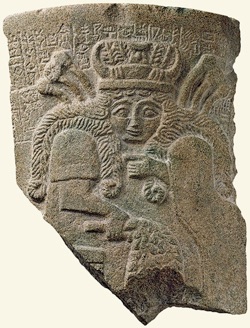
Image of goddess with similar iconography to the goddess on the ‘Stele of the Vultures’
Now in the Staatliche Museen, Berlin (VA 7248): image from website of the Morgan Library
As we have seen, Renate van Dijk-Coombes (referenced below, at p. 201) argued that the goddess depicted in both of the registers on the obverse of the ‘Stele of the Vultures’ (fragments B and C, illustrated above) is probably Ninhursag or possibly Inanna (and she pointed out, at note 8, that she is sometimes identified as Nisaba).
The relevant iconographic evidence for this identification is provided by the two other reliefs that are illustrated above:
✴that on one side of an inscribed limestone stele from Lagash that is now in the Iraq Museum (IM 61404), which dates to the reign of Ur-Nanshe, Eanatum’s grandfather; and
✴that on a fragment of an inscribed stone vessel that is now in the Staatliche Museen, Berlin (VA 7248), which almost certainly came from Lagash or Girsu and dates to the reign of Enmetena, Eanatum’s nephew.
Ur-Nanshe is depicted on the other side of the first stele, identified by inscription (RIME 1.9.1. 6a; CDLI, P431039) as:
“Ur-Nanshe, son of Gu-NI.DU), ensi of Lagash, [the one who] built the Ibgal (= great oval temple of Inanna at Girsu).”
He is accompanied on this face of the by a cup-bearer and, below them, his wife and daughter, all identified by inscription. Most of the other inscriptions on both sides of the stele are now lacunose and largely illegible, although the first line duplicates the inscription identifying Ur-Nanshe as the builder of the Ibgal, which suggests that the enthroned goddess depicted on the opposite side in Inanna. Giovanni Lovisetto (referenced below, at p. 55) observed that she:
“... holds a branch of dates [in her right hand] and possibly a cup, while her extraordinarily long and voluminous hair falls from a (possibly horned) headdress over her shoulders.”
The inscription (RIME 1.9.5. 25; CDLI, P431142) on the Enmetena vase reads:
“... he [= Enmetena] built E-engur of Zulum for [the goddess Nanshe: he built Abzu-pasira for the god Enki, king of Eridu; [he built the giguna [for] goddess Ninhur[sag]; ... when ... had been granted [presumably by a goddess], he, [Enmetana] set up (this) bur-sag vessel for her.”
Inanna is mentioned in some of the surviving fragments of the inscribed text:
✴as Pirjo Lapinkivi (referenced below, at p. 20) pointed out, Eanatum is referred to as the dam kiag2 (beloved spouse) of Inanna (at reverse, lines 586’-587’); and
✴she is also referred to (at obverse, lines 56’-60’) as:
“Inanna, [who] ... named -Eanatum] as:
‘[the one who is] fitting for the E-anna of Inanna of the Ib-gal (‘great oval’ [temple])”.
This is a reference to a temple excavated at at Lagash that had an outer oval-shaped walled court, which is known from inscribed foundation figurines as the Ibgal of Inanna (see, for example, Paul Collins, referenced below, at p. 105).
In this context, we should also consider another inscription of Eanatum (RIME 1.9.3.10; CDLI, P431085), which is on a fragmentary vase from Lagash that is now apparently in the Iraq Museum) records Eanatum’s construction of a structure for Ningirsu that he dubbed the E-za (Stone House):
“For the god Ningirsu, warrior of the god Enlil: Eanatum, ensi of Lagash:
✴á-sum-ma (granted power by) Ningirsu;
✴[the one] who restored to Ningirsu his beloved Gu’edena;
✴[the one] who subjugates the lands for Ningirsu;
... built the E-za (Stone House) for the god Ningirsu out of silver and lapis lazuli. He [also] built for him a storehouse, a building of alabaster stone, and amassed piles of grain for him (there). Eanatum:
✴[the one to whom] Ningirsu granted the gidru (sceptre).
His personal god is Sul-MUSHxPA.”
Anzu
A third important iconographical figure of this side of the stele is the so-called Anzu bird, which appears in:
✴in at least three places (marked A in the drawing above), as an emblem of some sort on:
•a battle standard;
•the top of Ningirsu’s battle-net; and
•adorning his chariot; and
✴as a lion’s head surrounded by feathers in the so-called ‘Anzu crown’ of both. figures of the goddess (marked a in this drawing).
As we have seen, this figure:
✴may have been reflected in the archaic ‘Feathered Figure Plaque’; and/or
✴was certainly represented on two earlier objects from Lagash/Girsu:
•the mace of Mesilim; and
•the so-called ‘Plaque of the Anzu Bird’ of Ur-Nanshe.
I discuss the identity of the goddess wearing the ‘Anzu crown’, the iconographical significance of the Anzu bird and its association with Ningirsu below.
It is difficult to know what Eanatum gained from these many and widespread victories recorded in these inscriptions: while we can imagine that they brought him both booty and prestige (and perhaps the right to tribute and military conscripts on an on-going basis), the extent of his political influence over the conquered cities is unclear. As noted above, Aage Westenholz (referenced below, 2020, at pp. 697-8) argued that Eanatum’s victories over cities that were far from Lagash does not prove that he established anything approaching a Sumerian state, centred on Lagash. While this is certainly true, it does seem to me that Eanatum’s claim that:
✴Inanna had given him the kingship of Kish; and
✴Kish had ‘trembled before him’;
does suggest that he had established hegemony over Kish for a period after his victory. Indeed, it is tempting to suggest that sought to present himself as a ‘new Mesilim’. Nevertheless, it seems that any such eminence was short-lived, since nothing in the surviving evidence suggests that any subsequent ruler of Lagash claimed the title ‘king of Kish.
Note Eanatum received the sceptre from Ningirsu
This figure takes its name from an Akkadian legend in which Ningirsu killed the Anzu bird. However, since this legend is known from only two texts from Susa that date to the Old Babylonian Period (ca. 2000 BC), we cannot simply assume that the this text corresponds directly to the oral tradition that must have been reflected in the iconography some 5-7 centuries earlier. For example, Chikako Watanabe (referenced below, at p. 32) has recently analysed the evolution of the iconography of the lion-headed eagle in early Mesopotamia:
“The lion-headed eagle, which comprises a bird of prey with the head of a lion, appears in the earliest pictorial representations shown in seal impressions which date back to the Uruk period. In this early period, the creature is represented in profile flying over captured enemies with wings stretched upright and head lowered; ... During the Early Dynastic period the lion-headed eagle was depicted in frontal view with wings and legs spread wide to stand over a pair of animals, such as
ibexes;
stags; or
lions.
[Frans Wiggermann (referenced below, at pp. 161-2)] identified the lion-headed eagle as Anzu and, when the creature is combined with the pairs of animals, they were thought to be associated with:
the god Enki in the case of the ibex [source ??]’
the goddess Ninhursag, in the case of the stag [see the relief BM 114308 at the Britiosh Museum, from the Temple of Ninhursag at Ur]; and
the god Ningirsu in the case of the lion.
The creature is also depicted on the ‘Stele of the Vultures’ together with a pair of lions’ heads, which are represented below the lion-headed eagle, on top of a net. The net contains naked enemies of Girsu; a large male figure grasps the tail feathers of the lion-headed eagle.
Enanatum I
Text
References:
Rey S., “The Temple of Ningirsu: the Culture of the Sacred in Mesopotamia”, (2024) University Park, PA
Lovisetto G., “Goddesses Visualized in Early Dynastic Mesopotamia”, in:
Babcock S. and Tamur E. (editors), “She Who Wrote: Enheduanna and Women of Mesopotamia, ca. 3400–2000 BC”, (2022) New York, at pp. 46-63
Westenholz A., “Was Kish the Center of a Territorial State in the Third Millennium?—and Other Thorny Questions”, in:
Arkhipov I. et al. (editors), “The Third Millennium: Studies in Early Mesopotamia and Syria in Honor of Walter Sommerfeld and Manfred Krebernik”, (2020) Leiden and Boston, at pp. 686-715
Steinkeller P., “Texts, Art and Archaeology: An Archaic Plaque from Mari and the Sumerian Birth-Goddess Ninhursag”, in:
Chambon G. et al. (editors), “Mélanges Assyriologiques en l'Honneur de Dominique Charpin”, (2019) Leuven, Paris and Bristol CT, at pp. 977-1012
Watanabe Ch. E., “Composite Animals in Mesopotamia as Cultural Symbols”, in:
di Paolo S. (editor), “Composite Artefacts in the Ancient Near East: Exhibiting an Imaginative Materiality, Showing a Genealogical Nature”, (2018) Oxford, at pp. 31-8
van Dijk-Coombes R. M., “Lions and Winged Things: A Proposed Reconstruction of the Object on the Right of the Lower Register of the Mythological Side of Eanatum's Stele of the Vultures”, Die Welt des Orients, 47:2 (2017) 198-215
Romano L., “La Corona del Dio: Nota sull’ Iconografia Divina del Protodinastico”, 14 (2008) 41-57
Frayne D. R., “The Royal Inscriptions of Mesopotamia, Vol. 1: Presargonic Period (2700-2350 BC)”, (2008) Toronto
Lapinkivi P., “The Sumerian Sacred Marriage and Its Aftermath in Later Sources”, in:
Nissinen M. and Uro R. (editors), “Sacred Marriages: The Divine-Human Sexual Metaphor from Sumer to Early Christianity”, (2008) University Park, PA, at pp. 7-42
Romano L., “La Stele degli Avvoltoi: una Rilettura Critica”, Vicino Oriente, 13 (2007) 3-24
Collins P., “The Sumerian Goddess Inanna (3400-2200 BC)”, Papers from the Institute of Archaeology, 5 (1994) 103-18
Winter I, J., “After the Battle Is Over: The ‘Stele of the Vultures’ and the Beginning of Historical Narrative in the Art of the Ancient Near East”, Studies in the History of Art, 16 (1985) 11-32