Empires of Mesopotamia:
First Dynasty of Ur
Lyres from the ‘Royal Cemetery’ of Ur


Empires of Mesopotamia:
First Dynasty of Ur
Lyres from the ‘Royal Cemetery’ of Ur
Lyres From the Royal Cemetery
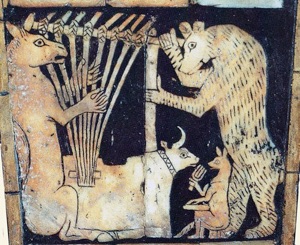
Shell relief from the sound box of a lyre (U. 10556) from the death pit of PG 789 (described bellow).
As we shall see, Leonard Woolley discovered a number of metal bull’s heads and associated shell plaques in some of his royal graves in the cemetery of Ur. As Renate van Dijk (referenced below, at pp. 1-2) observed, by th time of their excavation, their wooden cores had disintegrated, but Woolley was often able to pour
“... plaster into the cavity left behind, which, when removed from the earth, revealed the shape of the instrument. These bulls’ heads were attached to the sound boxes of lyres. The sound box formed the abstract body of the bull, while the bulls’ heads were rendered in a more realistic style. The shape of these instruments is confirmed by archaeological and iconographic evidence.”
One such pice of evidence is from the shell plaque illustrated above, which (as we shall see) decorated the front of the lyre that Woolley discovered in the Death Pit of PG 789.
In this section, I discuss the surviving remains of seven of these lyres lyres (including that from the death pit of PG 789), with an emphasis of the iconography of the images in the shell reliefs that originally decorated the fronts of their sound boxes.
Lyres from the Death Pit PG 1237
As discussed in my page on the Royal Cemetery, Leonard Woolley (referenced below, 1934a, at p. 113) referred to PG 1237 as the ‘Great Death Pit' because it contained the remains of 74 human bodies, only 5 of which were those of men:
“The other 68 occupants of the pit were women who lay for the most part in well-ordered rows across the pit from northwest to southeast: [however], six kept rather apart in the south corner, where were the remains of a canopy (?):
✴two were against the south-east wall:; and
✴four were grouped [among] four lyres which also against [this] wall, nearer to the east corner.”
Later in his account (at p. 124), he argued that:
“ ... someone had certainly gone down into the death pit ... and placed [these] lyres on the top of the dead bodies there.”
The implication is that the four women who lay underneath these lyres had probably played them during the burial of the presumably royal person for whom this death pot had been laid out.
The two of these lyres (U. 12353 and U. 12354) that are relevant to this discussion are discussed, in turn, below.
Golden Lyre
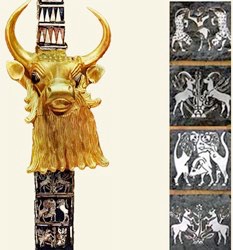
Left: Front of the reconstructed sound box of a lyre (U. 12353) from tthe east corner of PG 1237
Image from Leonard Woolley (referenced below, 1934b, Plate 115)
Right: Modern reproduction of the shell reliefs (from Carole Rawcliffe, referenced below, at p. 71)
The remains of the golden lyre (U. 12353) were exhibited in the Iraq Museum (IM 8694), at least until 2003, when they fell victim to the chaos that followed the US invasion. According to Leonard Woolley (referenced below, 1934a, at p. 301), the bull’s head attached to the sound box, a particularly heavy and thick layer of gold had been hammered over a core. The four plaques below it depict (from the uppermost register);
✴a bull-man holding a pair of leopards by their tails;
✴a pair of mountain goats eating the leaves of trees in a mountain setting;
✴a pair of lions attacking a down-facing mountain goat; and
✴a pair of deer (?) eating the leaves of trees in a mountain setting.
[Lyre U. 12353 had largely consisted of unsheathed wood that that had decayed, although most of the mosaic border of its sounding box remained in situ and the four mosaics that had decorated its front also survived in their relative positions. Woolley also recorded (at p. 301) that the bull’s head is made from an unusually thick layer of gold hammered over a core.]
Silver Lyre
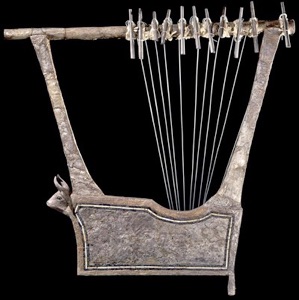
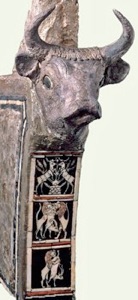
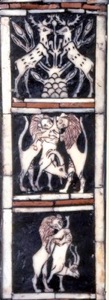
Restored silver lyre (U. 12354) from the east corned of PG 1237
now in the British Museum (BM 121199); images from the museum website
The remains of the silver lyre (U. 12354) are now in the British Museum (BM 121199). According tp Leonard Woolley (referenced below, 1934am at p. 582), the whole instrument was made of wood overlaid with thin sheet silver. The three plaques depict (from the uppermost register);
✴a pair of antlered deer eating the leaves of trees in a mountain setting;
✴a pair of lions attacking a down-facing mountain goat; and
✴a lion attacking a down-facing mountain goat.
[Lyre U. 12354 had been made of wood overlaid with very thin plates of silver and, although the lyre had been crushed and wood between the silver layers had disappeared, the film left by the wood allowed the sliver layers to be separated, to the extent that Woolley was able to describe the restored instrument as a shadow, albeit a faithful one, of its former self. ]
Silver Bull’s Head and Plaques from the Burial Chamber PG 800b
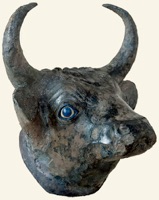
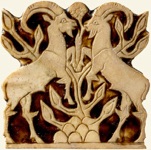
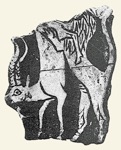
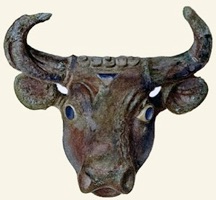
A B C
Objects found at the foot of the coffin of Pu-abum (location 51)
A: Text Silver bull’s head (U. 10916), now in the Penn Museum (B17065): image from the museum website
B: Shell plaque (U. 10917a), now in the British Museum (BM 121529): image from the museum website
C: Shell plaque (U. 10917b), now lost ?: image from Leonard Woolley (referenced below, 1934b, Plate 100)
Leonard Woolley (referenced below, 1934a, at p, 91) recorded that, during his excavation of the burial chamber of the famous Queen Pu-abum (PG 800b). he found the objects illustrated at the foot of her coffin (locations 51 and 52). He described them as:
✴a silver bull's head (U. 10916); and
✴two shell plaques:
•one (10917a) that survived in tact; and
•one (10917b) of which only a fragment survived;
and suggested that they had decorated the sound box of a lyre. It is generally accepted that the bull’s head probably did come from the sound box of a lyre, although the original function of the two shell plaques is less clear [reference needed]. the plaques depict (respectively):
✴a pair of mountain goats eating the leaves of trees in a mountain setting; and
✴a lion attacking an upturned ibex (?).
Lyres from the Death Pit of PG 789
Although the burial chamber PG 789 (which abutted the earlier burial chamber of Pu-abum discussed above) was thoroughly looted at the time of its excavation, the death pit that was associated with it survived in tact. It contained 63 human corpses, and a large number of important objects were distributed between them. According to Leonard Woolley (referenced below, 1934a, at pp. 69-70), these objects included the remains of two lyres:
✴the Great Lyre (U. 10556), which had lain:
“... [against] the northwest side of the pit, standing over the top of the bodies there; and
✴a second lyre ((U. 10557), which had lain:
“... against the [nearby southwest] wall of the [burial] chamber, ... and actually standing on the skull of one of the [female corpses] ...”
I discuss these two lyres in turn below.
Great Lyre
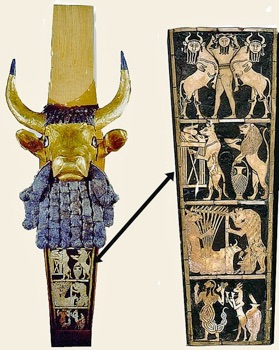
Reconstruction of the sound box of a lyre (U. 10556) from PG 789, now in the Penn Museum
Left: Front view, showing the head of a bearded bull made of gold sheet and lapis lazuli (B17694B)
Right: enlarged view of the reconstructed shell plaque on the front panel (B17694A):
image from the website of the Morgan Library and Museum
Inevitably, the wooden parts of the instrument had decayed by the time of its excavtion, although its outline could still be recognised. The surviving elements were made up of:
✴a bull’s head that was made of gold sheet over a wooden core (with the beard and hair made of lapis lazuli), which had decorated the sound box; and
✴four shell plaques that had been set in bitumen and arranged below it in four registers below it.
According to Donald Hansen (referenced below, at pp. 105-7), the
✴the plaque in top register depicts a naked hero who grasps a pair of human-headed bulls; and
✴the three lower registers probably depict the preparations for his funerary banquet, either prior to or following his arrival in the netherworld:
•a canine with human hands who acts as a butcher carries a table stacked with raw meat, followed by a lion carrying a large jar and a pouring vessel;
•a seated ass plays a bull-headed lyre which is supported by a bear, and a smaller animal that sits of the bear’s foot holds a sistrum (as also illustrated at the top of this page); and
•a scorpion man:
-walks ahead of a gazelle that has the upper body of a human and carries two beakers; and
-carries a cylindrical object (a scroll ?) that probably came from the large vessel behind the gazelle.
Copper Bull’s Head and Plaques
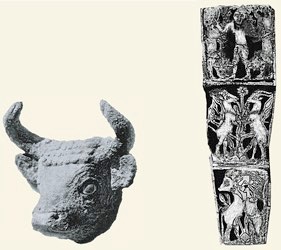
Remains of a lyre (U. 10577 ) from the death pit PG 789: now in the British Museum (not displayed)
Image of bull’s head from Leonard Woolley (referenced below, 1934b, at Plates 120)
Image of plaque reliefs from Jack Cheng (referenced below, Figure 1, at p. 166)
As noted above, these remains were found against Leonard Woolley (referenced below, 1934a, at p. 69), this lyre had been placed against the southwest wall of the burial chamber, where it was ‘actually standing on the skull’ of one of the female corpses that lay there. In an earlier record (at p. 65), he characterised the 12 female corpses (numbers 51-62) that lay against this wall as:
“... the most important, (or at least the most richly adorned) of all [the corpses that were found in the pit].”
He also recorded (at p. 69) that:
“All that really remained of the lyre was the decoration of the front of the sounding-box, namely:
✴the head of a young bull cast in copper; and
✴three shell plaques engraved with animal scenes, ... [which] had suffered a good deal from the decay of the surface of the shell.
The copper head was in excellent condition.”
The plaques depict (from the top):
✴a naked hero holding two upturned lions (?) that each bites one of his legs;
✴a pair of mountain goats eating the leaves of trees in a mountain setting; and
✴a lion a lion grasping a deer by its neck and biting the back of its head.
Lyre from the Death Pit PG 800a
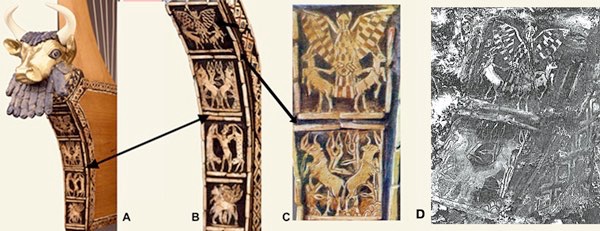
Part of the reconstructed sound box of a lyre (U. 10412) from PG 800a, now in the British Museum (BM 121198).
Images A and B from the museum website
Image C from a painting by Mary Baker, reproduced by Leonard Woolley (referenced below, 1934b, Plate 110)
Image D: Top two plaques in situ: image from Leonard Woolley (referenced below, 1934b, Plate 108)
As argued in my page on the Royal cemetery, the death pit PG 800a was laid out above the burial chamber and death pit PG 789 after an unknown period of time and was unrelated to it. As Leonard Woolley (referenced below, 1934a, at p. 74) recorded:
“At the southwest end of the [pit] there lay a harp [= the lyre U. 10412] and the bodies of 10 women . The ‘harp’ stood against the pit wall, and one [of the women] lay right against it with the bones of her hands actually in the place of the strings; she must have been the ‘harpist’ and was playing almost to the last. The other 9 women were ranged in two rows facing each other, 3 in one and 6 in the other; all wore the rich head-dress of the court.”
The original object is often (but incorrectly) referred to as ‘the queen’s lyre’ because Leonard Woolley incorrectly associated this death pit with the burial chamber (PG 800b) of Queen Pu-abum.
The wooden parts of the instrument had decayed, although its outline could still be recognised. The surviving elements were from its sound box. They comprised:
✴a bull’s head that had lost its horns, which was made of gold sheet over a wooden core, with the beard and hair made of lapis lazuli; and
✴four plaques made of lapis lazuli, shell and red limestone mosaic set in bitumen, which were arranged in four registers below it.
As now reconstructed, the four plaques depict (from the uppermost register):
✴a lion-headed eagle grasping a pair of goats (an iconography that is not found in association with any other lyre found at Ur); and
✴three scenes using conventional iconography:
•a pair of bulls eating the leaves of trees in a mountain setting;
•a bull-man holding a pair of leopards by their hind legs; and
•a lion grasping a deer by its neck and biting the back of its head.
Copper Bull’s Head and Plaques from the Death Pit PG 1332
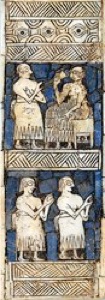
Left: Bull’s head and shell plaques from a lyre (U. 12435 ) from the death pit PG 1332
Now in the Penn Museum (30-12-696 and 30-12-484 respectively)
Images from Leonard Woolley (referenced below, 1934b, at Plates 116- and 117 respectively)
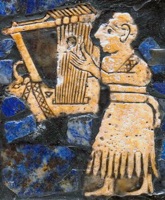
Right: Image of a lyre on the Standard of Ur: image from the British Museum website (BM 121201)
As Leonard Woolley (referenced below, 1934a, at p.124) recorded, this death pit contained about 43 human corpses laid out in two layers that were separated by a layer of earth just over a meter in height. He never found an associated burial chamber and never identified the corpse of the primary burial. Furthermore, the grave goods around the corpses were apparently unimpressive, although, as he observed (at p. 126):
“This lamentable poverty was, to some extent, relieved by the presence of a lyre [= U. 12435, in the lower level] at the northeast end of the death pit.”
He noted that, with one exception, all of the bodies in this lower layer were arranged with their heads facing south or southwest. The exception (which he labelled body 3) lay with its head in the north corner of the pit beside the lyre and a curved copper wand that he identified (at p. 128) as one of what would have been a pair of castanets (long metal clappers mounted on wood) that were beaten together to ‘emphasise the rhythm for the dancers’. For this reason he identified ‘body 3’ as ‘the musician’ (at p. 124). Donald Hansen (referenced below, at p. 107) observed that the lyre found near his body was probably a smaller version of those discussed so far, and similar to those carried by musicians on ‘relief plaques and seals’ (see for example the musician illustrated on the right above, in a detail from the ‘banqueting scene’ of the Standard or Ur.
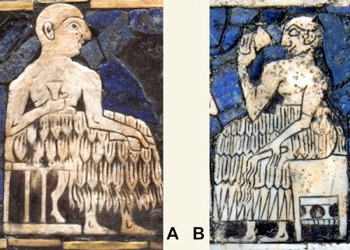
A: Image of a king at a banquet on the Standard of Ur: image from the British Museum website (BM 121201)
B: Enlarged image of the seated figure in the top register of U. 12435
Unlike all of the other lyre plaques discussed so far, the two on this lyre:
✴were formed using the same technique as that used (for example) for the images in the Standard of Ur (see Leonard Woolley, referenced below, 1934a, at p. 263); and
✴depict only humans (as opposed to mythological creature) in a ‘real’ world setting.
Furthermore, the most important of these four men (illustrated again above, as image B) is very similar to the king (illustrated above, as image A) who, (on the ‘peace side’ of the Standard of Ur) presides over the banquet at which the lyre mentioned above was played: each figure:
✴is the only one of the men depicted who a ‘flounced’ skirt; and
✴holds a beaker in one had and a branch (probably a date branch, symbolising kingship - see Jerald Starr, in this page of his website ‘Sumerian Shakespeare’) in the other.
Donald Hansen (referenced below, at p. 107) suggested that the four men depicted on the lyre are participating in an Early Dynastic banquet scene, and that:
✴the seated figure is the banqueter; and
✴the other three are his attendants.
References
Miller et al., “A Sacred Landscape of Sumer: Statuettes from Ur Depicting a Goat on a Tree”, Journal of Ancient Near Eastern Religions”, 20 (2020) 27-47
van Dijk R. M., “Mesopotamian Early Dynastic Bull-Lyres”, in:
"Calidoscopio del Pasado:’ XIV Jornadas Interescuelas / Departamentos de Historia: Facultad de Filosofía y Letras, Universidad Nacional de Cuyo., Mendoza, Argentina (2013), at pp. 1-17
Cheng J,, "A Review of Early Dynastic III Music: Man’s Animal Call”, Journal of Near Eastern Studies, 68:3 (2009) 163-78
Rawcliffe C. et al., “Laser Engraving Gulf Pearl Shell - Aiding the Reconstruction of the Lyre of Ur “, in:
Nimmrichter J. et al. (editors), “Lasers in the Conservation of Artworks: LACONA VI Proceedings, Vienna, Austria, Sept. 21–25, 2005”, (2007) Heidelberg, at pp. 68-74
Marchesi G., “Who Was Buried in the Royal Tombs of Ur? The Epigraphic and Textual Data”, Orientalia, NS 73:2 (2004) 153-97
Hansen D. P., ”Great Lyre’ with Bull’s Head and Inlaid Front Panel”, in:
Aruz J. and Wallenfels R. (editors), “Art of the First Cities: The Third Millennium BC, from the Mediterranean to the Indus”, (2003) New York, at pp. 105-7
Woolley C. L. (1934a), “Ur Excavations (Volume I): The Royal Cemetery (Text)”, (1934) London and Philadelphia PA
Woolley C. L. (1934b), “Ur Excavations (Volume II): The Royal Cemetery (Plates)”, (1934) London and Philadelphia PA