Empires of Mesopotamia:
Kingdom of Kish in the ED IIIa/Fara Period


Empires of Mesopotamia:
Kingdom of Kish in the ED IIIa/Fara Period
Fara Period
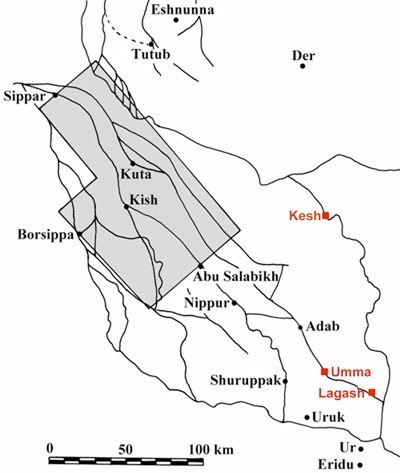
Probable area of the Kishite state suggested by information in the the Fara Tablets
Map adapted from Dorota Ławecka (referenced below, Figure 5, at p. 437), my additions in red
This period in the history of Mesopotamia is so-designated because it is documented by the ca. 1,000 administrative, lexical and literary texts that were discovered at Fara, the site of ancient Shuruppak, during excavations by the Deutsche Orient-Gesellschaft. As Walther Sallaberger and Ingo Schrakamp (referenced below, at p. 62) observed:
“Recent research, (using archaeological and philological arguments) has demonstrated that the majority of the texts from the DOG excavations date to the ED IIIa period. They were probably written within a short period of time (ca. 10-15 years, or [perhaps] ca. one generation). .... [Similar] texts from Abu Salabikh show palaeographic features similar to those from Fara, [although some] palaeographic peculiarities ... point to a somewhat later date.”
However, Piotr Steinkeller (referenced below, 2024, note 35, at p. 12) cited other sources that characterise the texts from Abu Salabikh as being close in time to the Fara texts or perhaps marginally later.
As Dorota Ławecka (referenced below, at p. 427-8 observed, these texts:
“... belong to the archive of an important, supra-regional administration centre, apparently operating during a difficult time, under serious threat of invasion, and finally during a war. Several southern cities (namely Adab, Lagash, Nippur, Umma, Uruk and Shuruppak) act in concert. Their alliance seems to be so close that it was dubbed by Francesco Pomponio [(referenced below, 1994)] the ‘Hexapolis of Shuruppak’. Close ties are confirmed by the references to the officials from these cities who were working together and were paid in Shuruppak, and also by common economic enterprises, like sheep breeding. ... It is interesting that the same toponyms, even in a similar order, are mentioned on school tablets from Abu Salabikh and Ebla. It seems that we are dealing here with a stable alliance, a league or cooperation and not with an ad hoc undertaking. To the north of it, we have only Kish. It is frequently mentioned in the tablets from Fara but in different contexts. It seems that Kish did not take part in the Sumerian ‘Hexapolis’. ... In my estimation of the Kish state area I will consider Abu Salabikh north of Nippur as its southern border. A hint regarding the northern extent can be found on one of the Fara tablets, where a man from Sippar employed by the king is referred to. ... The resulting, very rough and approximate, assessment of the state’s area would be around 10,000 square kilometers.”
Walther Sallaberger and Ingo Schrakamp (referenced below, at pp. 62-3) similarly observed that:
“Fara/Shuruppag was a member of a supra-regional organisation ... that was formerly referred to as ‘Kiengi League’ and more recently named the ‘Hexapolis of Shuruppak’ or ‘Regio’. According to administrative texts, this organisation included Kish, Zimbir/Sippar, Nippur, Adab, Kesh, Ahutiki , Umma, Lagash and Uruk-Kulaba.”
Clearly the ‘Hexapolis of Shuruppak’ should be made up of only six, cities (Adab, Lagash, Nippur, Umma, Uruk and Shuruppak: the other cities mentioned here (principally Kish, Sippar and Kesh) are all mentioned in the texts relatively frequently, but not in a military context. In the illustration above, I have added Umma, Lagash and Kesh to Dorota Ławecka’s ‘Map 5’ in order to represent the political geography of the region as it appears in the Fara texts. I should add here that, although the location of ancient Kesh has long been the subject of debate, Piotr Steinkeller (referenced below, 2022, at p. 4) noted that, following a recent discovery:
“... the religious centre of Kesh, which ... can positively be identified as one of the ten tells forming the site of Tulul al-Baqarat [about 50 km north of Adab - see the map above].”
Kiengi League (aka Hexapolis of Shuruppak)
Two of the Fara texts are of central importance for the membership pf Pomponio’s hexapolis:
✴WF 92 (P011049):
•182 gurush (men) of Uruk
•192 (men) of Adab
•94 (men) of Nippur
•60 (men) of Lagash
•56 (men) of Shuruppak 86 (men) of Umma
•The ones stationed (here): they came (from) Kiengi (=Sumer)
•Entrusted (to the military command): a total of 670 men, the ones stationed (here)
✴WF 94 (P011051:
•140 gurush (men), lu2-tush (residents) of Uruk
•215 (men, residents of) Adab
•74 (men, residents) of Nippur
•110 (men, residents of) Lagash
•66 (men, residents of) Shuruppak
•128 (men, residents of) Umma
•A total of 650 [actually 733] men, residents of Kiengi: the reason for the arithmetic discrepancy is unclear.
As Piotr Steinkeller (referenced below, 2024, at p. 4) argued:
“All these individuals, who without any doubt were soldiers, [were] apparently brought to Shuruppak and entrusted there to some military agency.”
In other words, these texts arguably indicate that, at some time in the Fara Period, six city states of Kiengi (Uruk, Adab, Nippur, Lagash, Shuruppak and Umma) formed part of a military alliance and, on at least two occasion, they all dispatched men to Shuruppak, where they seem to have been placed under a single overall commander. In what follows:
✴the term ‘Kiengi League’ refers specifically to this military alliance of six Sumerian cities; and
✴references to the work of Piotr Steinkeller refer to his important paper of 2024 unless otherwise stated.
Steinkeller (in his Appendix 1, at pp. 15-9) produced transliterations and translation of these two texts (his Text 1 and Text 2) and six others that were apparently concerned with the affairs of the Kiengi League. Two of these (discussed at p. 4) were of particular importance:
✴WF 101 (P011059: Steinkeller’s Text 3):
•670 men who went to battle, they ate food
•1,612 men (stationed) ki-unkin (= in the camp), they ate food (and) anointed themselves with oil.
✴WF 93 (P011050: Steinkeller’s Text 4):
•1,532 men, 39 junior masons, 41 female workers;
•a total of 1612 people who ate food 47 men who went to Kish
He argued that:
✴the 670 men from Uruk, Adab, Nippur, Lagash, Shuruppak and Umma in WF 92 were probably the same 670 men who ‘went into battle’ in WF 101 (proving, if proof were needed, that they were clearly soldiers; and
✴the 1612 men who apparently stayed in the camp in WF 101 ‘represented reserve or support forces’, as did the 1612 people who ate food in WF 93.
He therefore suggested that, since:
✴WF 101 and WF 93 seem to parallel each other very closely; and
✴WF 93 names 47 men who went to Kish;
it is reasonable to conclude that the destination of the 670 warriors listed in WF 101 (and also in WF 92) was also the city of Kish.
This analysis would probably be accepted by most scholars. However, nothing in these texts allows us to determine:
✴whether Kish exercised overall command of the Kiengi League or if it was alternatively its target;
✴if Kish was the target of the Kiengi League, then which city exercised its overall command.
Conventional View on the Leader of the Alliance and its Target
The ‘conventional view here was articulated by Walther Sallaberger and Ingo Schrakamp (referenced below, at pp. 62-3):
“Some early [Mesopotamian] rulers are dated to the Fara period on palaeographic grounds, most importantly Mesalim of Kish, ... [Also in this period], Fara/Shuruppak was a member of a supra-regional organisation ...
✴This league may have been subject to the authority of Kish, where probably Mesalim or one of his predecessors held power. ... Besides economic interest, the organisation also had a defensive function: administrative texts attest that contingents of some hundred men, levied by the members of the organisation, were rallied at Fara/Shuruppuk in order to confront an enemy that is, unfortunately, never named.
✴Since the city of Ur was not a member of the city league and was practically never mentioned in the Fara documents, it may be identified as one adversary of the ... league led by Kish. The competition between Ur and the city league may constitute the political background for the outstanding feature of the Royal Graves at Early Dynastic Ur.
✴That the supra-regional organisation was led by Kish is also suggested by an allotment of land by Menunsi, king of Kish [NTSSh 154, P010498, from Shuruppak], which demonstrates that the ruler could dispose of land in other cities, [in this case, presumably in Shuruppak].”
This view was also expressed more recently (and more concisely) by Sébastien Rey (referenced below, at p. 151), who referred to Fara texts that:
“... record that [a] federation referred to as ki.en,gi jointly conscripted a body of corvée troops to fight an adversary whose identity is unknown, though it could have been Ur, a city-state that is hardly mentioned in the [Fara texts]. It seems that Kish might well have been the hegemonic guardian of this new world order, and the possibility of some kind of overlordship is intimated by the fact that Mesalim of Kish acted as the arbitrator in resolving the boundary dispute between Lagash and neighbouring Umma.”
Thus, in the received wisdom:
✴since Kish:
•exercised hegemony over Lagash, Umma and Adab in the reign of King Mesalim;
•possibly exercised hegemony over Shuruppak in the reign of King Menunsi; and
•is frequently mentioned in the Fara texts, albeit not in the context of the Kiengi League;
it is likely that it also held overall command of the armies of the six cities of the Kiengi League and was possibly recognised by all of them as their overlord; and
✴since Ur is barely mentioned in the Fara texts, it probably the target of the campaign of this alliance that was recorded in the Fara texts.
Steinkeller, who (as we shall see, placed the reigns of both Mesalim and Menunsi before the Fara period) countered that:
✴nothing in the surviving Fara sources indicates that Kish led a military alliance of Sumerian cities against anyone (see note 9, at p. 7); and
✴the absence of Ur from the Kiengi League (and its almost total absence from the ‘Fara texts’) might simply indicate that it was directly subject to Uruk at this time, which would mean that:
“... its status would have been not unlike that [which] it enjoyed later in the ED IIIb period, when ... it was a dependency of Uruk, with Uruk’s ruler exercising a dual kingship over these two city-states”, (see p. 11).
Alternative Hypotheses for the Leader of the Alliance and its Target
Hypothesis of Xianhua Wang
Xianhua Wang (referenced below, at p. 236) briefly addressed this subject in his thesis on the emergence of the Enlil as the chief god of Sumer and the related matter of the role of the city of Nippur. He argued that:
✴Enlil was already associated in some way with the region named Kiengi for a period before the latter term came to refer to the whole of Sumer (see p. 234); and
✴the collective activities involving the cities of Uruk, Adab, Nippur, Lagash, Shuruppak, and Umma in the Fara period:
“... must have helped [to] perpetuate the close association of nam-lugal [= kingship] with Enlil in the subsequent Pre-Sargonic Period”, (see p. 236).
If I have understood him correctly, he is suggesting that:
✴in the Fara period, the term Kiengi referred only to the territories of Uruk, Adab, Nippur, Lagash, Shuruppak; and Umma; and
✴(for whatever reason) these cities recognised Enlil as:
•the ‘overlord’ of their respective city gods (including the city god of Nippur); and
•responsible (by virtue of his ‘seniority’) for awarding nam lugal to the man whom he deemed to be most worthy of exercising hegemony over them.
It was in this context that Wang made the following observation (again at p. 236):
“The difficulty historians have in elucidating the history of southern Mesopotamia during the transition from the ED Period to the Sargonic Period [is mostly] due to the complexity of the process of the reshuffling of regional powers [at this time]. The regional power that began the process after the Hexapolis [= Kiengi League] was likely Ur from the south, excluded from the [League], when the Royal Cemetery [at Ur] evidenced the growth of royal power in the city. The disbanding of the [Kiengi League] may be the achievement of Meskalamdu or Mesanepada ... ”
I think that the point here is that we know:
✴from one of Mesanepada’s own royal inscriptions (RIME 1.13.5.1; CDLI, P431203) that he held the title ‘king of Ur’ while his father, Meskalamdu was ‘king of Kish’;
✴from the inscription (RIME 1.13.5.2; CDLI, P431204) carried by the seal one of Mesanepada’s wives that he inherited the title ‘king of Kish’ (presumably on his father’s death); and
✴from an inscription (RIME 1:13:6:3; CDLI, P431208) of his son and successor, A’anepada, that he was once more ‘king if Ur’ at the time of his death and A’anepada’s accession.
Thus, in this scenario (as I understand it):
✴Ur began the process of the ‘reshuffling of regional powers’ in southern Mesopotamia by taking Kish, which :
•would explain its sudden prosperity; and
•might have precipitated the formation of the Kiengi League, from which it was obviously excluded; and
✴the ‘disbanding’ of the League might have resulted from the [putative] military success of Meskalamdu or Mesanepada, as hegemon of Kish, Ur, Eridu and Larsa (see note 642).
I am not sure that this analysis captures all the possibilities: for example, the military success of the Kiengi League could have precipitated the end of Mesanepada’s apparent hegemony over Kish. However, I think that the important thing to take from Wang’s analysis is that Ur’s apparent exclusion from the Kiengi League might be related to the fact that, at about the same time, Meskalamdu and then Mesanepada assumed the title ‘king of Kish’.
Hypothesis of Piotr Steinkeller
In the abstract of his paper of 2024, Steinkeller summarised as follows:
“A group of [Fara texts] describes a mobilisation of troops from Uruk, Adab, Nippur, Lagash, Umma and Shuruppak, clearly in anticipation of a major military operation. It is argued [here] that the target of that campaign, which was led by Uruk, was the city-state of Kish.”
Steinkeller began by acknowledging (at p. 5) that:
“... the hypothesis that the [Fara texts] relate to a military campaign against Kish rests on highly circumstantial evidence.”
However, he went on to consider the evidence from another broadly contemporary administrative tablet from Shuruppak (TSSh 242, P010783), arguing (at p. 7) that it should be split into four sections that can probably be translated as follows:
✴[from Shuruppak, the find-spot of the inscription, to] ki-unkin (the camp), [the distance is] 2,360 ‘ropes’ (= 140.1 km.)
✴from Adab and Umma to the camp, [the distance is] 3,110 ‘ropes’ (= 184.7 km.)
✴from Lagash to the camp, the distance is] 3,980 ‘ropes’ (= 236.4 km.)
✴from Lagash, [the distance to the camp is] 3,980 ‘ropes’
He observed (at p. 4 and note 2) that:
“As far as I know, the term ki-unkin, [which is translated above as ‘camp’], is documented only in ... two Fara tablets, [WF 101 (above) and TSSh 242 (under discussion here)].”
He then argued (at p. 7) that, in relation TSSh 242:
“... if one follows the waterways:
✴the distance between Lagash (Al-Hiba) and Kish is 236 km; [and]
✴[that] between Shuruppak and Kish is 140 km.”
He also pointed out that, while the case of Adab and Umma is less straightforward, it might be significant that:
✴the distance between Umma and Kish is 151 km; and
✴that between Umma and Adab is 36 km.; making a total of 187 km.
He then observed that:
“Be that as it may, one can make a pretty good case ... that the present tablet is an estimate of the distances between:
✴various southern cities; and
✴a spot [described as ki-unkin = camp] situated in the immediate vicinity of Kish.
If this tablet can be linked with the sources I discussed earlier (which is very plausible), in my view, we would find here additional evidence that the target of [this military campaign] ... was the city of Kish.”
Steinkeller then discussed other ‘Fara texts’ that offered further support for his argument, summing up (at p. 8) as follows:
“To be sure, none of these data conclusively prove the correctness of my hypothesis. But there is one more important argument: it is beyond doubt that the troops mentioned in [the eight Fara text collected in his Appendix 1] were mobilised for a huge military operation, which must have been directed against a specific opponent. If that opponent was not Kish, it is difficult to think of any other alternative target.”
Steinkeller then turned (at p. 5) his hypothesis that the agency behind the mustering of the troops of the Kiengi League at Shuruppak was:
“... without any doubt was the city of Uruk, which supplied the largest number of soldiers. Here it is important to note that Uruk and [the adjacent centre of] Kulaba are highly visible in the surviving Fara sources, suggesting that, at that time, Uruk exercised hegemony over significant portions of the south.”
He subsequently observed (at p. 10) that:
“Whether or not the sources I surveyed earlier offer evidence of a military campaign that a coalition of southern city-states conducted against Kish, it is certain that, at that time, the dominant political power in the south was Uruk. In fact, there is convincing evidence that, sometime in the ED IIIa period, Uruk was able to bring under its control significant portions of southern Babylonia.”
In this context, he highlighted the particular importance a broadly contemporary administrative document from Abu Salabikh (TSSh 302; P010800):
“... which appears to be a gazetteer of the places remaining under the hegemony of Uruk. According to its colophon (col. 6, lines 1-4), this text lists:
‘103 territories of Uruk (under) the ensik Lumma’.”
Although many of these toponyms are obscure, his list of those that can be identified includes:
✴Ur (col. ii, line 8);
✴Kesh (col. ii, line 9);
✴Umma (col. iv, line 2);
✴Kulaba (col. vii, line 3);
✴Nippur (col. ix, line 1); and
✴Larsa (col. xi, line 6).
He suggested (at p. 12, following Gianni Marchesi, referenced below, 2006, at p. 62, whom he quoted at note 30) that:
“It appears quite likely that it was this Lumma (about whom nothing else is known) who commanded the troops participating in the postulated campaign against Kish.”
As he observed (at pp. 11-2) the absence of Lagash and Adab from this list might suggest that they participated in the alliance as independent cities, and that the fact that the text was written at Shuruppak might have rendered the inclusion of this city superfluous.
In further support of this hypothesis, Steinkeller cited (at p. 12) an administrative document from Abu Salabikh that was published by Robert Biggs and Nicholas Postgate (referenced below, at pp. 108-9) that is now in the Iraq Museum (IM 081445; P010458). The opening lines of this text record:
“... a field area assigned to an ensik of Uruk. If an ensik of Uruk indeed held agricultural land at Abu Salabikh, we would find here an incontrovertible proof that this city had been a dependency of Uruk or, at the very least, that it recognised Uruk’s overlordship [in the Fara period].”
He then summed up (at p. 12) as follows:
“All these data demonstrate (beyond any doubt, in my view) the paramount position of Uruk within the political picture of southern [Mesopotamia] during the [Fara] period. And, should my hypothesis about the campaign against Kish be correct, this would mean that Uruk had succeeded at that time in putting an end to the interference of Kish in the affairs of southern [Mesopotamia].”
Kiengi League: Preliminary Conclusions
Few scholars would disagree with the first line of the abstract of Steinkeller’s paper:
“A group of [Fara texts] describes a mobilisation of troops from Uruk, Adab, Nippur, Lagash, Umma and Shuruppak, clearly in anticipation of a major military operation.”
It seems to me that the lack of consensus on the questions of both the agency behind the organisation of this military operation and its target arises because of fundamentally different views on the vital matter of chronology:
✴the conventional view, in which Kish was the agency behind this mobilisation, seems to be based on the proposition that it took place in or shortly after the reign of king Mesalim of Kish, who had certainly exercised hegemony over Adab, Lagash and Umma;
✴Wang’s hypothesis is based on the proposition that the mobilisation took place in a later period, when Meskalamdu and Mesanepada of Ur exercised hegemony over Kish, Eridu and Larsa; and
✴Steinkeller’s hypothesis is based on his view that:
•Mesalim ‘unquestionably belonged to [or pre-dated] the ED II period’, (see p. 13);
•another king of Kish named Menunsi, who had controlled Shuruppak (at least), probably post-dated Mesalim and belonged to the ED II or the early ED IIIa period (see p. 14); and
•the Kiengi League was formed in a yet later period;
-after Shuruppak [at least, had] ‘passed from the hands of Kish to those of Uruk’, (see p. 14); and
-during or shortly before the reign of Ur-Nanshe, the earliest-known independent kink of Lagash.
Thus, before proceeding with the analysis of the Kiengi League, we should look at the thorny problem of synchronisms in the Fara Period.
Synchronisms in the Fara Period
Walther Sallaberger and Ingo Schrakamp (referenced below, at p. 62) argued that:
“The texts from Fara and Abu Salabikh do not provide any reliable synchronisms. ... [However, some] early rulers are dated to the Fara period on palaeographic grounds, most importantly Mesilim of Kish ...”
They also cited (at note 93) a synchonism proposed by Gianni Marchesi (referenced below, 2015, at p. 144): he argued that:
“According to the colophon of [TSSh 302; P010800 from Abu Salabikh , discussed above], Lumma, [who] was the ruler of Uruk [in the Fara period], was probably a contemporary of Menunsi of Kish [since] they both are attested [in the Fara texts], which probably cover a very short period of time.”
Thus, on this basis:
✴Lumma of Uruk; and
✴both Mesalim and Menunsi of Kish;
ruled in the relatively short Fara Period, which also saw the military campaign of the Kiengi League, made up of Uruk, Adab, Nippur, Lagash, Shuruppak and Umma.
Piotr Steinkeller (referenced below, 2024, Appendix 3, at p, 23), who (as we have seen) did not accept this ‘late’ dating for Mesalim and Menunsi, began his chronological analysis with the inscriptions of Ur-Nanshe, who was (as far as we know) the first independent king of Lagash. More specifically, he argued that these inscriptions display various ‘peculiarities typical of Fara texts’, which strongly suggests that his reign roughly coincided with the Fara period. However, he added that:
“... our best evidence in support of this [synchronism] is provided by CUSAS 26, 69 [= CDLI, P427630)], a legal text from Adab that mentions A-kurgal, the son of Ur-Nanshe and his successor to the throne of Lagash [see A-kurgal, ensi of Lagash, at 5:5- 6:1].”
He argued that this inscription:
“... constitutes a transitional phase between the orthography of:
✴the Fara tablets and Ur-Nanshe’s inscriptions; and
✴the inscriptions of Eanatum (the son and successor of A-kurgal).
He followed this by arguing that:
“This evidence forces us to conclude that the reign of Ur-Nanshe was contemporaneous with the Fara tablets. Even if this reign was slightly later than those materials (a possibility that cannot be excluded), it still firmly belonged to the ED IIIa period, as it is usually defined by the archaeologists and philologists alike. ... As for Mesalim, whose reign has traditionally been dated to ED II, this ruler must have been a predecessor of Menunsi [see above]. This dating finds support in [Mesalim’s] inscriptions, whose paleography is strikingly archaic, being comparable to those of Enmebaragesi of Kish.”
If this is accepted, then it is reasonable to consider the Kishite kings discussed on the previous page:
✴Enmerbaragesi (and his son Akka, if he actually was a historical figure); and
✴Mesalim and Lugalnamnirshum, both of whom pre-dated Ur-Nanshe (as discussed below);
as all belonging to a relatively short period of time before Kish ceased to exercise hegemony over Adab, Lagash and Umma. More importantly for our current analysis, he pointed out (see note 33, at p. 12):
“... it is conceivable that Ur-Nanshe himself, or alternatively his son A-kurgal, participated in the postulated campaign [of the Kiengi League] against Kish.”
Evidence for the Period before Ur-Nanshe
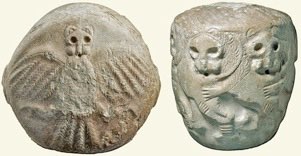
Mace-head of Mesalim, King of Kish (RIME 1.8.1.1; P462181), from the original Ningirsu temple at Girsu
Now in the Musée du Louvre (AO 2349), images from the museum website
As discussed in the previous page, the mace-head illustrated above was dedicated to Ningirsu by King Mesalim of Kish, in his capacity as hegemon of Lagash. As Sébastien Rey (referenced below, at p. 61 and at pp. 209-10) observed:
✴it was almost certainly originally dedicated and housed in the original temple of Ningirsu, which was excavated at ‘Tell K’ at Girsu; and
✴its find-spot suggests that it was subsequently ritually buried in the foundations of the temple that Ur-Nanshe built on the same site to replace it (which is discussed below).
In other words, Mesalim’s reign clearly pre-dated that of Ur-Nanshe (which is at least a start).

Large copper spearhead inscribed with the name of Lugalnamnirshum, king of Kish (RIME 1.8.2.1: P462183)
From the original Ningirsu temple at Girsu, now in the Musée du Louvre (AO 2675: image from museum website)
Fortunately, there is further evidence in the form of the copper spearhead, which:
✴was also discovered on Tell K; and
✴carries an inscription on its neck that was only partially legible until 1994, when it was rescued from a layer of corrosion, revealing that it had been dedicated (presumably to Ningirsu) by Lugalnamnirshum, king of Kish (see, for example, Douglas Frayne, referenced below, 2008, at p. 73).
Sébastien Rey (referenced below, at p. 209) pointed out that a number of scholars have been misled by an early, flawed description of the find-spot of this important object, which placed it in Ur-Nanshe’s temple: thus. for example, Gianni Marchesi (referenced below, 2015, at pp. 144-5, Uruk entry 4 and Table 1.2, at p. 142) argued that it had been dedicated by a king of Uruk who:
✴used the title ‘king of Kish’; and
✴exercised hegemony over Lagash towards the end of Ur-Nanshe’s reign and into that of his son, A-kurgal.
In fact, as Sébastien Rey (as above) pointed out, this spearhead (like the mace-head of Mesalim discussed above) had almost certainly been dedicated in the original Ningirsu temple and then ritually buried in the foundations of Ur-Nanshe’s new temple. He therefore reasonably argued (at p. 210) that Lugalnamnirshum:
“... was doubtless one of Mesalim of Kish’s successors, and, therefore, in all likelihood, another foreign overlord of Girsu [and Lagash] in the period before Ur-Nanshe ascended to power.”
In other words, the reign of Ur-Nanshe, the first independent ruler of Lagash, post-dated the reigns of at least two Kishite kings who had exercised hegemony over the city:
✴Mesalim; and
✴Lugalnamnirshum.
Evidence From the Reign of Ur-Nanshe at Lagash
As Piotr Steinkeller (referenced below, 2019, p. 122) observed, Ur-Nanshe is:
“... the first ruler of Lagash for whom extensive historical information survives ... He appears to have been a usurper, but the specifics of his rise to power remain uncertain.”
Francesco Pomponio (referenced below, 2025, at pp. 3-4) observed that, in his 40 or so surviving inscriptions, Ur-Nanshe claims to have:
✴rebuilt the walls of Lagash;
✴built or rebuilt 19 buildings, almost all of them of a religious character (notably including the rebuilding of the temple of Ningirsu at Girsu and the building of the Ibgal temple of Inanna in Lagash);
✴commissioned 12 statues of deities;
✴excavated 10 canals; and
✴organised the arrival of ships from Dilmum carrying timber as tribute.
He argued (at p. 4) that this suggests that Ur-Nanshe rose to power after a period of crisis in which the state of Lagash had been devastated, and that his subsequent reign was both long and peaceful.
Piotr Steinkeller (referenced below, 2024, p. 11, note 33) noted (in relation to the evidence that ‘Uruk held sway over most of southern Babylonia, as far north as Nippur’ in the Fara Period) that:
“Given the fact that the reign of Ur-Nanshe of Lagash was roughly contemporaneous with the Fara sources, it is conceivable that Ur-Nanshe himself (or alternatively his son A-kurgal) participated in the postulated campaign [of the Kiengi League] against Kish. However, [there is evidence to suggest] that Ur-Nanshe was involved in military conflicts with Umma and Ur [see below]. If Umma and Ur indeed were subjects of Uruk at that time, this would have made Lagash an enemy of Uruk. But, since political alliances must have been subject to frequent change in the south, this information is of little value. It is also likely that inter-city-state conflicts continued even in the presence of hegemonic powers, such as those of Kish or Uruk.”
In other words, Steinkeller was willing to countenance a war between Lagash and the combined forces of Ur and Umma at the time that all three cities belonged to the Urukean-led Kiengi League. However, Francesco Pomponio’s slightly later paper (mentioned above) was entitled “Did Ur-Nanshe defeat Ur ?” As it happens, his analysis of the evidence for Ur-Nanshe’s putative victory over Ur and Umma potentially offers a more convincing answer to Steinkeller’s conundrum.
Did Ur-Nanshe defeat Ur ?
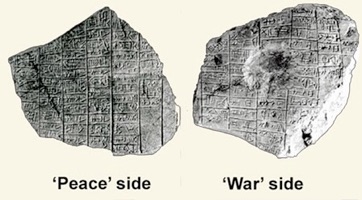
Inscriptions on door socket (RIME 1.9.1.6b, P431040) from ‘the area of the Bagara temple’ in Lagash,
now in the Iraq Museum: image from CDLI (P222390)
As Francesco Pomponio (referenced below, 2025, at pp. 6-7) observed, the inscription (RIME 1.9.1.6b, CDLI, P431040) that provides the only surviving evidence for Ur-Nanshe’s putative victory over Ur and Umma is on a a limestone slab (illustrated above), which was excavated at Tell al-Hiba in 1975-6, together with a few inscriptions of two later rulers of Lagash (Eanatum, Ur-Nansh’e grandson, and the mush later and Gudea). Pomponio described it as:
“... a copy of one or two royal inscriptions [that] is written on both faces of a broken slab, which must have served as a door socket and, being broken, was re-used for a scribal exercise on stone.”
He pointed out (at p. 7) that, since the time of this discovery, it has been recognised that the texts on the two sides of the slab are very different: as he observed (at p. 10):
✴the text on the so-called ‘peace side’ (lines 1-61) is:
“... a copy of a plaque of Ur-Nanshe, similar to many inscriptions of this king”; but
✴the text on the ‘war side’ (lines 62-105):
“... belongs to a wholly different category of texts, of which no specimen ... has [yet] been discovered with Ur-Nanshe as its author. In all probability, it was copied from a stele in which a scene of war or a parade of prisoners was carved, flanking or otherwise accompanying the inscription.”
It is this ‘war side’ text that is of interest for our present analysis.
The most important point to make here is that, while the ‘peace side’ is unambiguously devoted to the achievements of ‘Ur-Nanshe, king of Lagash’, he is not named at any point in the surviving text on the ‘war side’: for example, the first readable lines of this text (lines 64-8) tell us that three prominent men were involved in a war:
✴... of Lagash;
✴the man of Ur; and
✴the man of Umma.
The usual completion/ translation of the following text can be summarised as follows:
✴The man of Lagash:
•defeated the man of Ur;
•captured 5 senior officers, 3 of whom are named; and
•heaped up burial mounds (lines 69-86); and
✴then:
•defeated the man of Umma;
•captured 5 named senior officers as well as Pabilgaltuku, the ensi of Umma; and
•heaped up burial mounds for the man of Umma (lines 87-105).
As Pomponio pointed out (at p. 11), this account raises another problem with the ‘accepted wisdom’: he asked rhetorically:
“[Why], only in this inscription, does ... [this ruler of Lagash] define himself as ‘man’ (lu2) of Lagash, instead of lugal or ensi2, [thereby putting] himself on the same par with his [putative] vanquished enemies?
He then pointed out that this problem goes away if we assume that, in the passage in which the ‘man of Lagash’ is named, he is an object (like the man of Ur) rather than the subject, so that the passage in question would read:
“(He) defeated the man of Lagash (and) the man of Ur”.
In other words, in Pomponio’s opinion, the likelihood is that the original text described a war in which a now-unknown ruler defeated three allied armies led by three commanding officers, who are referred to as:
✴the man of Lagash;
✴the man of Ur; and
✴the man of Umma.
Pomponio reasonably assumed (at p. 12) that:
“... [the] name and title(s) [of this now unknown enemy] would have been written in the first column of the ... inscription.”
The implication is clear: it is at least possible that this text described the events that led to the devastation of Lagash and the subsequent emergence of Ur-Nanshe onto the world stage. It seems to me that this insight allows us to resolve Steinkeller’s conundrum, since it is at least possible that:
✴the ‘war side’ of this inscription described the invasion of Lagash, Ur and Umma by Uruk, after which all three cities (like Shuruppak, mentioned above) passed into ‘the hands of Uruk’; and
✴on this occasion, Ur-Nanshe fought on the side of Uruk, a decision that earned him the kingship of Lagash.
Did Ur-Nanshe Help Uruk to Defeat Lagash, Ur and Umma ?
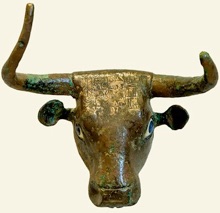
Inscribed copper bull’s head from the site of the Temple of Ningirsu at Girsu,
now in the Musée du Louvre (AO 2676): image from Wikipedia
Somewhat surprisingly, the beautiful bull’s head illustrated above carries an inscription on its forehead recording its dedication to Ningirsu by:
“Lugalsi, gala-mah (the chief lamentation-priest) of Uruk”, (see Gianni Marchesi, referenced below, 2011, note 244, at p. 124).
As Sébastien Rey (referenced below, at p. 279) observed, this was one of a pair of almost identical heads: the other one, which is not inscribed, is now in the archeological museum of Istanbul. He suggested (at p. 280) that these heads had probably served as ornaments on instruments (probably lyres) played on liturgical occasions, and (at p. 281) that:
“... they were [dedicated] by Lugalsi to form part of the ... cultic apparatus [of Ur-Nanshe’s new temple].”
He added (at p. 280) that they were subsequently ritually buried in the SE side of the temple and noted (at p. 284) that they belonged to a:
“... systematic deposition [of sacred objects] in and around the Ur-Nanshe building ...”;
which had taken place when Enmetana (Ur-Nanshe’s great grandson) had undertaken the first major restoration of the temple since its original construction (over the archaic temple) by Ur-Nanshe.
Gianni Marchesi (referenced below, 2015, at pp. 144-5, Uruk entry 4) wrongly assumed that these two bulls head had been found in the ‘same archaeological context’ as the spear-head of Lugalnamnirsumma (see above). He therefore argued that:
“[Since]:
✴it is very unusual to find objects dedicated by ‘foreigners’ in Lagash (the only other known example is the mace of Mesalim, king of Kish) ...; and
✴the ED IIIb kings of Uruk, used to style themselves ‘king of Kish’;
it is likely that Lugalnamnirsumma, like [Lugalsi], the lamentation priest..., was also from Uruk.
In fact, as we have seen, both Mesalim and Lugalnamnirsumma were ‘actual’ kings of Kish who had made their dedications to Ningirsu as overlords of Lagash/ Girsu in the original Ningirsu temple, long before the reign Ur-Nanshe. In view of this, the fact that these bulls’ heads were dedicated by a ‘foreigner’ (Lugalsi, chief lamentation-priest of Uruk) is even more ‘unusual’ than Marchesi thought. He suggested that their presence at Girsu:
“... may reflect a period of political weakness at Lagash, during which the city-state fell under the hegemony of Uruk”.
However, I suggest that the fact that they were also sufficiently important to merit ritual burial by Enmetana suggests that they were profoundly important objects that had been dedicated in Ur-Nanshe’s temple in a period in which Uruk and Lagash were allies.
Stele of Inanna (?)
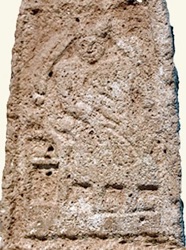
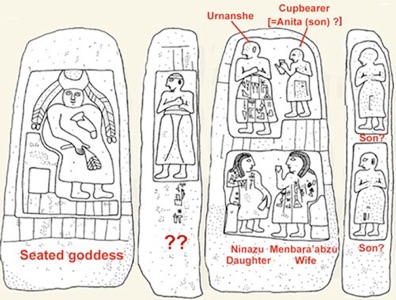
Four-sided inscribed stele from Lagash (RIME 1.09.01.06a, P431039), now in the Iraq Museum (IM 61404):
Left: relief of goddess (Inanna ?): image from Wikimedia
Right: sketch of reliefs on all four sides by Claudia Suter (referenced below, Figure 1, at p. 346)
My additions in red: figure identifications from Licia Romano (referenced below, Figure 1, at p. 184)
As we have seen, almost all of Ur-Nanshe’s inscriptions focus on his temple building and other religious and civic projects. Although a number of these record his building of the Ibgal temple of Inanna at Lagash, the inscription on the stele illustrated above is:
✴the only one in which (as far as we can tell) he mentions only his building of the Ibgal temple; and
✴furthermore, his building of this temple is mentioned twice:
✴the caption under Ur-Nanshe (surface a; lines 1-5) records that:
•“Ur-Nanshe, son of Gunidu, ensi of Lagash, built the Ibgal [= oval temple of Inanna at Lagash]”; and
• this information is repeated at the start of the main text on this side, which runs from right to left between the four royal figures (surface e; lines 1-7).
Interestingly, this is also the only one of the many surviving inscriptions of Ur-Nanshe in which he used the title ensi: in all of the others, he is described as lugal (king) of Lagash.
Unfortunately, the caption under the seated goddess on the obverse is now illegible. Giovanni Lovisetto (referenced below, at pp. 54-5) described the iconography of this image as follows:
“The enthroned divine figure is larger than the others: she holds a branch of dates and possibly a cup, while her extraordinarily long and voluminous hair falls from a (possibly horned) headdress over her shoulders. ... Interestingly, the throne and her feet are placed on a sort of a podium, possibly signalling that this is a depiction of a statue, in front of which the five male figures [on the reverse and the two sides] are performing a libation ritual, perhaps during the inauguration of the Inanna temple itself. ... Even though the name of the goddess is not preserved in the inscription, the reference to the Ibgal and the fact that the stele was found nearby have led most scholars to identify this figure as Inanna.”
The inscription under the man who approaches Inanna from her left is also now illegible, although he was probably an important official:
✴Licia Romano (referenced below, at p. 185) suggested that:
“... his dress is an attribute typical of high-rank military officials or of the king himself as chief of the army; while
✴Giovanni Lovisetto (referenced below, at p. 54) characterised him as ‘a high priest’, presumably because he assumed that all of the male figures depicted on the stele were ‘performing a libation ritual’.
If we assume that Lovisetto is correct, then we could go further and identify this man as Lugalsi, the chief lamentation-priest of Uruk (= the man who had dedicated a pair of bulls’ heads to Ningirsu at Ur-Nanshe’s new temple to this god at Girsu (as discussed above), whose full title would have been chief lamentation-priest of the goddess Inanna.
Interestingly, Francesco Pomponi (referenced below, 2025, at p. 6) observed that. if we put the ‘war side’ of RIME 1.9.1.6b to one side, the only surviving mention of a military project of Ur-Nanshe comes in the inscription under discussion here, which:
“... in the space of not more than seven lines [see surface 2, lines 11’-17’], recorded that Ur-Nanshe captured one or more enemies (kings or states), whose names [are no longer legible].”
At the risk of piling one unproven hypothesis on another, I wonder whether Ur-Nanshe achieved these military successes at the time of his putative alliance with Uruk, and that he built the Ibgal at Lagash soon after the city fell to Uruk, at which time, he might have served as the city’s governor (ensi).
Evidence From the Reign of Ur-Nanshe at Lagash
I suggest that the body of evidence above supports the hypothesis that:
Lagash, Ur and Umma, like Shuruppak, ‘passed from the hands of Kish to those of Uruk’ in the Fara period, which allowed the outsider Ur-Nanshe
Kings of Kish after Mesalim
Menunsi
Piotr Steinkeller, having discussed Enmebaragesi and Mesalim (both of whom he dated to ED I-II) observed (at pp. 13-4) that:
“There was yet another early ruler of Kish who likely exercised hegemony over sections of southern [Mesopotamia]: his name was Menunsi, ... [and he is known only from] the Fara text NTSSh 154 (CDLI, P010498).”
He translated the opening lines of this text as follows:
“15 bur2 of land had been granted/assigned to A-kigal by Menunsi, king of Kish”, (lines i: 1-2).
He then noted that these lines are followed by:
✴a list of goods (at lines i:3 - ii:4); and
✴a list of three officials:
•[PN], the mashkim-gi4 (envoy?), (line iii: 1);
•Ageshtin, the field registrar of Uruk, (line iii: 2); and
•Enkishe, the farmer, (line iii: 3).
Hypothesis Proposed by Piotr Steinkeller in 2024
In the earlier paper (Piotr Steinkeller, referenced below, 2013, note 81, at p. 150) in which he had first suggested that the Kiengi League had been established in order to oppose the Kishite dominance in southern Mesopotamia, he observed that:
“My interpretation is seemingly contradicted by the text NTSSh 154, i 1-2, which records a donation, apparently in Shuruppak, of [15 bur2] of land by a king of Kish to a certain individual ... It is possible, however, that the text refers to an earlier donation, which preceded the creation of the [Kiengi League]. Be that as it may, the testimony of NTSSh 154 is very important, since it demonstrates the domination of Shuruppag by Kish at some point in time.”
However, he had hardened his view by the time of his paper 0f 2024, in which he argued (at p. 14) that:
“In my view, the most likely interpretation of this text is that it records a reconfirmation of a land grant that, sometime earlier, had been made by Menunsi, king of Kish to a certain A-kigal of Shuruppak. Given the very large area of agricultural land involved, Akigal must have been an important person.
✴The goods enumerated in this text appear to have been gifts presented by Akigal (or, more likely, his heirs) to the officials who authorised the transaction.
✴Significantly, [these officials] included:
•a field registrar from Uruk; and
•the local Shuruppak official in charge of agricultural land.
✴The role of the mashkim-gi4 is less clear: most likely, he was an envoy from Uruk, who represented the ruler of Uruk on that occasion. It would be fair to speculate that the ruler of Uruk in question was none other than the ensik Lum-ma of TSSh 302 [see above].
It appears that this transaction had been occasioned by a change in the political status of Shuruppak, namely, its having passed from the hands of Kish to those of Uruk. As the king of Uruk has now become the owner of Shuruppak’s land holdings, the legal validity of the grant needed to be recognised by him. The large size of the original donation would certainly have called for the crown’s direct involvement in this matter.”
He then argued that:
“If this analysis of NTSSh 154 is correct, this would mean that Menunsi was in possession of Shuruppak some years before the [Fara period]. Although we lack any means to determine when exactly it was, the most likely guess appears to be that Menunsi lived either sometime toward the end of [ED I=II] or at the very beginning of ED IIIa. In either case, however, his reign was probably later than that of Mesalim.”
Hypothesis of Gianni Marchesi
Gianni Marchesi (referenced below, 2015, at p. 140 and note 14), who assumed that Menunsi ruled at Kish at the time of this land grant at Shuruppak, argued that, at this time:
✴he exercised hegemony over almost all of the main Sumerian cities, including both Shuruppak and Uruk; and
✴a field registrar from Uruk was involved in the land grant because the land in question was in Uruk.
In support of this hypothesis, he pointed out that a roughly contemporaneous text from Abu Salabikh, (published by Robert Biggs and Nicholas Postgate, referenced below, at pp. 108-9: now in the Iraq Museum: IM 081445; P010458) records that a ruler of Uruk had been assigned land, presumably at Abu Salabikh. He concluded from this evidence that:
“It appears then that the very same authority [= Kish] had the power to dispose of land in both [Uruk and Abu Salabikh].”
Interestingly, as we have seen, Piotr Steinkeller argued (at p. 12), in relation to the same inscription, that:
“If an ensik of Uruk indeed held agricultural land at Abu Salabikh, we would find here an incontrovertible proof that this city had been a dependency of Uruk or, at the very least, that it recognised Uruk’s overlordship [in the Fara period].”
In other words:
✴Marchesi argued that Kish exercised hegemony over all of Uruk, Shuruppak and Abu Salabikh in the Fara Period, which explains why:
•Menunsi was able to grant land in Uruk to Akigal of Shuruppak (as recorded in the inscription from Shuruppak); and
•Menunsi (or another king of Kish in this period) was (or was also) able to grant land in Abu Salabikh to a now-unnamed ensi of Uruk (as recorded in the inscription from Abu Salabikh); while
✴Steinkeller argued that:
•Menunsi had indeed granted land in Shuruppak to Akigal, but that he had done so prior to the Fara Period; and
•in the Fara Period, by which time both Shuruppak and Abu Salabikh had ‘passed from the hands of Kish to those of Uruk’:
-the inscription from Shuruppak recorded the confirmation by a ruler of Uruk that the land in Shuruppak, which Menunsi had previously granted to Akigal, still belonged to either Akigal or his heirs; and
-the inscription from Abu Salabikh recorded the assignation of agricultural land there to the city’s Urukean overlord.
It seems to me that the land that Menunsi assigned to Akigal probably was in Shuruppak (rather than in Uruk), since this would explain why:
✴his title to the land in question was ‘registered’ in Shuruppak; and
✴Ageshtin, the field registrar who was involved in the transaction, was specifically recorded as an official from outside Shuruppak (unlike Enkishe, the official in charge of agricultural land, who did not need to be given a place of origin, presumably because he was local).
If this is correct, then the fact that Ageshtin came from Uruk (rather than Kish) might indicate that the transaction was, as Steinkeller suggested, a reconfirmation of land grant after Uruk replaced Kish as overlord of Shuruppak . However, I am not sure that this takes us very far: after all, Menunsi could have assigned land at Shuruppak to Akigal shortly before:
✴the formation of the Kiengi League; and
✴the putative passage of both Shuruppak and Abu Salabikh from ‘the hands of Kish to those of Uruk’.
In my view, all we can really say is that Menunsi probably ruled at Kish in or shortly before the Fara period.
Enna-il, King of Kish
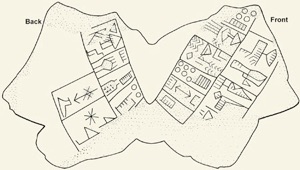
Sketch of the Akkadian inscription (RIME 1.8.3.2, P462185) on a fragments of a statue of Enna-il from Nippur:
Now in the Iraq Museum (IM 61325): image adapted from Ignace Gelb et al. (referenced below, Plate 50)
Enna-il is known from two royal inscriptions from Nippur:
✴One (RIME 1.8.3.1, P462184), which was given the excavation number 6 NT 100) seems to be an Ur III period copy of the original, records that Enna-il, son of A’anzu, defeated Elam ‘for the goddess Inanna’.
✴The other (RIME 1.8.3.2, P462185), which was given the excavation number 6 N 271) is on a surviving fragment of a limestone statue (illustrated above) that was apparently found on the site of the temple of Inanna at Nippur. It was inscribed in two lines on what was originally the right shoulder of a statue of Enna-il: according to Gianni Marchesi (referenced below, 2011, at pp. 179-80), who transliterated and translated the inscription:
•the first line records the purchase by Enna-il of a number of plots of land; and
•the second line records that:
“Enna-il, king of Kish, [made] an [image of himself] ... and set it up before Ishtar (= Inanna)”, (see lines 14’-20’).
It therefore seems likely that Enna-il set up his statue at the temple of Inanna at Nippur in commemoration of his victory in Elam, although we do not know whether he actually invaded Elam or simply expelled Elamite raiders from land that was subject to Kish. According to Douglas Frayne (referenced below, 2008, at pp. 75-6), the first of these inscriptions was ‘almost certainly’ and the second was certainly written in Akkadian.
At least two other texts link Enna-il to Nippur:
✴Gianni Marchesi (referenced below, 2011, at p. 180) referred to an unpublished ED literary text from Nippur (6 NT 104) in which, Enna-il is given the titles king of Kish and ensí-gal denlil (chief steward of Enlil); and
✴Piotr Steinkeller (referenced below, 2013, note 67, at p. 148) observed that:
“[Enna-il’s] presence at Nippur is further demonstrated by an ED literary text from Nippur (preserved in a later, possibly Ur III, copy), which describes his involvement in the delivery of Ur’s ‘first offering’ for Enlil from Ur to Nippur”.
He translated the relevant lines as follows:
“... the licorice, which sprouted in a desolate place for the table of Enlil; the fat of the cow (and) the pure milk, the 'first offering' of Ur for the table of Enlil; ... Enna-il, the king, hailed Enlil (and) Ninlil there”, (ECTJ 219, lines iii’:1 - iv’: for ‘ECTJ 219’, see Aage Westenholz, referenced below, 1975).
Xianhua Wang (referenced below, at p. 83 and note 237) commented that, if:
•the Ur III copy (ECTJ 219) is faithful to the original; and
•‘Enna-il, the king’ who ‘hailed Enlil’ in this copy is the king of Kish named in the royal inscriptions above;
then:
“... [Enna-il] would be the earliest historical [Mesopotamian ruler who] ... is known to have collected ‘first fruit offerings’ for Enlil and Ninlil, [and, in doing so, he may have been] acting as the ruler [= hegemon ?] of Ur”.
In fact, he is also the first king of Kish who can be securely linked to Nippur in any capacity: while it is true that Eanatum and Enmetana of Lagash both cited Mesalim as the ruler responsible for the establishment of the border between Lagash and Umma as mandated by Enlil (the city god of Nippur), this tradition might well reflect the interpretation of these later rulers of Lagash rather than that of Mesalim himself.
Gianni Marchesi (referenced below, 2011, at p. 180 and note 108) published and translated the text on a statue that he dated on stylistic grounds to the ED IIIb period as follows:
“To Shara: [when] Enna-il was king of Kish: Uriri, the chief cook, presented (this statue).”
He suggested that:
✴the statue possibly came from Umma (where Shara was the chief deity); and
✴this might suggest that Enna-il was an ‘overlord’ there.
Piotr Steinkeller (referenced below, 2013, note 67, at p. 148) similarly argued that the inscription on this statue:
“... probably [indicates that] Enna-il exercised some form of suzerainty [hegemony ?] over Umma.”
Gianni Marchesi (referenced below, 2015, at pp. 153-4 and note 161) again argued that this statue:
“... which dates to [Enna-il’s] reign, ... is clearly ED IIIb in style.”
He also argued (in note 19, at p. 140) argued that Enna-il:
“... was probably the last great king of Kish proper. In this connection, note that ... [the title] ‘chief steward of Enlil’, [which he was given literary text 6 NT 104 from Nippur - see above], ...was later borne by the overlords Lugalzagesi [of Umma and Uruk] and Sargon [of Akkad].”
Piotr Steinkeller (referenced below, 2024, at p. 14) argued that:
“Enna-il:
✴could have been the ruler of Kish whom the southern coalition faced at the time of the Fara archive [and the Kiengi League]; [or]
✴ if he lived later (that is, in ED IIIb), he might alternatively have been ... the unidentified king of Kish, who (together with Mari and Akšak) invaded the territories of Lagash during the reign of Eanatum, [the grandson of Ur-Nanshe].”
Kings of Kish from Enmebaragesi to Enna-il
Obviously, the history of this period is plagued by uncertainties in relation to both the absolute and the relative chronologies of the Kishite kings listed above. However, scholars generally agree that the earliest king of Kish known from our surviving sources is Mebaragesi, who became known in Sumerian legend as Enmebaragesi, the father and predecessor of Akka. The find-spot of one of his two surviving royal inscriptions suggests that he ruled at a time when the hegemony of Kish extended into the Diyala region, and there might also have been a historical basis to:
✴the surviving Ur III texts in which he appears as the overlord of Uruk at the time of Gilgamesh; and
✴the claim in the later SKL recensions that he defeated ‘the land of Elam’ (since, for example, raiders from ‘Elam’ might have threatened the security of his hold on the Diyala valley).
If ‘Akka, son of Enmebaragesi’ was actually a historical figure, then his reign would have followed that of his father.
The next two Kishite kings discussed above were:
✴Mesalim, who certainly exercised hegemony over Adab, Umma and Lagash; and
✴Lugalnamnirshum, who almost certainly exercised hegemony over Lagash.
Since:
✴each of these kings dedicated an oversized weapon (the mace of Mesalim and the spear-head of Lugalnamnirshum) in the original Ningirsu temple at Girsu; and
✴both of these votive objects were ritually buried in the foundations of the later temple of Ur-Nanshe;
we can at least assume that both Mesalim and Lugalnamnirshum reigned before Ur-Nanshe.
This brings us to Menunsi. As we have seen:
✴Gianni Marchesi, who:
•assumed an unusually late date for Mesalim; and
•argued (almost certainly incorrectly) that Lugalnamnirshum was a king of Uruk;
placed the reign of Menunsi in the Fara Period, between those of Enmebaragesi and Mesalim; while
✴Piotr Steinkeller placed:
•the reign of Mesalim shorty after that of Enmebaragesi; and
•the reign of Menunsi between the reign of Mesalim and the Fara Period.
Finally, we come to Enna-il, who certainly controlled Nippur and possibly exercised hegemony over Ur and/or Umma. Piotr Steinkeller argued that:
✴he might have ruled at Kish in the Fara Period, at the time of the so-called ‘Kiengi League’ ; or
✴(if he ruled thereafter) he might have been:
“... the unidentified king of Kish, who ... invaded the territories of Lagash during the reign of Eanatum, [the grandson of Ur-Nanshe]”, Gianni Marchesi reasonably characterised him as ‘probably the last great king of Kish proper’.
References
Pomponio F. “Did Ur-Nanše Defeat Ur?”, in:
Alivernini S. et al. (editors), “‘And I Have Also Devoted Myself to the Art of Music’: Ancient Near Eastern Studies in Honor of Franco D’Agostino, Presented on His 65th Birthday by His Pupils, Colleagues and Friends”, (2025) Münster, at pp. 3-14
Rey S., “The Temple of Ningirsu: the Culture of the Sacred in Mesopotamia”, (2024) University Park, PA
Steinkeller P., “Campaign of Southern City-States against Kiš as Documented in the ED IIIa Sources from Šuruppak (Fara)”, Journal of Cuneiform Studies, 76 (2024) 3-26
Lovisetto G., “Goddesses Visualized in Early Dynastic Mesopotamia”, in:
Babcock S. and Tamur E. (editors), “She Who Wrote: Enheduanna and Women of Mesopotamia, ca. 3400–2000 BC”, (2022) New York, at pp. 46-63
Steinkeller P., “Two Sargonic Seals from Urusagrig and the Question of Urusagrig’s Location’, Zeitschrift für Assyriologie, 112:1 (2022) 1–10
Steinkeller P.., “Babylonian Priesthood during the Third Millennium BCE: Between Sacred and Profane”, Journal of Ancient Near East Religions, 19 (2019) 112-51
Suter C., “On Images, Visibility, and Agency of Early Mesopotamian Royal Women”, in:
Lluis F. et al. (editors), “The First Ninety Years: A Sumerian Celebration in Honor of Miguel Civil”, (2017) Boston and Berlin, at pp. 337-62
Marchesi G., “Toward a Chronology of Early Dynastic Rulers in Mesopotamia”, in:
Sallaberger W. and Schrakamp I. (editors), “Associated Regional Chronologies for the Ancient Near East and the Eastern Mediterranean: History and Philology: Vol. 3”, (2015) Turnhout, at
pp. 139-58
Sallaberger W. and Schrakamp I., “Part I: Philological Data for a Historical Chronology of Mesopotamia in the 3rd Millennium”, in:
Sallaberger W. and Schrakamp I. (editors), “Associated Regional Chronologies for the Ancient Near East and the Eastern Mediterranean. History and Philology: Vol. 3”, (2015) Turnhout, at pp. 1-130
Ławecka D., “Early Dynastic Kish: City-State or Country-State?”, in:
Bieliński P. et al. (editors), “Proceedings of the 8th International Congress on the Archaeology of the Ancient Near East (30 April -4 May 2012, University of Warsaw): Volume 1, Plenary Sessions, Township and Villages, High and Low - The Minor Arts for the Elite and for the Populace”, (2014) Wiesbaden, at pp. 425 -39
Romano L., “Ur-Nanshe’s Family and the Evolution of its Inside Relationships as Shown by Images”, in:
Marti L. (editor), “La Famille dans le Proche-Orient Ancien: Réalités, Symbolismes, et Images: Proceedings of the 55th Rencontre Assyriologique Internationale at Paris 6–9 July 2009, Paris”, (2014) Winona Lake, IN, at 183-192
Steinkeller P., “An Archaic “Prisoner Plaque” from Kiš”, Revue d'Assyriologie et d'Archéologie Orientale, 107 (2013) 131-57
Marchesi G., “The Historical Framework (Chapter 2)” and “The Inscriptions on Royal Statues (Chapter 4)”, in:
Marchesi G. and Marchetti N., “Royal Statuary of Early Dynastic Mesopotamia”, (2011) Winona Lake, IN, at pp. 97-128 and pp. 155-85 respectively
Wang X., “The Metamorphosis of Enlil in Early Mesopotamia”, (2011) thesis of Cambridge University
Frayne D. R., “The Royal Inscriptions of Mesopotamia, Vol. 1: Presargonic Period (2700-2350 BC)”, (2008) Toronto
Marchesi G., “Lumma in the Onomasticon and Literature of Ancient Mesopotamia”, (2006) Padua
Pomponio F., “The Hexapolis of Šuruppak,: Political and Economic Relationships between Šuruppak and other Towns of Central and Southern Mesopotamia”, in:
Pomponio F., and Visicato G., “Early Dynastic Administrative Tablets of Šuruppak”, (1994) Naples, at p. 10-20
Gelb I. J., et al., “Earliest Land Tenure Systems in the Near East: Ancient Kudurrus (Second Volume: Plates)”, (1991) Chicago IL
Biggs R. D. and Postgate J. N., “Inscriptions from Abu Salabikh: 1975”, Iraq 40 (1978 ) 101–18
Westenholz A., “Early Cuneiform Texts in Jena: Presargonic and Sargonic Documents from Nippur and Fara in the Hilprecht-Sammlung Vorderasiatischer Altertümer, Institut Fur Altertumswissenschaften Der Friedrich-Schiller-Universität, Jena”, (1975) Copenhagen