Empires of Mesopotamia:
Mesopotamia in the ED IIIa Period


Empires of Mesopotamia:
Mesopotamia in the ED IIIa Period
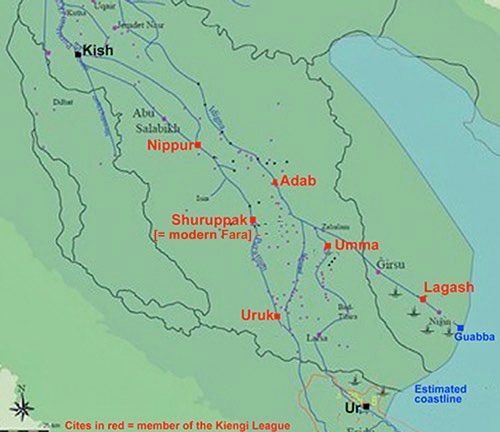
Known members of the so-called Kiengi League
Adapted from Jasmina Osterman (referenced below, Map 1, at p. 58): my additions in bold (red, black and blue)
Fara Tablets
The most useful sources for the events in Mesopotamia in the ED IIIa period are the so-called Fara Tablets, which were found at Fara, the site of ancient Shuruppak, and mostly carry administrative texts from this period. As Eric Cripps (referenced below, at p. 113 and note 5, citing Harriet Martin, referenced below, at p. 115) observed, Shuruppak was destroyed by fire, and the excavations that led to the discovery of this large archive in the early 20th century involved:
“... with few exceptions, burned buildings of ED IIIa period. As a result of the fire, tablets, seal impressions, metal objects and complete pots were left in the buildings. Later settlements were apparently eroded away where they existed.”
Walther Sallaberger and Ingo Schrakamp (referenced below, at p. 62) observed that:
“ Recent research, using archaeological and philological arguments, has demonstrated that the majority of the texts from the [earliest] excavations date to the ED IIIa period. They were probably written within a short period of time (ca. 10-15 years). ... The destruction of Fara could perhaps be correlated with the end of Palace A at Kish. The texts from the [subsequent excavations at Abu Salabikh] appear to be of slightly younger date ...”.
We can therefore be relatively confident texts found in these two related archives date to a relatively short period of time in the ED IIIa period.
Kiengi League
As Piotr Steinkeller (referenced below, 2013, at p. 150) pointed out, the inscriptions on a group of Fara Tablets:
“... attest to the existence at that time of some form or organised political and military co-operation between the city states of Uruk/Kulaba, Lagash, Adab, Umma, Nippur, and Shuruppak [see the map above], which may even have taken the form of a league.”
He added (at note 81) that the possibility that this ‘league’ was a military alliance is suggested by a particular group of these sources, In a more recent paper (referenced below, 2024, Appendix I, at pp. 15-19) he transliterated and translated the eight ‘Fara texts’ that belong to this group and used these as the basis for a detailed analysis on the characteristics of what I refer to in this page as the ‘Kiengi League’. In what follows, all references to Steinkeller’s work relate to this 2024 paper unless otherwise stated.
Two of the texts in Steinkeller’s Appendix I are of central importance for this analysis. He translated them (as his Text 1 and Text 2) as follows:
✴WF 92 (P011049):
•182 gurush (men) of Uruk
•192 (men) of Adab
•94 (men) of Nippur
•60 (men) of Lagash
•56 (men) of Shuruppak
•86 (men) of Umma
•The ones stationed (here): they came (from) Kiengi (=Sumer)
•Entrusted (to the military command): a total of 670 men, the ones stationed (here)
✴WF 94 (P011051:
•140 gurush (men), lu2-tush (residents) of Uruk
•215 (men, residents of) Adab
•74 (men, residents) of Nippur
•110 (men, residents of) Lagash
•66 (men, residents of) Shuruppak
•128 (men, residents of) Umma
•A total of 650 [actually 733] men, residents of Kiengi: note that the reason for the arithmetic discrepancy is unclear.
As he argued (at p. 4):
“All these individuals, who without any doubt were soldiers, [were] apparently brought to Shuruppak and entrusted there to some military agency.”
In other words, these texts arguably indicate that:
✴at some time in the ED IIIa period, six city states of Kiengi (Uruk, Adab, Nippur, Lagash, Shuruppak and Umma) belonged to a military alliance; and
✴on at least two occasion, they all dispatched men to Shuruppak, where they seem to have been placed under a single overall commander.
Two other texts from this group are of also of importance for the present analysis:
✴WF 101 (P011059: Steinkeller’s Text 3):
•670 men who went to battle, they ate food
•1,612 men (stationed) ki-unkin (= in the camp), they ate food (and) anointed themselves with oil.
✴WF 93 (P011050: Steinkeller’s Text 4):
•1,532 men, 39 junior masons, 41 female workers;
•a total of 1612 people who ate food 47 men who went to Kish
He argued (at p. 4) that:
✴the 670 men from Uruk, Adab, Nippur, Lagash, Shuruppak and Umma in WF 92 were probably the same 670 men who ‘went into battle’ in WF 101 (proving, if proof were needed, that they were clearly soldiers); and
✴the 1612 men who apparently stayed in the camp in WF 101 ‘represented reserve or support forces’, as did the 1612 people who ate food in WF 93.
He therefore suggested that, since:
✴WF 101 and WF 93 seem to parallel each other very closely; and
✴WF 93 names 47 men who went to Kish;
it is reasonable to conclude that the destination of the 670 warriors listed in WF 101 (and also in WF 92) was also the city of Kish.
This analysis would probably be accepted by most scholars, particularly since, as Eric Cripps (referenced below, at p. 152) observed, at this time:
“... Shuruppak was [arguably] located at a propitious place on the waterway system, suitable for the communications centre of a military alliance of the Sumerian cities of Adab, Lagash, Nippur, Shuruppak, Umma and Uruk.”
Note, however, that there is still debate about some aspects of the alliance, particularly since the texts discussed above:
✴mentions neither Kish (which had certainly exercised hegemony over Adab, Lagash and Umma in the ED II period) nor Ur; and
✴contain no information that identified either:
•the city that exercised military command over the allied army; or
•the target of their planned campaign.
The conventional view was recently expressed by Sébastien Rey (referenced below, at p. 151), who referred to Fara texts that:
“... record that [a] federation referred to as ki.en,gi jointly conscripted a body of corvée troops to fight an adversary whose identity is unknown, though it could have been Ur, a city-state that is hardly mentioned in the [Fara texts]. It seems that Kish might well have been the hegemonic guardian of this new world order, and the possibility of some kind of overlordship is intimated by the fact that Mesilim of Kish acted as the arbitrator in resolving the boundary dispute between Lagash and neighbouring Umma.”
Thus, in the received wisdom:
✴since Kish:
•exercised hegemony over Lagash, Umma and Adab in the reign of King Mesilim;
•continued to exercise hegemony over Lagash (at least) under King Lugalnamnirshum;
•possibly exercised hegemony over Shuruppak in the reign of King Menunsi (see below); and
•is frequently mentioned in the Fara texts (albeit not in the context of the Kiengi League);
it is likely that it also held overall command of the armies of the six cities of the Kiengi League and was possibly recognised (by some or all of them) as their overlord; and
✴since Ur is barely mentioned in the Fara texts, it was probably the target of the campaign of this alliance.
Piotr Steinkeller (referenced below, 2024) , who (as we shall see, placed the reigns of both Mesilim and Menunsi before the Fara/ED IIIa period) countered that:
✴nothing in the surviving Fara sources indicates that Kish led a military alliance of Sumerian cities against anyone (see note 9, at p. 7); and
✴the absence of Ur from the Kiengi League (and its almost total absence from the ‘Fara texts’) might simply indicate that it was directly subject to Uruk at this time, which would mean that:
“... its status would have been not unlike that [which] it enjoyed later in the ED IIIb period, when ... it was a dependency of Uruk, with Uruk’s ruler exercising a dual kingship over these two city-states”, (see p. 11).
As we shall see, he argued strongly that Uruk exercised overall command over the allied army and the target of its planned campaign was Kish.
King Menunsi of Kish
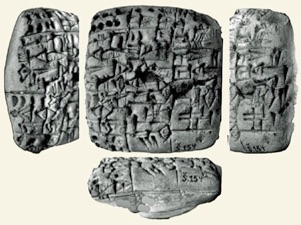
Administrative tablet from Shuruppak carrying an inscription (CDLI, P010498)
that refers to a land grant by King Menusi of Kish
Now in the Istanbul Museum (NTSSh 154): image from CDLI
Piotr Steinkeller (referenced below, 2024, at pp. 13-4), having discussed Enmebaragesi and Mesilim (both of whom he dated to the ED I-II period), observed that:
“There was yet another early ruler of Kish who likely exercised hegemony over sections of southern [Mesopotamia]: his name was Menunsi, ... [and he is known only from] the Fara text NTSSh 154 (CDLI, P010498).”
He translated the opening lines of this text as follows:
“15 bur2 of land had been granted/assigned to Akigal by Menunsi, king of Kish”, (lines i: 1-2).
He then noted that these lines are followed by:
✴a list of goods (at lines i:3 - ii:4); and
✴a list of three officials:
•[PN], the mashkim-gi4 (envoy?), (line iii: 1);
•Ageshtin, the field registrar of Uruk, (line iii: 2); and
•Enkishe, the farmer, (line iii: 3).
Hypothesis of Gianni Marchesi
Gianni Marchesi (referenced below, 2015, at p. 140 and note 14), who assumed that Menunsi ruled at Kish at the time of the land grant documented in this text, argued that:
✴he probably exercised hegemony over the six cities of the Kiengi League but not at Ur; and
✴the land that he assigned to Akigal was at Uruk (since the field registrar who presumably recorded the grant was based there).
In support of this hypothesis, he pointed out that a roughly contemporaneous text from Abu Salabikh, (published by Robert Biggs and Nicholas Postgate, referenced below, at pp. 108-9: now in the Iraq Museum: IM 081445; P010458) records that land there had been assigned to an ensi of Uruk. He concluded from this evidence that:
“It appears then that the very same authority [= Kish] had the power to dispose of land in both [Uruk and Abu Salabikh].”
Hypothesis of Piotr Steinkeller
Piotr Steinkeller (referenced below, 2013, note 81, at p. 150), in the first paper in which he had suggested that the Kiengi League had been established in order to oppose the Kishite dominance in southern Mesopotamia, observed that:
“My interpretation is seemingly contradicted by the text NTSSh 154, i 1-2, which records a donation, apparently in Shuruppak, of [15 bur2] of land by a king of Kish to a certain individual ... It is possible, however, that the text refers to an earlier donation, which preceded the creation of the [Kiengi League]. Be that as it may, the testimony of NTSSh 154 is very important, since it demonstrates the domination of Shuruppak by Kish at some point in time.”
He had hardened his view by the time of his paper 0f 2024, in which he argued (at p. 14) that:
“In my view, the most likely interpretation of this text is that it records a reconfirmation of a land grant that, sometime earlier, had been made by Menunsi, king of Kish to a certain Akigal of Shuruppak. Given the very large area of agricultural land involved, Akigal must have been an important person.
✴The goods enumerated in this text appear to have been gifts presented by Akigal (or, more likely, his heirs) to the officials who authorised the transaction.
✴Significantly, [these officials] included:
•a field registrar from Uruk; and
•the local Shuruppak official in charge of agricultural land.
✴The role of the mashkim-gi4 is less clear: most likely, he was an envoy from Uruk, who represented the ruler of Uruk on that occasion.
It appears that this transaction had been occasioned by a change in the political status of Shuruppak, namely, its having passed from the hands of Kish to those of Uruk. As the king of Uruk has now become the owner of Shuruppak’s land holdings, the legal validity of the grant needed to be recognised by him. The large size of the original donation would certainly have called for the crown’s direct involvement in this matter.”
He then argued that:
“If this analysis of NTSSh 154 is correct, this would mean that Menunsi was in possession of Shuruppak some years before the [Fara period]. Although we lack any means to determine when exactly it was, the most likely guess appears to be that Menunsi lived either sometime toward the end of [the ED I-II period] or at the very beginning of ED IIIa period. In either case, however, his reign was probably later than that of Mesilim.”
King Menunsi of Kish: Conclusions
Interestingly, Marchesi and Steinkeller agreed that, at the time that Menunsi granted land to Akigal (as evidenced by NTSSh 154), he exercised hegemony over Shuruppak. However:
✴Marchesi hypothesised that;
•the land that Menunsi granted to Akigal was in Uruk; and
•at the time of this grant, Menunsi’s hegemony extended to all the cities of the Kiengi League (which included both Uruk and Shuruppak); while
✴Steinkeller hypothesised that:
•the land in question was in Shuruppak; and
•Menunsi had transferred it to Akigal before Shuruppak had passed ‘from the hands of Kish to those of Uruk’; and
I will return to this key question after completing this survey of the political development of Uruk in the ED IIIa period.
Lumma, Ensi of Uruk
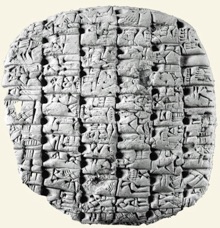
Obverse of an administrative tablet from Shuruppak with an inscription (P010800) naming the ensi Lumma
Now in the Istanbul Museum (TSSh 302)
Image adapted from Horst Steible and Fatma Yildiz (referenced below, Plate 1, at p. 227)
Gianni Marchesi (referenced below, 2006, at pp. 62-3) referred briefly (his analysis of the meaning of a Sumerian proper noun, ‘Lumma’) to the inscription (TSSh 302: CDLI, P010800) on a double-sided administrative tablet from Shuruppak which is now in the Istanbul Museum (TSSh 302), since it ends with a reference to an ensi named Lumma. He argued (at p. 63) that the inscribed text:
“... appears to be a list of the districts of Uruk, subdivided into subgroups, each [of which] is associated with the name of an official. At the end of the text (rev. v 10), it is specified that the above-mentioned districts belong to Uruk [and] the colophon ... [names] Uruk [again, with] Lumma being the city-ruler [ensi].”
He suggested (in note 294) that, although a ruler of Uruk would be expected to use the title ‘en’ (lord) or lugal (king), there are precedents for the use of the term ensi for rulers of Uruk in documents written in places (such as Shuruppak) where the title ensi was used by the local city ruler. Horst Steible and Fatma Yildiz (referenced below, see their summary at p. 226) agreed that there are a number of aspects of the text that:
“... taken together, make it probable that [it] was composed not in Shuruppak, but possibly in Uruk”, (my translation).
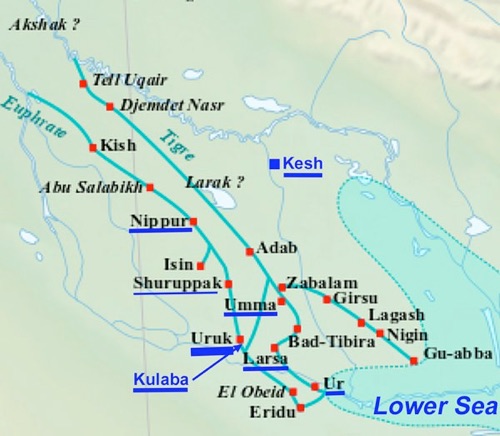
Image from Wikipedia: my additions in dark blue
See Piotr Steinkeller (referenced below, 2022, at p. 4 and map 1, at p. 5, citing Maurizio Viano, referenced below)
for the site of Kesh at modern Tulul al’Baqaratat
More recently, Piotr Steinkeller (referenced below, 2024, at p. 10) argued that this text:
“... appears to be a gazetteer of the places remaining under the hegemony of Uruk. According to its colophon (col. 6, lines 1-4), [it] lists:
‘103 territories of Uruk (under) the ensi Lumma’.”
Although many of these toponyms are obscure, his list of those that can be identified includes:
✴Ur (col. ii, line 8);
✴Kesh (col. ii, line 9);
✴Umma (col. iv, line 2);
✴Kulaba (col. vii, line 3);
✴Nippur (col. ix, line 1); and
✴Larsa (col. xi, line 6).
Dates of the Reigns of Menunsi and Lumma
Hypothesis of Gianni Marchesi
Gianni Marchesi (referenced below, 2015, at p. 144) argued that:
“[Lumma] was probably a contemporary of Menunsi of Kish: they both are attested on tablets from the ED IIIa archives of Shuruppak, which probably cover a very short period of time.”
The tablets from Shuruppak that he had in mind were both discussed above:
✴TSSh 302, which documents a number of territories of Uruk at the time of the ensi Lumma; and
✴NTSSh 154, which documents a land transfer by King Menunsi of Kish to the otherwise-unknown Akigal, which involved (inter alia) Ageshtin, the field registrar of Uruk.
As we have seen, in relation to the latter paper, Marchesi argued (at p. 140 and note 14) that:
✴Menunsi ruled at Kish at the time of the land grant to Akigal;
✴the land in question was at Uruk (since the field registrar who presumably recorded the grant was based there); and
✴the evidence of NTSSh154 supports the hypothesis that, at this time, the Kiengi League was:
“ ... simply an administrative grouping of six cities that were ... under the dominion of Kish.”
The implication seems to be that Lumma served as ensi of Uruk under the hegemony of Menunsi.
In support of this hypothesis, Marchesi pointed out (in note 14, at p. 140) that a roughly contemporaneous text from Abu Salabikh (published by Robert Biggs and Nicholas Postgate, referenced below, at pp. 108-9: now in the Iraq Museum: IM 081445; P010458) records that land (presumably at Abu Salibikh) had been assigned to a now-unnamed ensi of Uruk. He concluded from this evidence (at note 14) that:
“It appears then that the very same authority [= King Menunsi of Kish] had the power to dispose of land in both;
✴... Uruk, [to Akigal]; and
✴... Abu Salabikh, [to an ensi of Uruk, presumably Lumma].”
Hypothesis of Piotr Steinkeller
As we have seen, Piotr Steinkeller (referenced below, 2024) argued that:
✴Menunsi ruled at Kish at some time before the issuance of the administrative document NTSSh 154 at Shuruppak; and
✴the document itself:
•was issued in the Fara period by a ruler of Uruk after Shuruppak had passed ‘from the hands of Kish to those of Uruk’; and
•confirmed Akigal’s ownership (or that of his heirs) of the land he had originally been granted by Menunsi.
Furthermore, he argued that the 103 territories listed in TSSh 302:
✴all belonged to Uruk during the rule of the ensi Lumma in the Fara period, and
✴included:
•Ur (col. ii, line 8);
•Kesh (col. ii, line 9);
•Umma (col. iv, line 2);
•Kulaba (col. vii, line 3);
•Nippur (col. ix, line 1); and
•Larsa (col. xi, line 6).
Like Marchesi, Steinkeller claimed support for his hypothesis from the roughly contemporaneous text from Abu Salabikh (IM 081445; P010458). which records that land (presumably at Abu Salibikh) had been assigned to a now-unnamed ensi of Uruk:
✴Marchesi (above) saw this as further proof that King Menunsi of Kish exercised hegemony over both Uruk and Abu Salibikh in the Fara period; while
✴Steinkeller (at p. 12) it as:
“... incontrovertible proof that [Abu Salibikh (like the 103 places named in TSSh 302, including Umma, Ur and Larsa)] been a dependency of Uruk or, at the very least, that it recognised Uruk’s overlordship [at this time].”
He argued (at pp. 11-2) that:
•the absence of Lagash and Adab from this list might suggest that they participated in the alliance as independent cities;
•the absence of Shurppak might simply reflect the fact that the text was written there (making its inclusion in the list superfluous).
t
Kish, Uruk and the Kiengi League
He then summed up (at p. 12) as follows:
“All these data demonstrate (beyond any doubt, in my view) the paramount position of Uruk within the political picture of southern [Mesopotamia] during the ED IIIa period. And, should my hypothesis about the campaign against Kish be correct, this would mean that Uruk had succeeded at that time in putting an end to the interference of Kish in the affairs of southern [Mesopotamia].”
It would be fair to speculate that the ruler of Uruk in question was none other than the ensik Lum-ma of TSSh 302 [see above]
that:
“It appears quite likely that it was this Lumma (about whom nothing else is known) who commanded the troops participating in the postulated campaign against Kish.”
n relation to the text on IM 081445, which records the transfer of land at Abu Salibikh to an ensi of Uruk:
Marchesi hypothesised that this grant was made at a time when the hegemony exercised by Menunsi or another king of Kish extended to all the cities of the Kiengi League and also to Abu Salibikh; while
tr Steinkeller (referenced below, 2024, at p. 12) argued (pace Gianni Marchesi) that:
“... direct evidence of Uruk’s footprint at Abu Salabikh is the text [on the tablet IM 081445, published by] Robert Biggs and J. N. Postgate (see above)], which records a field area assigned to an ensi of Uruk: if an ensi of Uruk indeed held agricultural land at Abu Salabikh, we would find here an incontrovertible proof that this city had been a dependency of Uruk or (at the very least) that it recognised Uruk’s overlordship [in the Fara period].”
Steinkeller hypothesised that this grant was made by a king of Uruk, at a time when hegemony over Abu Salibikh had passed from Kish to Uruk.
The simple fact is that neither of these sources throws much light on the fundamental unknown: in the campaign described in the Fara texts:
did the armies Uruk, Adab, Nippur, Lagash, Shuruppak and Umma fight under the command of Kish against Ur (or another target); or
the the armies Adab, Nippur, Lagash, Shuruppak and Umma fight under the command of Uruk against Kish.
[Steinkeller, who (as we shall see, placed the reigns of both Mesilim and Menunsi before the Fara/ED IIIa period) countered that:
✴nothing in the surviving Fara sources indicates that Kish led a military alliance of Sumerian cities against anyone (see note 9, at p. 7); and
✴the absence of Ur from the Kiengi League (and its almost total absence from the ‘Fara texts’) might simply indicate that it was directly subject to Uruk at this time, which would mean that:
“... its status would have been not unlike that [which] it enjoyed later in the ED IIIb period, when ... it was a dependency of Uruk, with Uruk’s ruler exercising a dual kingship over these two city-states”, (see p. 11).
Interestingly, Marchesi had entertained only two possibilities for the purpose of the Kiengi League (at p. 140): it was either:
“ ... simply an administrative grouping of six cities that were, in fact, under the dominion of Kish” (as discussed above); or
“... an alliance or league of the independent Sumerian cities of Uruk, Adab, Nippur, Lagash, Shuruppak, and Umma.”
In an earlier paper (Gianni Marchesi, referenced below, 2006, at p. 62), he had suggested that, at the time that the list of Urukean territories in TSSh 302 was complied:
“... Uruk ... was probably the leading centre of the union and/or alliance of Sumerian cities that is known as the [Kiengi League].”
However, he subsequently changed his mind on this:
for the
it is likely that it also held overall command of the armies of the six cities of the Kiengi League and was possibly recognised (by some or all of them) as their overlord; and
since Ur is barely mentioned in the Fara texts, it was probably the target of the campaign of this alliance.
Alternative Hypotheses for the Leader of the Alliance and its Target
Hypothesis of Xianhua Wang
Xianhua Wang (referenced below, at p. 236), in his thesis on the emergence of Enlil as the chief god of Sumer and the related matter of the role of the city of Nippur, argued that:
✴Enlil was already associated in some way with the region named Kiengi for a period before the latter term came to refer to the whole of Sumer (see p. 234); and
✴the collective activities involving the cities of Uruk, Adab, Nippur, Lagash, Shuruppak, and Umma in the Fara period:
“... must have helped [to] perpetuate the close association of nam-lugal [= kingship] with Enlil in the subsequent Pre-Sargonic period”, (see p. 236).
If I have understood him correctly, he is suggesting that:
✴in the Fara period, the term Kiengi referred only to the territories of Uruk, Adab, Nippur, Lagash, Shuruppak; and Umma; and
✴(for whatever reason) these cities recognised Enlil as:
•the ‘overlord’ of their respective city gods (including the city god of Nippur, Ninurta); and
•responsible (by virtue of his ‘seniority’) for awarding nam lugal to the man whom he deemed to be most worthy of exercising hegemony over them.
It was in this context that Wang made the following observation (again at p. 236):
“The difficulty historians have in elucidating the history of southern Mesopotamia during the transition from the ED period to the Sargonic period [is mostly] due to the complexity of the process of the reshuffling of regional powers [at this time]. The regional power that began the process after the Hexapolis [= Kiengi League] was likely Ur from the south, excluded from the [League], when the Royal Cemetery [at Ur] evidenced the growth of royal power in the city. The disbanding of the [Kiengi League] may be the achievement of Meskalamdu or Mesanepada ... ”
I think that the point here is that we know:
✴from one of Mesanepada’s own royal inscriptions (RIME 1.13.5.1; CDLI, P431203) that he held the title ‘king of Ur’ while his father, Meskalamdu was ‘king of Kish’;
✴from the inscription (RIME 1.13.5.2; CDLI, P431204) carried by the seal one of Mesanepada’s wives) that he inherited the title ‘king of Kish’ (presumably on his father’s death); and
✴from an inscription (RIME 1:13:6:3; CDLI, P431208) of his son and successor, A’anepada, that he was once more ‘king if Ur’ at the time of his death and A’anepada’s accession.
Thus, in this scenario (as I understand it):
✴Ur began the process of the ‘reshuffling of regional powers’ in southern Mesopotamia by taking Kish, which :
•would explain its sudden prosperity; and
•might have precipitated the formation of the Kiengi League, from which it was obviously excluded; and
✴the ‘disbanding’ of the League might have resulted from the [putative] military success of Meskalamdu or Mesanepada, as hegemon of Kish, Ur, Eridu and Larsa (see note 642).
I am not sure that this analysis captures all the possibilities: for example, the military success of the Kiengi League could have precipitated the end of Mesanepada’s apparent hegemony over Kish. However, I think that the important thing to take from Wang’s analysis is that Ur’s apparent exclusion from the Kiengi League might be related to the fact that, at about the same time, Meskalamdu and then Mesanepada assumed the title ‘king of Kish’.
Hypothesis of Piotr Steinkeller
In the abstract of his paper, Steinkeller summarised its purpose as follows:
“A group of [Fara texts] describes a mobilisation of troops from Uruk, Adab, Nippur, Lagash, Umma and Shuruppak, clearly in anticipation of a major military operation. It is argued [here] that the target of that campaign, which was led by Uruk, was the city-state of Kish.”
He began by acknowledging (at p. 5) that:
“... the hypothesis that the [Fara texts] relate to a military campaign against Kish rests on highly circumstantial evidence.”
However, he went on to consider the evidence from another broadly contemporary administrative tablet from Shuruppak (TSSh 242, P010783), arguing (at p. 7) that it should be split into four sections that can probably be translated as follows:
✴[from Shuruppak, the find-spot of the inscription, to] ki-unkin (the camp), [the distance is] 2,360 ‘ropes’ (= 140.1 km.)
✴from Adab and Umma to the camp, [the distance is] 3,110 ‘ropes’ (= 184.7 km.)
✴from Lagash to the camp, the distance is] 3,980 ‘ropes’ (= 236.4 km.)
✴from Lagash, [the distance to the camp is] 3,980 ‘ropes’
He observed (at p. 4 and note 2) that:
“As far as I know, the term ki-unkin, [which is translated above as ‘camp’], is documented only in ... two Fara tablets, [WF 101 (above) and TSSh 242 (under discussion here)].”
He then argued (at p. 7) that, in relation TSSh 242:
“... if one follows the waterways:
✴the distance between Lagash (Al-Hiba) and Kish is 236 km; [and]
✴[that] between Shuruppak and Kish is 140 km.”
He also pointed out that, while the case of the distance between Adab and Umma is less straightforward, it might be significant that:
✴the distance between Umma and Kish is 151 km; and
✴that between Umma and Adab is 36 km.; making a total of 187 km.
He then observed that:
“Be that as it may, one can make a pretty good case ... that the present tablet is an estimate of the distances between:
✴various southern cities; and
✴a spot [described as ki-unkin = camp] situated in the immediate vicinity of Kish.
If this tablet can be linked with the sources I discussed earlier (which is very plausible), in my view, we would find here additional evidence that the target of [this military campaign] ... was the city of Kish.”
Steinkeller then discussed other ‘Fara texts’ that offered further support for his argument, summing up (at p. 8) as follows:
“To be sure, none of these data conclusively prove the correctness of my hypothesis. But there is one more important argument: it is beyond doubt that the troops mentioned in [the eight Fara text collected in his Appendix 1] were mobilised for a huge military operation, which must have been directed against a specific opponent. If that opponent was not Kish, it is difficult to think of any other alternative target.”
Steinkeller then turned (at p. 5) his hypothesis that the agency behind the mustering of the troops of the Kiengi League at Shuruppak was:
“... without any doubt was the city of Uruk, which supplied the largest number of soldiers. Here it is important to note that Uruk and [the adjacent centre of] Kulaba are highly visible in the surviving Fara sources, suggesting that, at that time, Uruk exercised hegemony over significant portions of the south.”
He subsequently observed (at p. 10) that:
“Whether or not the sources I surveyed earlier offer evidence of a military campaign that a coalition of southern city-states conducted against Kish, it is certain that, at that time, the dominant political power in the south was Uruk. In fact, there is convincing evidence that, sometime in the ED IIIa period, Uruk was able to bring under its control significant portions of southern Babylonia.”
Kiengi League: Preliminary Conclusions
Few scholars would disagree with the first line of the abstract of Steinkeller’s paper:
“A group of [Fara texts] describes a mobilisation of troops from Uruk, Adab, Nippur, Lagash, Umma and Shuruppak, clearly in anticipation of a major military operation.”
It seems to me that the lack of consensus on the questions of both the agency behind the organisation of this military operation and its target arises because of fundamentally different views on the vital matter of chronology:
✴the conventional view, in which Kish was the agency behind this mobilisation, seems to be based on the proposition that it took place in or shortly after the reign of king Mesilim of Kish, who had certainly exercised hegemony over Adab, Lagash and Umma;
✴Wang’s hypothesis is based on the proposition that the mobilisation took place in a later period, when Meskalamdu and Mesanepada of Ur exercised hegemony over Kish, Eridu and Larsa; and
✴Steinkeller’s hypothesis is based on his view that:
•Mesilim ‘unquestionably belonged to [or pre-dated] the ED II period’, (see p. 13);
•another king of Kish named Menunsi, who had controlled Shuruppak (at least), probably post-dated Mesilim and belonged to the ED II or the early ED IIIa period (see p. 14); and
•the Kiengi League was formed in a yet later period;
-after Shuruppak [at least, had] ‘passed from the hands of Kish to those of Uruk’, (see p. 14); and
-during or shortly before the reign of Ur-Nanshe, the earliest-known independent king of Lagash.
Thus, before proceeding with the analysis of the Kiengi League, we must grapple with the thorny problem of synchronisms in the ED IIIa period.
Stone Bowls
In the section above on the surviving inscriptions of Enmebaragesi, which happen to be on stone bowls, I quoted the following passage by Nicholas Postgate (referenced below, at p. 127):
“Stone bowls were special: a ritual procedure which symbolised political hegemony over a city entailed the ruler making an offering in a stone bowl to the patron deity of the city. This is attested at Adab and at Nippur, and the earliest example is probably at Khafayah, where a stone bowl with the name of (En)mebaragesi ... must have come from a temple”.
As promised there, I now return to this important observation. As Postgate subsequently made clear (at p, 167) the evidence of the ‘ritual procedure’ of this kind attested at Adab is found on three fragment of a stone (steatite) vessel from the Esar temple at Adab, which (as noted above) recorded that:
“Mesilim, king of Kish, beloved son of Ninhursag [dedicated this vessel] ...”, (RIME 1.8.1.3; P431033).
Postgate also pointed out (at p. 168) that there is evidence from the early version of the so-called ‘Kesh Temple Hymn’ from Abu Salabikh (probably ancient Eresh) that another king of Kish participated in a similar ritual at Kesh. This version, which belongs to the ED III/Fara period was published by Robert Biggs (referenced below) in 1971: prior to that date, this hymn was known only from the Old Babylonian period. As Biggs observed (at p. 196):
“Although the Abu Salabikh copies are approximately eight centuries earlier than copies known before, there is a surprisingly small amount of deviation (except in orthography) between them.”
One of these few ‘deviations’ occurred in a passage (at lines 105-17) that describes the dedication of the temple and the role played by various priests and the king:
✴in the the OB version we read (at line 107) that:
“In the temple, the king put a stone bowl in place”; but
✴in the Abu Salabikh version, this king is identified as the king of Kish.
Biggs commented that this:
“... implies composition of the [Abu Salabikh version] at a time when Kish controlled Sumer, at least ... in the general area of which Kesh is to be located.”
Although the location of ancient Kesh has long been the subject of debate, Piotr Steinkeller (referenced below, 2022, at p. 4) noted that, following a recent discovery:
“... the religious centre of Kesh, which ... can positively be identified as one of the ten tells forming the site of Tulul al-Baqarat [about 50 km north of Adab - see the map above].”
Postgate (as above) argued (at pp. 168-9) that:
“Since we know that Mesilim ... presented stone bowls to the temple at neighbouring [sic] Adab, one cannot avoid putting two and two together and seeing this as a reflection of a royal intervention in the temple affairs of Kesh, symbolising the same statement of sovereignty as already seen at Girsu and Adab, whether it was Mesilim himself or one of his predecessors or successors who was recognised as King of Kish. Inscribed stone bowls were not an innovation of Mesilim: (En-)mebaragesi ... left his succinct inscription on at least two stone bowls.:
✴[one that was] excavated at Khafayah... ‘ and
✴another ... [that] found its way onto the local antiquities market (IM 30590: ‘confiscated at Kut’).”
Interestingly, as shown on the map above, Kut is close to Tulul al-Baqarat, the site of ancient Kesh.
In short, it is possible that, for much of the ED I-II period Kish:
✴exercised hegemony over:
•the land along the left bank of the Tigris from Khafayah to Kesh; and
•other land on the right bank that included Adab, Umma and Lagash (and perhaps also Nippur and Shuruppak ??); and
✴used this land as a buffer zone from which to protect Kish and the cities over which it exercised hegemony from ‘Elamite’ raids.
References
Postgate J. N., “City of Culture 2600 BC: Early Mesopotamian History and Archaeology at Abu Salabikh”, (2024) Oxford
Rey S., “The Temple of Ningirsu: the Culture of the Sacred in Mesopotamia”, (2024) University Park, PA
Steinkeller P., “Campaign of Southern City-States against Kiš as Documented in the ED IIIa Sources from Šuruppak (Fara)”, Journal of Cuneiform Studies, 76 (2024) 3-26
Osterman J., “From ki-en-gi to Šumerum: how Sumer was Created?”, Radovi: Zavod za Hrvatsku Povijest Journal, 54:3 (2022) 39-72
Steinkeller P., “Two Sargonic Seals from Urusagrig and the Question of Urusagrig’s Location”, Zeitschrift für Assyriologie, 112:1 (2022) 1–10
Viano, M. “On the Location of Irisaĝrig Once Again”, Journal of Cuneiform Studies, 71 (2020) 5–52
Marchesi G., “Toward a Chronology of Early Dynastic Rulers in Mesopotamia”, in:
Sallaberger W. and Schrakamp I. (editors), “Associated Regional Chronologies for the Ancient Near East and the Eastern Mediterranean. History and Philology: Vol. 3”, (2015) Turnhout, at pp. 139-58
Sallaberger W. and Schrakamp I., “Part I: Philological Data for a Historical Chronology of Mesopotamia in the 3rd Millennium”, in:
Sallaberger W. and Schrakamp I. (editors), “Associated Regional Chronologies for the Ancient Near East and the Eastern Mediterranean. History and Philology: Vol. 3”, (2015) Turnhout, at pp. 1-130
Steible H. and Yıldız F., “(TS)Š 302: Eine Importtafel aus Uruk in Šuruppak ?”, in:
Sassmannshausen L. (editor), “He Has Opened Nisaba's House of Learning: Studies in Honor of Ake Waldemar Sjoberg on the Occasion of His 89th Birthday on August 1st 2013”, (2014) Leiden and Boston, at pp. 217–28
Steinkeller P., “An Archaic “Prisoner Plaque” from Kiš”, Revue d'Assyriologie et d'Archéologie Orientale, 107 (2013) 131-57
Wang X., “The Metamorphosis of Enlil in Early Mesopotamia”, (2011) thesis of Cambridge University
Biggs R. D. and Postgate J. N., “Inscriptions from Abu Salabikh: 1975”, Iraq 40 (1978 ) 101–18 Marchesi G., “Lumma in the Onomasticon and Literature of Ancient Mesopotamia”, (2006) Padua
Cripps E. L., “Land Tenure and Social Stratification in Ancient Mesopotamia: Third Millennium Sumer before the Ur III Dynasty”, (2006) thesis of Liverpool University.
Martin H. P., “A Reconstruction of the Ancient Mesopotamian City of Shuruppak”, (1988) Birmingham